 Skip to content


AI Cyberattacks: How Hackers Are Breaching Defenses
Artificial intelligence (AI) is transforming cybercrime. Tools that once required deep technical skill are now accessible to anyone, allowing attackers to launch faster, more convincing and more damaging campaigns. AI is also making threats to data security harder to detect and easier to scale. As this technology becomes more widely used by threat actors, businesses must understand how AI is changing the face of cybersecurity. Recognizing these risks is the first step toward building the right defenses.
The Rise of AI-Driven Cybercrime
The emergence of generative AI has given cybercriminals new capabilities that make attacks more scalable, automated and difficult to detect. Threat actors now use large language models to generate convincing phishing emails, customize social engineering scripts and even write or refine malware code with minimal effort. What used to take hours of manual work can now be done in seconds – and at a much more sophisticated level.
This level of automation means more frequent, targeted and adaptable attacks. AI can quickly analyze public data to personalize messages, identify system weaknesses and optimize attack timing. Moreover, these threats will affect every business. According to a recent survey by Darktrace, 74 percent of cybersecurity pros say AI-powered threats are already a major challenge for their organization, while 90 percent expect these threats to have a significant impact over the next one to two years.
As AI becomes central to how cyberattacks are developed and deployed, businesses need to rethink their approach to threat detection and prevention. Understanding how hackers are using AI is critical for improving risk management and building defenses that can anticipate and disrupt these advanced techniques.
How AI Is Powering the Next Generation of Cyberattacks
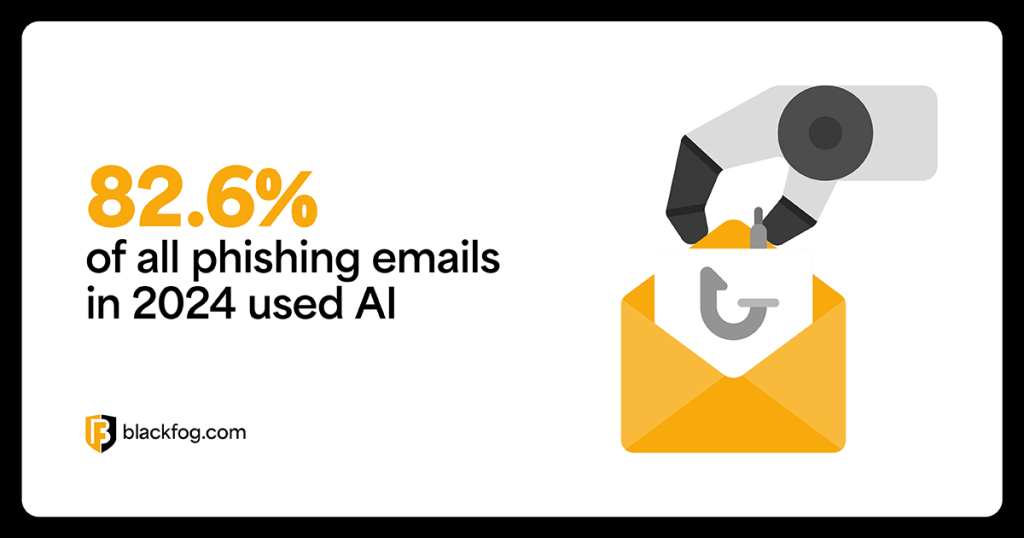
Attackers are now using AI to enhance almost every stage of a cyberattack, from reconnaissance to execution. These tools allow criminals to launch more persuasive, targeted and efficient campaigns that bypass traditional defenses, disrupt systems or find and exfiltrate data.
Below are some of the most common ways AI is being exploited:
- Phishing automation: AI can generate phishing emails that mimic the tone, structure and language of legitimate business communication to make highly personalized, convincing messaging. According to KnowBe4, 82.6 percent of all phishing emails in 2024 used AI in some capacity.
- Malware creation and evasion: AI can help design malware that adapts to avoid detection by signature-based antivirus tools. It can also automatically change its code, use obfuscation techniques or simulate normal user behavior to bypass endpoint protection.
- Social engineering at scale: Tools that analyze social media, public records and leaked data can craft highly tailored scams. This includes creating dialogue for phone or chat-based scams, impersonating executives and even generating deepfake voice or video content. This can all be used to trick employees into giving hackers access to systems, or even handing over data directly.
- Ransomware optimization: AI allows attackers to identify system vulnerabilities and determine the most disruptive time to launch encryption. It can also craft customized ransom messages that use company-specific language or data to appear more credible. This makes ransomware more effective, increases pressure on victims and improves the chance of payment.
- Data exfiltration mapping: AI can study a company’s digital environment to locate valuable assets, find insecure endpoints and identify the most efficient data extraction routes. It can automate exfiltration timing to avoid peak monitoring hours, reducing the likelihood of detection.
Adversarial Attacks on AI Systems
As more businesses adopt AI models to drive decisions, they also face a new class of threats: adversarial attacks. These involve manipulating the inputs to AI systems to trick them into making incorrect or harmful decisions. For example, attackers might feed altered data into a machine learning model to evade detection, confuse classification algorithms or even extract sensitive training data.
Techniques like model inversion, data poisoning and prompt injection allow threat actors to reverse-engineer AI behavior, insert malicious data or trick it into revealing sensitive information. This poses serious risks in areas like fraud detection, content moderation and cybersecurity automation, where decisions must be fast and accurate.
Without proper controls, adversarial attacks can compromise business operations, corrupt decision-making or expose sensitive data. This makes it essential for organizations to secure both the data and the AI models they rely on.
Warning Signs of an AI-Powered Cyberattack
AI-powered attacks are often more subtle and convincing than traditional cyberthreats. Because they use automation and personalization, they can bypass standard detection tools and appear entirely legitimate on the surface.
However, there are early indicators that suggest something is wrong. Businesses should watch for the following red flags that can indicate an AI-powered cyberthreat:
- Sudden surge in targeted phishing attempts: If employees begin receiving a higher volume of realistic, well-written phishing emails or text messages, this may be the result of AI-generated content. These attacks often mimic company language and internal references, making them harder to spot.
- Unusual system behavior or errors: Unexpected performance issues or strange outputs from applications, especially AI-powered tools, could indicate prompt injection, data poisoning or system manipulation by attackers probing for weaknesses.
- Access to sensitive data from unfamiliar locations: Unexplained attempts to retrieve confidential files or databases from new IP addresses or user accounts could signal account compromise or AI-assisted credential attacks.
- Anomalous network activity: AI tools can disguise exfiltration traffic or mimic regular behavior to avoid standard monitoring tools, but there can still be telltale signs that advanced AI-based detection methods can spot.
- Suspicious voice or video communications: Deepfake audio or video content used to impersonate executives, especially in time-sensitive requests, is an emerging tactic. If a communication seems slightly off, it could be synthetically generated.
- Multiple failed login attempts or strange account activity: Automated login attempts from AI scripts can overwhelm systems or guess credentials. If this is followed by successful logins under unusual circumstances, it may indicate an active intrusion.
AI has changed the way cyberattacks are planned and executed, giving attackers new tools to launch faster, more targeted and more convincing campaigns. Whether it is phishing, malware or data exfiltration, these threats are growing harder to spot with traditional security tools.
To stay protected, businesses must adopt advanced, behavior-based detection technology that can identify unusual activity in real-time and stop attacks before damage is done. Understanding how AI is being used by cybercriminals is no longer optional. It is essential.
Share This Story, Choose Your Platform!
Related Posts

The State of Ransomware: February 2026
BlackFog's state of ransomware February 2026 measures publicly disclosed and non-disclosed attacks globally.
Steaelite RAT Enables Double Extortion Attacks from a Single Panel
Steaelite is a newly emerging RAT that unifies credential theft, data exfiltration, and ransomware in a single web panel, accelerating double extortion attacks.

ClawdBot and OpenClaw: When Local AI Becomes A Data Exfiltration Goldmine
ClawdBot stores API keys, chat histories, and user memories in plaintext files, and infostealers like RedLine, Lumma, and Vidar are already targeting it.

West Harlem Group Assistance Stops Ransomware and Cryptojacking with BlackFog ADX
West Harlem Group Assistance secures its community mission by preventing ransomware and cryptojacking with BlackFog ADX.

Why Traditional Security Fails To Deal With Advanced Persistent Threats
Learn why advanced persistent threats remain a growing cybersecurity risk in 2026 and where organizations must focus to address them.

What Does Advanced Threat Protection Really Mean In 2026?
Find out why businesses need advanced threat protection to cope with the new era of sophisticated, persistent cyber risks.