 Skip to content

As large language models (LLMs) gain popularity across the enterprise, a new and largely invisible threat is emerging shadow AI. This refers to employees using AI tools and models without IT’s approval or knowledge. While these tools boost productivity, drafting emails, summarizing notes, generating code, they also create an expanding risk surface that most organizations are ill-prepared to defend.
Sensitive data can easily slip out through AI prompts and browser-based AI services operating beyond the reach of traditional security controls. In this post, we examine why fragmented or detection-only security approaches are proving insufficient against shadow AI, and why security leaders must think about prioritizing unified, real-time protection to protect data in the age of decentralized AI adoption.
The Rise of Shadow AI In The Enterprise
Shadow AI is essentially the AI era equivalent of shadow IT.
It encompasses any AI systems or services that employees use unofficially, without oversight. This could range from an engineer quietly plugging proprietary code into ChatGPT for debugging help to a marketing team using a free AI copywriter or an HR analyst uploading resumes to an AI tool. Recent surveys show this phenomenon is widespread: 78% of AI adopters bring their own AI tools into work, and nearly 60% rely on unmanaged AI apps.
The danger is that, unlike approved enterprise applications, these AI tools exist outside the company’s controlled environment. They actively ingest, learn from, and even redistribute enterprise data without leaving any trace in corporate logs or audit trails. What might seem like a harmless experiment, say, pasting a confidential strategy document into an AI prompt to get a summary, can result in that sensitive data being stored on third-party servers or incorporated into an AI model.
New Data Exfiltration Pathways And Risks
Every time an employee enters company information into an external AI system, a potential data breach is occurring. Unlike a traditional cyberattack, this breach isn’t carried out by a cybercriminal, it’s done unwittingly by an employee with good intentions.
Consider an example: in 2023, Samsung engineers used ChatGPT to help debug code and summarize meeting notes, inadvertently leaking proprietary source code and sensitive internal documents in the process. Within weeks, at least three incidents of confidential data being uploaded to ChatGPT were recorded. Because the AI service retains user inputs for training, those Samsung trade secrets ended up on OpenAI’s servers.
The company had essentially lost control of its crown jewels via a simple prompt. Samsung responded by banning external AI tools and even developing a private AI, but the damage was done; data that leaked could not be retrieved or deleted from the AI provider’s systems.
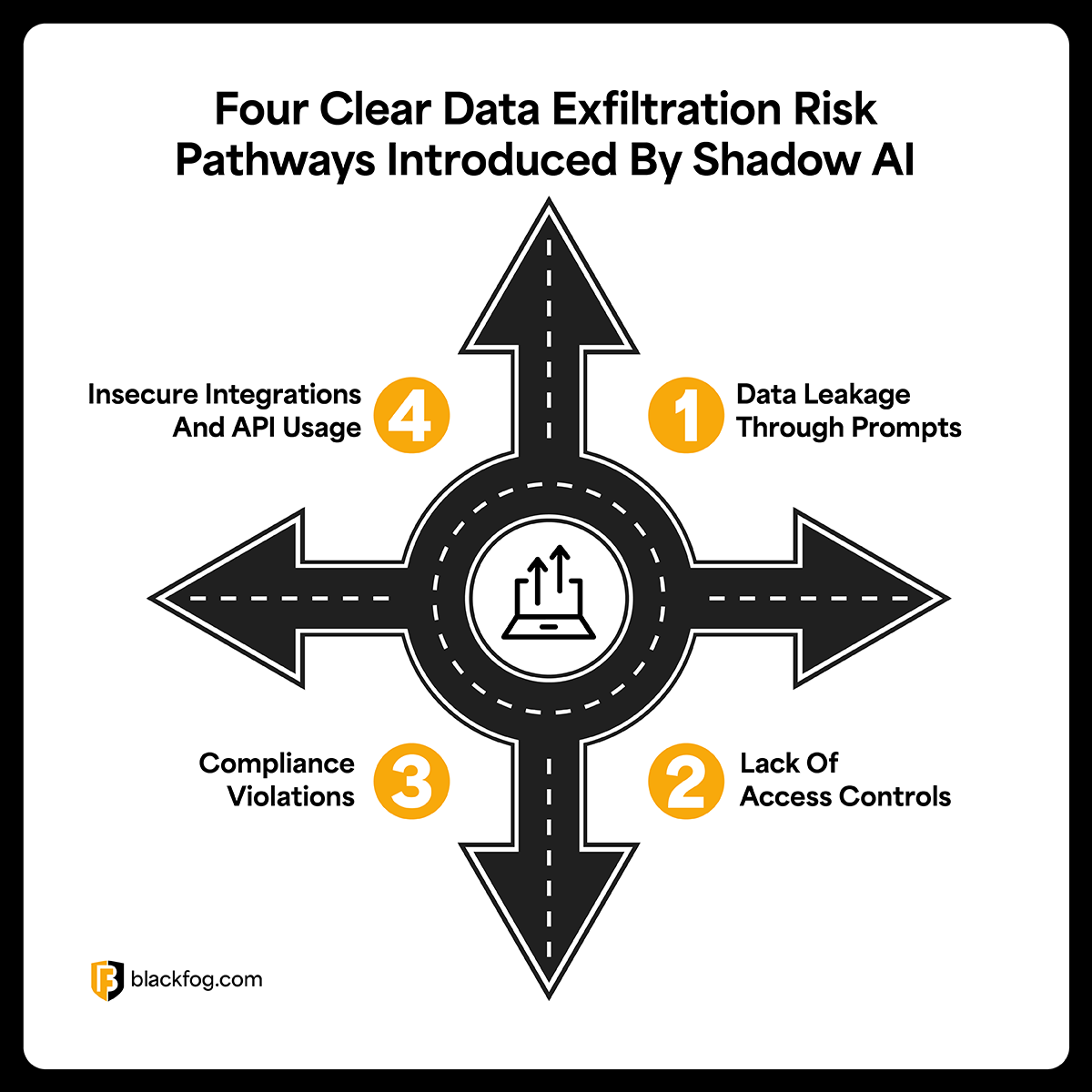
Some of the clearest risk pathways introduced by shadow AI include:
Data Leakage Through Prompts
Employees may paste source code, design documents, financial reports, or personal data into generative AI prompts. Once that data leaves the organization’s boundary, there’s no guarantee how it’s stored or used. Even if an AI vendor claims to not retain data, enforcement is murky and there are no guarantees that sensitive inputs won’t be used in model training or appear in another form later.
Lack of Access Controls
Most consumer AI tools don’t offer enterprise-grade access control, encryption, or logging. There are typically no role-based restrictions or audit logs for prompts and responses. Security teams therefore have zero visibility into who is sending what data to which AI service. If an incident occurs, there’s essentially nothing to investigate – no logs and no alerts.
Compliance Violations
Feeding regulated data (customer PII, health records, payment information, etc.) into an unsanctioned AI tool can directly violate laws and industry regulations. Many regulations require strict control over how sensitive data is stored and processed, which an external AI service may not meet. Organizations may find they have no way to enforce a “right to be forgotten” or data deletion on the AI provider’s side. This opens the door to legal penalties and breach disclosure requirements, even if the leak is unintentional.
Insecure Integrations and API Usage
Beyond direct prompt usage, some employees might use browser extensions, unofficial plugins, or third-party AI integrations that connect to internal systems. These tools can move data from corporate apps to external AI APIs while bypassing normal security controls. A browser plugin that summarizes emails using an AI model might quietly send email content outside the company. If the integration is not vetted, it becomes a hidden exfiltration channel.
Why Traditional Security Tools Fall Short
Stopping shadow AI data leaks is, unfortunately, difficult with legacy security strategies. Most enterprise defenses were built for a world of emails, managed devices, and known applications, not for spontaneous interactions with cloud AI models. This means traditional tools like DLP, CASB, and perimeter gateways are often blind to shadow AI activity.
There are generally several reasons for this blind spot:
Encrypted Traffic and Unsanctioned Channels
Generative AI services (e.g. ChatGPT, Claude, Bard) are typically accessed via HTTPS web traffic or API calls. Network-based DLP and CASB solutions that inspect traffic can’t easily see inside encrypted web sessions without heavy SSL interception (which many organizations don’t comprehensively do). Employees using personal devices or off-network access further compound this, as those sessions may never traverse corporate gateways at all.
Lack of Policies and Control Integration
A lot of organizations have not updated their security policies or tools to account for AI usage. In a study, 97% of organizations reported they lack proper AI usage controls in their security framework. You can’t enforce what you can’t see; if the DLP doesn’t recognize an AI prompt field as a channel for sensitive data, it won’t apply any protection mechanisms. Similarly, CASB solutions might catalogue known SaaS applications, but a new AI SaaS tool can go unnoticed.
Reliance on Detection Over Prevention
The biggest shortcoming is that too many defenses are geared toward detecting and alerting after the fact, rather than actively preventing data loss. A company might rely on manual reviews or AI usage logs (if they even have them) to spot policy violations. But by the time an alert fires, that sensitive data is already sitting on an external server.
Toward Unified, Real-Time Protection
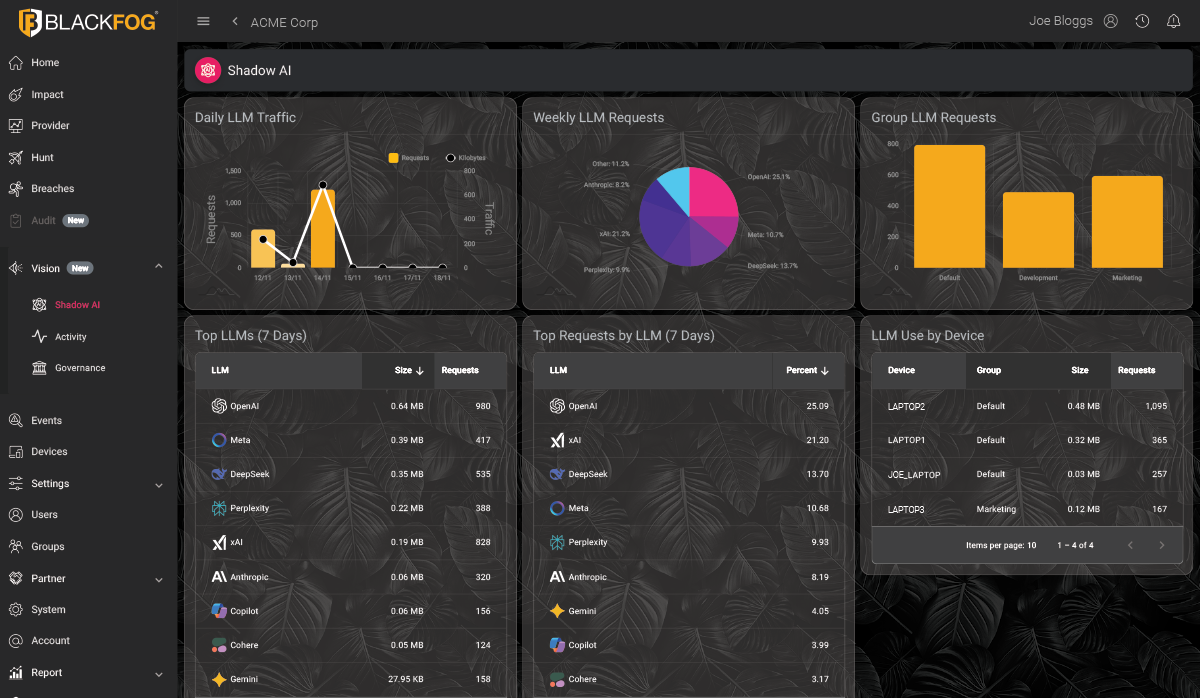
To manage shadow AI risk, security leaders should think about moving from reactive, piecemeal defenses to a unified, preventive security strategy. The goal is to deliver real-time prevention of data loss and exfiltration across all AI interactions, sanctioned or unsanctioned.
Instead of only guarding the perimeter or relying on app-by-app policies, organizations should consider extending security to the point of data egress on each device. Anti data exfiltration (ADX) solutions monitor outbound data in real-time, detecting when users attempt to share information outside the organization.[1]
When confidential information is submitted to an AI service or unknown endpoint, the system recognizes the risk and blocks the transmission on the spot. It can even identify AI related traffic and apply protective policies before any data is exposed.
A unified protection strategy for AI should include a few main elements:
Complete Visibility into AI Usage
Security teams need to know if and how employees are interacting with AI platforms. This could involve detecting connections to known AI service endpoints, flagging unusual data flows (e.g. large text payloads going to an unfamiliar server), or analyzing user behavior for signs of sensitive content being shared. The first step to control is awareness, a unified solution should illuminate all those shadow AI interactions happening across the organization.
Data Classification and Policy Enforcement
When a user does engage with an AI tool, any data they intend to send out should be inspected against data loss prevention policies instantly. Modern tools can fingerprint sensitive data or use machine learning to recognize things like source code, customer identifiers, or financial information in context. If something forbidden or high risk is detected in an outgoing prompt or file, the system should block it before it leaves, and alert both the user and security team.
Enforce Controls Across All AI Tools
Unified protection means one set of controls covering all AI usage, not just official tools. Even if your company has an approved AI platform, employees might still use external ones. Your defenses must be agnostic to which AI is in play, cloud AI service, on-prem LLM, browser plugin, or otherwise. The solution should apply the same level of scrutiny everywhere, ensuring that no AI channel becomes a blind spot.
User Education and Safe Enablement
Lastly, employees should be educated on the risks of shadow AI and guided toward safe usage. With strong preventive controls in place, security teams can actually enable AI adoption more confidently. Instead of blanket bans that users work around, companies can allow employees to harness AI with guardrails that prevent egregious data leaks. This balanced approach maintains compliance and security without damaging innovation.
Conclusion and Your Next Steps
LLMs and generative AI are transforming how businesses operate, but they have also opened a Pandora’s box of new data security challenges. Shadow AI has expanded the enterprise attack surface beyond the reach of traditional defenses. In this environment, relying on scattered policies or after-the-fact detection is a recipe for trouble. The most effective path forward is a strategy focused on real-time prevention of data exfiltration across all AI interactions. By monitoring at the source (the device or user) and stopping unauthorized data flow in its tracks, organizations can reduce the risk of leaks and compliance violations without diminishing the advantages of AI. Learn more about BlackFog ADX Vision which can help.
Share This Story, Choose Your Platform!
Related Posts
Steaelite RAT Enables Double Extortion Attacks from a Single Panel
Steaelite is a newly emerging RAT that unifies credential theft, data exfiltration, and ransomware in a single web panel, accelerating double extortion attacks.
ClawdBot and OpenClaw: When Local AI Becomes A Data Exfiltration Goldmine
ClawdBot stores API keys, chat histories, and user memories in plaintext files, and infostealers like RedLine, Lumma, and Vidar are already targeting it.

West Harlem Group Assistance Stops Ransomware and Cryptojacking with BlackFog ADX
West Harlem Group Assistance secures its community mission by preventing ransomware and cryptojacking with BlackFog ADX.
Why Traditional Security Fails To Deal With Advanced Persistent Threats
Learn why advanced persistent threats remain a growing cybersecurity risk in 2026 and where organizations must focus to address them.
What Does Advanced Threat Protection Really Mean In 2026?
Find out why businesses need advanced threat protection to cope with the new era of sophisticated, persistent cyber risks.
How Can You Prevent Viruses And Malicious Code Today?
Preventing viruses and malicious code is harder than ever in a landscape where APTs are a growing threat. Here's what you need to know to stay safe.