 Skip to content

How AI-Powered Threat Detection Catches What Traditional Tools Miss
The nature of cyberattacks faced by enterprises is changing fast. Threat actors now increasingly rely on AI to power their efforts, from ransomware that rewrites itself to evade detection to highly convincing, personalized phishing emails generated at scale. These threats are built to slip past the signature-based defenses many businesses still depend on and are at the heart of many modern attacks.
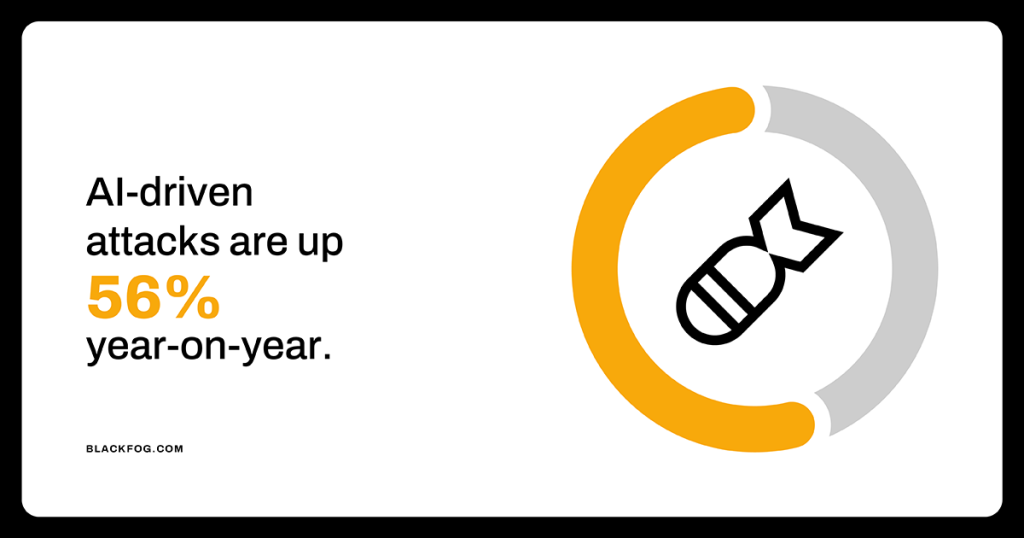
Indeed, IBM’s 2026 Cost of a Data Breach report found that AI-driven attacks increased by 56 percent year-on-year, with deepfake impersonations and AI-enabled malware driving the highest volume of those incidents. As such, modernizing detection has become essential. To do this, firms need to adopt the same tools as their adversaries, which is why AI-powered services, including generative and agentic tools, are now a core part of any security stack built to withstand current threats.
How Signature-Based Detection Works
Traditional security tools work by matching activity against a database of known threats. Each piece of known malware carries a distinct fingerprint, such as a file hash or a recognizable snippet of code. Security tools scan for those markers and block anything that matches.
This approach powers much of the everyday security stack, and is used across layers of protection, including antimalware software, firewalls, intrusion detection systems and email filters. These sit at the endpoints, the network edge and the inbox, screening what passes through. For most organizations, signature-based detection remains the first line of defense, catching the known threats that make up everyday attacks. However, this approach has a few critical limitations that can reduce its effectiveness in a modern threat environment.
The Limitations Of Traditional Approaches
Signature-based defenses can only stop what they already recognize. Any attack that carries no known fingerprint passes straight through. This gap is widening as AI-generated attacks spread, giving even less-skilled threat actors an easy way to produce threats that legacy tools cannot identify.
The following attack types routinely evade signature-based detection:
- Zero-day exploits: Attacks against unknown or unpatched vulnerabilities have no existing signature to match against, so legacy tools have nothing to flag.
- Fileless and living-off-the-land attacks: These abuse legitimate system tools such as PowerShell rather than installing malware, leaving no file for a scanner to inspect.
- Adaptive and polymorphic malware: This rewrites its own code with each infection, changing its fingerprint constantly so no single signature stays valid.
- AI-generated phishing: Fresh, personalized lures are produced at scale, each one unique enough to slip past filters trained on known examples.
- Encrypted payloads: Malicious code hidden inside encrypted traffic passes signature scanners that cannot see the content.
How AI-Powered Threat Detection Closes The Gap
AI-powered detection doesn’t rely on a list of known threats. Instead of matching fingerprints, it learns what normal activity looks like across users, devices and networks, then flags the behavior that deviates from it. This makes detection adaptive and context-driven, judging actions by what they do rather than whether they have been seen before.
Key capabilities of AI-powered threat detection tools that can offer benefits over legacy alternatives include:
- Self-learned baselines: Rather than relying on fixed rules an analyst has to write and update, AI behavioral analysis builds its own picture of normal activity and adjusts it continuously, spotting subtle deviations static thresholds would miss.
- Correlation across signals: AI offers the ability to identify and collate related events from different systems into a single picture in real-time, revealing multi-stage attacks that individual tools would see as harmless in isolation.
- Adaptation to new techniques: AI-powered detection can identify patterns and anomalies associated with emerging attacker techniques, helping security teams detect threats that signature or rule-based approaches may miss.
- Natural-language triage: Generative AI security models explain a flagged threat in plain terms and draft the investigation steps, giving analysts context that raw alerts never provide.
The Risks Of Relying On AI Detection
AI-powered tools can strengthen detection of cyberthreats, but leaning on them too heavily brings its own risks. Models can generate false positives, flagging benign activity as malicious and burying analysts in alerts that erode trust in the system. They can also miss the context a human would catch, misreading a legitimate but unusual action as an attack, or the reverse.
These systems are not set-and-forget. Models can become less effective as behavior changes and systems evolve, or they can be manipulated by attackers who target the AI itself. Continuous monitoring and validation are therefore essential, while humans must remain in the loop for critical decision-making. Clear AI security guidelines give teams the structure for this, defining where human oversight, validation and review are required.
Why A Layered, Zero-Trust Approach Matters
No single tool stops every threat, which is why layered defense sits at the heart of sound AI security best practices. A zero-trust model treats every user, device and connection as untrusted by default, verifying each one rather than assuming safety inside the network. It also assumes a breach will happen, so containment and monitoring matter as much as prevention.
AI-powered detection is a powerful layer within that structure, catching what signature-based tools miss. It works best alongside traditional detection, human oversight and strong access controls. AI has a clear place in modern defense-in-depth strategy, but it is not the whole answer.
AI-Powered Threat Detection FAQs
What’s the difference between signature-based and AI-powered threat detection?
Signature-based detection matches activity against a database of known threats, so it only catches what it has seen before. AI-powered detection learns what normal behavior looks like and flags deviations, letting it identify new and evolving threats that carry no known signature.
Can AI-powered threat detection produce false positives?
Yes. By flagging anything that deviates from normal, these tools can mark benign activity as suspicious. This is why human review and continuous tuning matter, keeping alert volumes manageable and stopping false positives from eroding trust in the system.
Does AI-powered threat detection replace the need for a SOC analyst?
No. It handles volume and surfaces threats faster, but analysts provide the context, judgment and final decisions the technology cannot. The strongest setups pair AI detection with human oversight rather than removing the analyst from the process.
What kinds of attacks does behavioral detection catch that signatures miss?
It catches threats with no known fingerprint, including zero-day exploits, fileless and living-off-the-land attacks, adaptive or polymorphic malware and AI-generated phishing. These evade signature matching but still deviate from normal behavior in ways an AI model can flag.
Share This Story, Choose Your Platform!
Related Posts
What Are The Advantages Of Using AI In Intrusion Detection?
Explore the advantages of AI in intrusion detection, from faster analysis and greater scale to identifying previously unseen attack patterns.
How Can Cybersecurity Professionals Defend Against Threats Posed By Malicious AI Tools?
Learn how cybersecurity professionals can defend against malicious AI tools with AI-specific monitoring, least-privilege access and outbound visibility.

Are There Any Government Policies On Using AI For Cybersecurity?
Learn how the EU AI Act and US NIST frameworks address the use of AI in cybersecurity and what their different approaches mean for businesses.

Can AI Be Used To Effectively Prevent Cyberattacks?
AI helps prevent cyberattacks by spotting threats without known signatures, but it works best alongside human oversight, governance and a layered strategy.

How Is GenAI Transforming Cybersecurity Strategies?
GenAI is reshaping cybersecurity strategy, from faster alert triage and incident response to the consolidation of tools into fewer platforms.
What Are the Main Security Risks Associated With Generative AI?
Generative AI security risks: data leakage, hallucination-driven errors and adversarial misuse. Learn the threats and how to mitigate them.