 Skip to content

Essential AI Security Trends Shaping Cyber Defense Strategies
Working with AI is no longer an occasional activity for cybersecurity professionals. It increasingly plays a central role in shaping the alerts they see, the tools they run and the threats they face. AI is now embedded in the software enterprises depend on, both within the security team and the wider business, which means keeping it out of the organization is neither realistic nor desirable.
This puts a clear demand on security leaders to understand the latest developments, capabilities and risks. A complete picture of the current situation and an idea of where it is heading in the coming months and years is now essential in building a cybersecurity platform that’s fit for the modern generation of threats.
4 Key AI Trends Shaping Cybersecurity
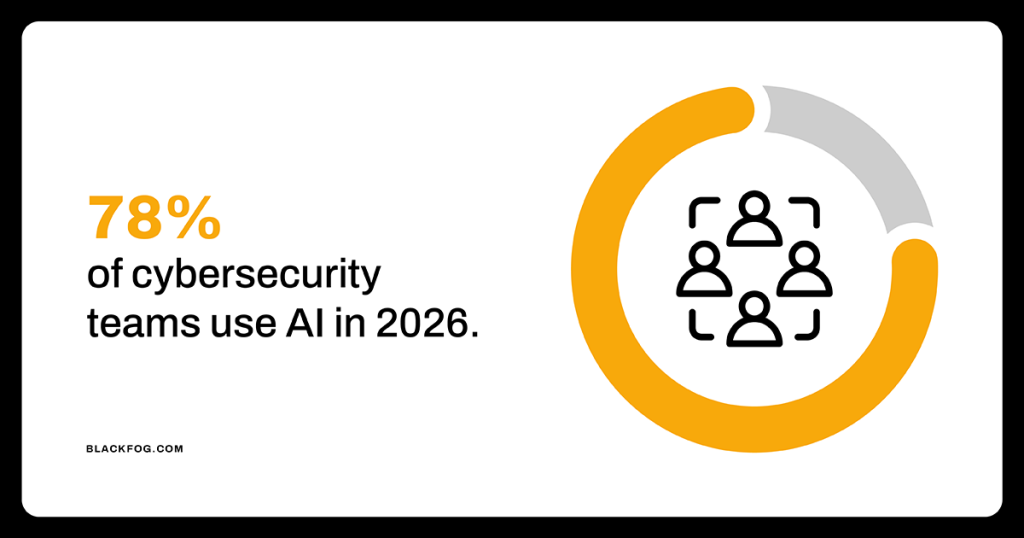
AI adoption in cybersecurity is accelerating. For example, a recent study by training provider SANS found that AI is now actively used by 78 percent of security teams – a significant jump from 50 percent the previous year. At that pace, the capabilities and risks shift faster than annual strategy cycles can track. The four trends below cover the developments security leaders most need to follow.
Trend 1: The Rise Of Generative AI In The SOC
Generative AI has quickly become a standard part of the security operations center (SOC), with research by Darktrace finding that 77 percent of security stacks now make use of these tools.
Inside the SOC, there are a range of practical applications for this form of AI. Analysts may use it to triage the flood of daily alerts, summarize complex incidents in plain language and draft the queries an investigation needs. A model can also turn a wall of log data into a readable account of what happened, giving junior staff clear context into an incident without the need for manual investigation of records.
The result is less time lost to tedious work and faster, clearer decision-making. For teams facing alert fatigue and staff shortages, generative AI offers a fast, cost-effective way to manage this load without the need to increase headcount.
Trend 2: The Escalation Of AI-Driven Attacks
Cybersecurity pros are not the only ones using AI. Threat actors are turning to the same generative tools to target businesses. AI lets them write phishing messages that are fluent, personalized and free of the errors staff were trained to spot, while it can also produce unique malware that can slip past detection tools that rely on known signatures.
The scale is illustrated by figures from European security awareness and human risk management firm SoSafe, which found that 87 percent of security professionals reported their organization had faced an AI-driven cyberattack in the past year. Attacks that adapt and multiply at machine speed overwhelm defenses built for a slower, more predictable threat.
AI-powered threat detection is therefore essential in meeting these challenges. Rather than matching known signatures, defensive AI models the behavior behind an attack and flags anomalies that may be impossible for human employees or traditional antimalware defenses to spot.
Trend 3: Agentic AI Supports Defenses But Humans Stay Involved
While generative tools work by answering a prompt, an agentic system can carry out a task from start to finish. In the SOC, that means an agent can triage an alert, work through the investigation across several steps and begin containment with little direct instruction, compressing work that once took analysts hours.
However, there is a recognition that handing autonomous systems the authority to act on live infrastructure carries real risk if a decision is wrong. This is why most teams’ AI security best practices keep a person in the loop. For instance, ISC2 research indicates that an overreliance on AI is the top concern among professionals, named by 62 percent of respondents. What’s more, half of professionals say their firms still hold humans accountable when AI makes mistakes.
Agentic AI can bring the scale and speed needed to keep up with evolving threats, but for now, human judgment remains the final check on any action that carries consequences.
Trend 4: Global Regulations Respond To AI Advances
Regulators are catching up with the technology. The EU AI Act, currently in the middle of a phased implementation, sets binding obligations for higher-risk systems covering human oversight, logging, transparency and cybersecurity. Alongside it, voluntary frameworks are becoming de facto expectations, including the NIST AI Risk Management Framework and ISO/IEC 42001, the first certifiable standard for managing AI.
For security teams, this shifts AI governance from good practice to a documented requirement. A key aspect of using generative or agentic tools is being able to show how a model reached a decision, who reviewed it and what actions were taken. Aligning deployments with recognized AI security guidelines is becoming the way teams demonstrate that their use of the technology meets regulatory compliance expectations.
Building A Strategy For AI In Cybersecurity
AI is now embedded in how attacks are run and how defenses respond, which means ignoring it is not an option. The question for security leaders is not whether to adopt generative and agentic tools, but how to do so under proper control.
That means developing clear best practices for their use, covering defined policies, human oversight of consequential decisions and governance that maps to emerging regulation. Managed effectively, AI strengthens a security team’s ability to keep pace with fast-moving threats. However, left unmanaged, it becomes another liability.
AI Security Trends FAQs
Is generative AI adoption in cybersecurity actually growing, or is it hype?
It’s not hype. The growth of AI has made it firmly established in cybersecurity rather than speculative. Generative tools are now a standard part of the security stack, used daily to triage alerts, summarize incidents and speed up investigation.
What is agentic AI in a security operations context?
Agentic AI describes systems that carry out multi-step tasks with limited human input, rather than simply responding to a prompt. In a SOC, an agent can triage an alert, investigate it and begin containment, while a human supervises consequential actions.
Are AI security regulations changing?
Yes. The EU AI Act is moving into phased enforcement, setting binding rules for higher-risk systems. Voluntary frameworks such as the NIST AI Risk Management Framework and ISO/IEC 42001 are becoming expected practice. Security teams should expect AI governance requirements to keep tightening.
How fast is AI-related cyber risk growing compared to other risk categories?
Faster than most. Industry research consistently ranks AI-related vulnerabilities among the fastest-growing risks security teams face, driven by the speed at which attackers have adopted the technology and the new exposures that AI tools introduce into the enterprise.
Share This Story, Choose Your Platform!
Related Posts
What Are The Advantages Of Using AI In Intrusion Detection?
Explore the advantages of AI in intrusion detection, from faster analysis and greater scale to identifying previously unseen attack patterns.
How Can Cybersecurity Professionals Defend Against Threats Posed By Malicious AI Tools?
Learn how cybersecurity professionals can defend against malicious AI tools with AI-specific monitoring, least-privilege access and outbound visibility.
Are There Any Government Policies On Using AI For Cybersecurity?
Learn how the EU AI Act and US NIST frameworks address the use of AI in cybersecurity and what their different approaches mean for businesses.
Can AI Be Used To Effectively Prevent Cyberattacks?
AI helps prevent cyberattacks by spotting threats without known signatures, but it works best alongside human oversight, governance and a layered strategy.
How Is GenAI Transforming Cybersecurity Strategies?
GenAI is reshaping cybersecurity strategy, from faster alert triage and incident response to the consolidation of tools into fewer platforms.
What Are the Main Security Risks Associated With Generative AI?
Generative AI security risks: data leakage, hallucination-driven errors and adversarial misuse. Learn the threats and how to mitigate them.