 Skip to content

What Enterprises Need To Know About Artificial Intelligence Privacy Concerns
The adoption of generative AI tools like ChatGPT, Copilot and Gemini has become near-universal across enterprise environments. From marketing and sales to HR and development, these platforms are now embedded in everyday workflows. But as their usage grows, so too do the concerns around privacy.
A key issue facing cybersecurity and compliance leaders is that sensitive business data is increasingly being entered into third-party systems, often without proper oversight or security. When employees interact with AI tools using unmanaged accounts or unclear policies, private information can quickly move beyond the organization’s visibility and outside its control, leaving businesses vulnerable to data leaks and compliance failings. So, what privacy risks does this introduce and how can firms regain control?
Where AI Uses Sensitive Business Data
Generative AI offers many benefits to businesses, helping teams work faster and automate everyday tasks. But many of these use cases require individuals to input sensitive or proprietary information. Whether through official tools or personal accounts, employees are regularly submitting internal data to platforms like ChatGPT, often without full awareness of how that data is handled.
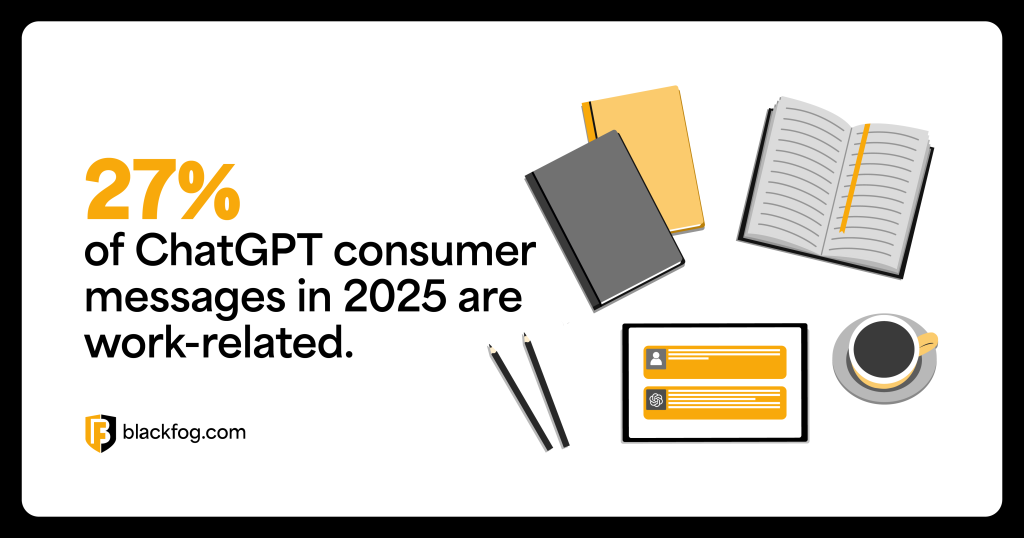
According to OpenAI, 27 percent of ChatGPT consumer messages in June 2025 were work-related. That’s a significant portion of daily usage involving professional or business content that may not be under the control of more secure options like Enterprise ChatGPT. Common scenarios where confidential data may be shared include:
- Editing or reviewing internal financial or legal documents.
- Uploading meeting notes or strategic reports for summarization.
- Drafting client communications or customer support messages with personal data.
- Refining or debugging proprietary code or technical documentation.
- Exploring business decisions or product plans using confidential context.
Each of these interactions presents privacy risks if not properly managed through approved tools and clear internal policies.
4 Key Privacy Concerns With Generative AI
Even when businesses use generative AI tools for legitimate and well-intentioned purposes, the way these systems operate can introduce new and often misunderstood privacy risks. Because user interactions are processed externally and may be retained, reviewed or accessed by AI platforms in ways that aren’t always obvious, they present distinct challenges for IT and compliance teams.
The risks aren’t limited to accidental misuse. Businesses also need to bear in mind the potential for vulnerabilities that threat actors can actively exploit. Below are four of the most critical privacy concerns organizations must be aware of and have plans to deal with.
1. Data Retention Without Awareness
Even when users disable chat history, their prompts may still be temporarily stored by the provider. This can lead to sensitive business information being retained on external servers without the company’s knowledge, increasing the risk of long-term exposure if systems are breached or accessed by unauthorized parties.
2. Training Data Exposure
Unless businesses are using enterprise-grade versions of AI tools, user-submitted prompts may be reviewed or reused to improve future model performance. This can result in sensitive internal data being unintentionally incorporated into training sets, increasing the risk that elements of this information may reappear in other users’ outputs.
3. Lack Of Administrative Visibility
When employees use personal or unapproved ChatGPT accounts, businesses lose visibility and control over data flows. IT teams are unable to audit usage, enforce controls or detect potential privacy violations, making it far easier for sensitive information to be shared, stored or accessed without oversight.
4. Prompt Injection And Exfiltration Attacks
Cybercriminals can exploit weaknesses in AI models or integrations to extract data. Techniques like prompt injection may trick the AI into revealing private information, while insecure plugins, APIs or browser extensions create new attack surfaces that can be targeted to create data breaches or exfiltrate business-critical content.
When Data Becomes The Target
While internal misuse of AI tools is a known concern, external threats present an equally serious risk. As AI platforms grow in popularity, attackers increasingly view them as a backdoor into corporate systems. The fact that data is retained in external environments beyond IT’s control makes them particularly tempting targets.
Attack vectors may involve cybercriminals using stolen credentials to access individual accounts, particularly if employees are using personal ChatGPT logins outside enterprise oversight, or prompt injection techniques that target weaknesses in AI systems to trick them into generating sensitive internal outputs.
The appeal for attackers is simple: compromise a single AI interface and they may gain access to a vast pool of confidential business insight. This makes generative AI not just a tool, but a growing target that demands the same level of protection as other high-value enterprise assets.
The Importance Of Embedding Privacy Into AI Use
The rise of generative AI has introduced a host of privacy challenges that every business must take seriously. From data retention and model training exposure to threat actor exploitation, these risks extend well beyond accidental misuse. As enterprises integrate AI into daily workflows, overlooking these concerns can lead to regulatory breaches, reputational damage or data loss.
To stay secure and compliant, privacy must be built into every aspect of AI usage. This means using enterprise-grade tools, enforcing clear policies and maintaining visibility over how and where data is shared. Only with this foundation can businesses use AI safely and responsibly.
Share This Story, Choose Your Platform!
Related Posts

The State of Ransomware: February 2026
BlackFog's state of ransomware February 2026 measures publicly disclosed and non-disclosed attacks globally.
Steaelite RAT Enables Double Extortion Attacks from a Single Panel
Steaelite is a newly emerging RAT that unifies credential theft, data exfiltration, and ransomware in a single web panel, accelerating double extortion attacks.
ClawdBot and OpenClaw: When Local AI Becomes A Data Exfiltration Goldmine
ClawdBot stores API keys, chat histories, and user memories in plaintext files, and infostealers like RedLine, Lumma, and Vidar are already targeting it.

West Harlem Group Assistance Stops Ransomware and Cryptojacking with BlackFog ADX
West Harlem Group Assistance secures its community mission by preventing ransomware and cryptojacking with BlackFog ADX.

Why Traditional Security Fails To Deal With Advanced Persistent Threats
Learn why advanced persistent threats remain a growing cybersecurity risk in 2026 and where organizations must focus to address them.

What Does Advanced Threat Protection Really Mean In 2026?
Find out why businesses need advanced threat protection to cope with the new era of sophisticated, persistent cyber risks.