Skip to content

In March 2026, a group calling themselves TeamPCP infiltrated Aqua Security’s build systems.
They started by hiding credential-stealing code inside Aqua’s Trivy vulnerability scanner. Using the credentials it collected, they compromised other widely used tools, including Checkmarx KICS and LiteLLM.
Two months later, they turned to individual developers, tampering with Nx Console, a VS Code extension that runs on developers’ own machines.
That led to their biggest claim. They say they stole around 3,800 of GitHub’s internal repositories from a single GitHub employee’s device, a figure GitHub called “directionally consistent” with its investigation.
In this blog post, we describe what the group did, why their actions could let them keep using stolen credentials even after victims removed the malicious code, and how some steps in the attack could have been avoided.
Who TeamPCP Is
TeamPCP appeared at the end of 2025 and is motivated by financial gain. The group claims it isn’t new, just rebranded. Its main communication channel is on Telegram. It launched in November 2025 and had close to 700 members by February 2026.
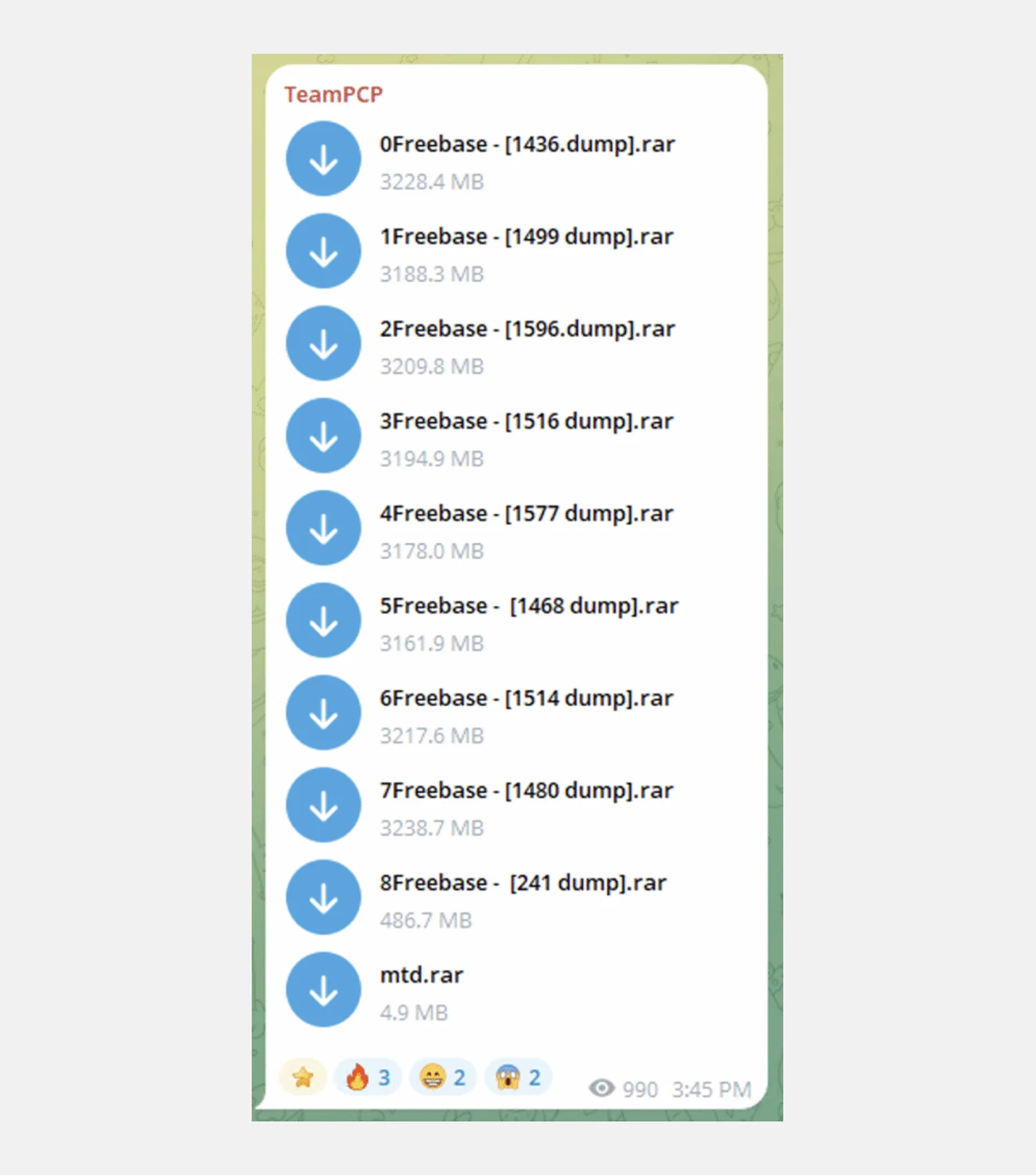
Figure 1: TeamPCP posting archives of stolen data to its Telegram channel.
A timeline of events
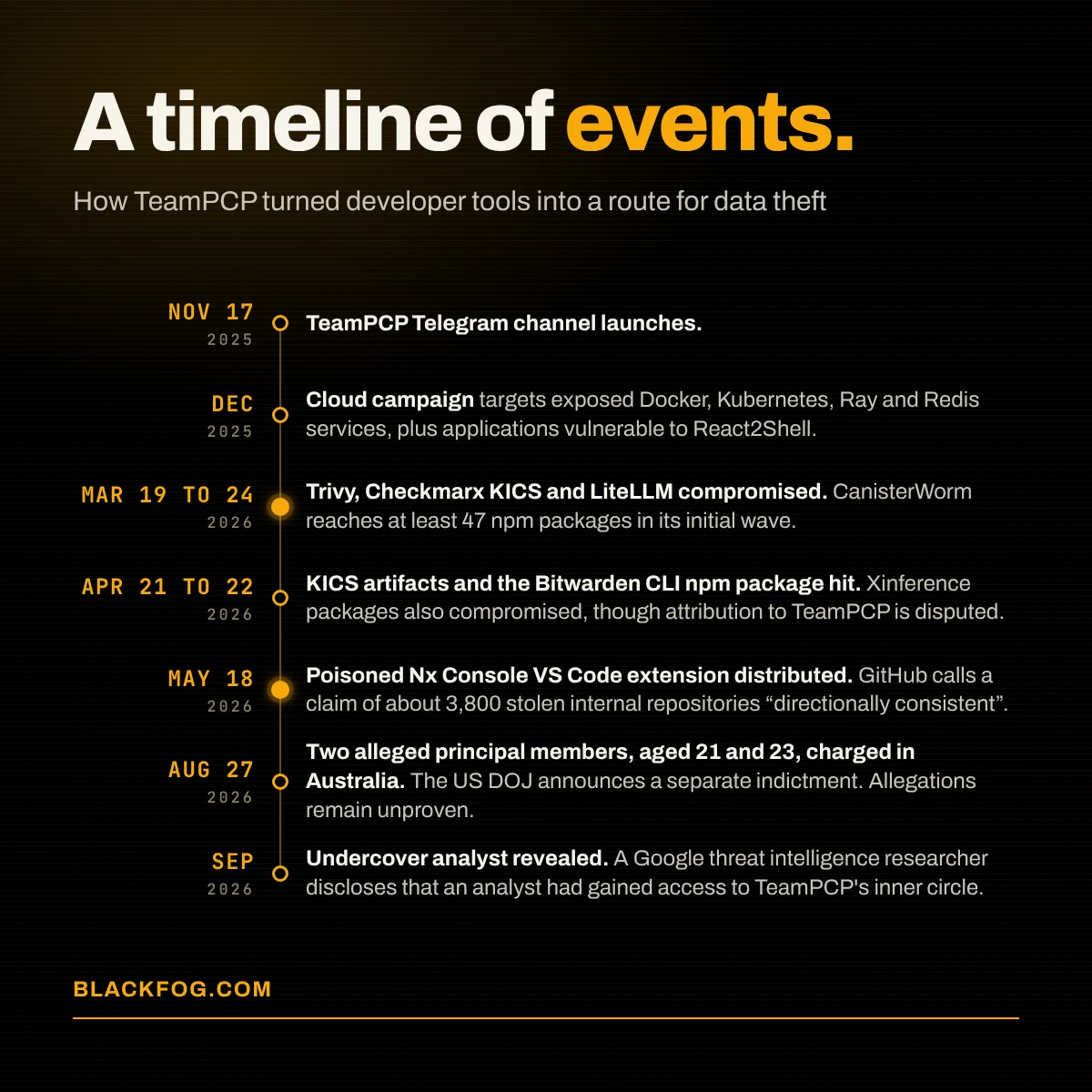
| Date | Event |
|---|---|
| Nov 17, 2025 | TeamPCP Telegram channel launches. |
| Dec 2025 | A cloud campaign targeted exposed Docker, Kubernetes, Ray and Redis services, plus applications vulnerable to React2Shell. |
| Mar 19–24, 2026 | Trivy, Checkmarx KICS and LiteLLM were compromised; CanisterWorm reached at least 47 npm packages in its initial wave. |
| Apr 21–22, 2026 | Further compromises affected KICS artifacts and the Bitwarden CLI npm package. Xinference packages were also compromised, but attribution to TeamPCP was disputed. |
| May 18, 2026 | A poisoned Nx Console VS Code extension was distributed. GitHub later said an attacker claim of about 3,800 stolen internal repositories was “directionally consistent” with its investigation. |
| Aug 27, 2026 | Australian authorities charged two alleged principal members, aged 21 and 23. The US Department of Justice separately announced an indictment against one of them; the allegations remain unproven. |
| Sep 2026 | A Google threat intelligence researcher disclosed that an undercover analyst had gained access to TeamPCP’s inner circle during the campaign. |
What TeamPCP Targeted
TeamPCP’s early cloud attacks gave it computing power and stolen credentials. Its later supply-chain attacks went further, planting malicious code in tools that could read secrets across build pipelines, developer accounts, and cloud environments. The table below shows what it targeted and what data or access was at risk.
| Where TeamPCP Struck | Documented Examples | Data Or Access At Risk |
|---|---|---|
| Exposed cloud infrastructure | Docker APIs, Kubernetes clusters, Ray dashboards, Redis servers and applications vulnerable to React2Shell (CVE-2025-55182) | Cloud credentials, computing capacity and a foothold for further activity |
| Security tooling in CI/CD | Aqua Security’s Trivy and the Checkmarx KICS GitHub Action | Pipeline secrets, cloud keys and GitHub tokens |
| AI infrastructure | LiteLLM, reported at about 95 million monthly downloads, and the compromised Xinference packages (attribution disputed) | Provider API keys, database credentials and Kubernetes access where available |
| Package registries | CanisterWorm’s npm packages, the Bitwarden CLI npm package and the Telnyx Python SDK | Publishing credentials that could distribute another malicious release |
| Developer workstations | Nx Console for VS Code, an extension with more than 2.2 million installs across versions | Source code and credentials accessible to the developer |
| Business data | Leak-channel material concerning e-commerce, finance and recruitment organizations in South Korea, Canada, the US, Serbia and the UAE | Names, contact details, employment records and CVs; researchers counted about 27 GB across 19 posted ZIP archives |
GitHub’s incident shows what that access could expose. GitHub said the theft concerned its internal repositories and found no evidence that customer-owned repositories were affected. Investigators also saw credentials stolen in March being used to explore other victim environments. Stolen GitHub repositories were later listed for at least $50,000. For the affected organizations, removing a poisoned package would not undo access already gained with an exposed token.
How TeamPCP Operates
The March campaign shows how one theft could lead to the next. TeamPCP got into a trusted tool, collected every secret it could reach, sent them out, and then exploited them. The tools and entry points changed, but the same sequence runs through every attack described below.
1. Get into software that already runs
In its cloud campaign, TeamPCP abused exposed management interfaces and applications vulnerable to React2Shell. With Trivy, the route ran through software releases. Aqua Security’s incident account found that credentials left valid after an earlier incident gave the attacker access to its open-source release environment.
The attacker force-pushed malicious commits to existing trivy-action tags and published a poisoned Trivy binary. A workflow using one of those tags could then run the new code without any configuration change. Aqua later confirmed that 76 of 77 tags were affected.
2. Collect credentials within reach
Once the code ran on GitHub-hosted runners, the Trivy payload searched Runner.Worker process memory for values marked as secrets. On self-hosted runners, it checked more than 50 paths for SSH keys, cloud credentials, Kubernetes files, and wallet material. The legitimate scan could continue afterward.
With LiteLLM, Python startup provided another execution path. Version 1.82.8 installed a .pth file that could run the payload when Python started, even without importing LiteLLM. Package analysis identified versions 1.82.7 and 1.82.8 as affected.
3. Encrypt and send the data
The Trivy stealer encrypted the collected material with AES-256-CBC and an RSA-4096 public key, bundled it as tpcp.tar.gz, and attempted an HTTPS upload to scan.aquasecurtiy.org, a lookalike of Aqua’s real domain. If the upload failed and a sufficiently privileged personal access token was available, the payload could create a tpcp-docs repository in the victim’s GitHub account and attach the archive to a release. That fallback would leave a different trail from an upload to the lookalike domain. Both routes depended on the permissions available where the payload ran.
4. Keep access and extend the campaign
On some machines, the malware installed a sysmon.py service that checked for commands every 50 minutes, according to LiteLLM payload analysis. Kubernetes-focused payloads could deploy privileged workloads. CanisterWorm extended the campaign through npm. It used stolen publishing tokens to identify packages the compromised accounts controlled and prepare malicious updates. The attacker ran that publishing tool separately at first, but about an hour later an updated version could spread on its own.
5. Turn stolen access into revenue
That access also had a resale value. TeamPCP has posted leaked material through ShellForce, offered credentials and source code for sale, and partnered with ransomware operators such as Vect. Hijacked servers supplied capacity for cryptomining and proxies. Some stolen tokens were used weeks after the initial theft, which is why prompt credential rotation matters even after a malicious release has been removed.
How to Defend Against TeamPCP
Here’s how to protect yourself from attacks like these.
- Review third-party actions before using them in your GitHub workflows. This includes looking at the code at the revision you plan on using and pinning the full commit SHA in your workflow.
- Limit the credentials your code has access to. Only provide access to a specific secret in a CI/CD job when that secret is needed. Where possible, use short-lived credentials issued through OIDC federation. Avoid running untrusted third-party code in jobs that have access to credentials for interacting with your production systems.
- Consider delaying package and editor extension updates on your developer machines (similar to how you might delay applying updates to dependencies in a build pipeline). Commit package lock files to version control. You may want to make an exception for applying security fixes promptly; however, note that the malicious version of Nx Console was available on the VS Code Marketplace for about 18 minutes, which was enough time for some people to install it.
- Mitigate the other attack vectors TeamPCP has used in the attacks described above. This includes limiting public access to Docker APIs, Kubernetes control planes, Ray dashboards, and Redis instances, and patching applications that use React Server Components against the React2Shell vulnerability (CVE-2025-55182).
- Look for known indicators of compromise. If you find tpcp.tar.gz, a tpcp-docs or docs-tpcp repository that you didn’t intentionally create, sysmon.py, or evidence of communication to scan.aquasecurtiy.org, models.litellm.cloud, or checkmarx.zone, you should consider rotating any credentials that may have been exposed and reviewing logs for evidence those credentials may have been used.
Stop the Data Leaving
TeamPCP’s encrypted archive uploads give you a concrete reason to check outbound traffic. Pinning revisions helps control which code runs, and tighter permissions limit the secrets it can reach. If malicious code still collects data, the transfer is another place to intervene alongside the build, package, and credential checks above.
That transfer’s importance extends beyond this campaign. Data exfiltration appeared in 96% of the attacks assessed in BlackFog’s first-quarter 2026 ransomware analysis. That figure applies to BlackFog’s dataset and period, rather than TeamPCP alone.
BlackFog’s anti data exfiltration (ADX) technology addresses that part of the chain. It monitors outbound traffic on devices and is designed to block unauthorized transfers before data leaves. That protection belongs alongside build security and credential management.
To see how it would fit your environment, request a BlackFog demo.