 Skip to content

Ransomware Protection: A Complete Guide To Preventing Modern Attacks
The threat posed by ransomware has reached new heights over the past 12 months. The sophistication and breadth of attacks is now unprecedented, with both major brands and small businesses being targeted by threat actors. Meanwhile, attackers now routinely deploy AI to automate phishing, bypass defenses and exfiltrate data faster than most firms can react.
Endpoint attacks have surged, while traditional tools can no longer contain data once a breach occurs. Most worryingly, the line between ransomware and nation-state disruption is blurring, putting supply chains and critical services in the crosshairs. All this means that, as we head into 2026, effective ransomware protection is more important than ever. This isn’t just about having a backup and recovery plan. It requires real-time detection solutions, data exfiltration control and resilience by design to guard against the newest generation of threats.
What Is Ransomware Protection And Why Does It Matter More Than Ever?
Ransomware protection refers to the range of proactive measures that stop ransomware from executing, spreading or stealing data. It is different from incident response, which focuses on mitigation and recovery during and in the wake of an attack. Effective protection works continuously to identify suspicious activity early and prevent attackers from accessing or exfiltrating sensitive information.
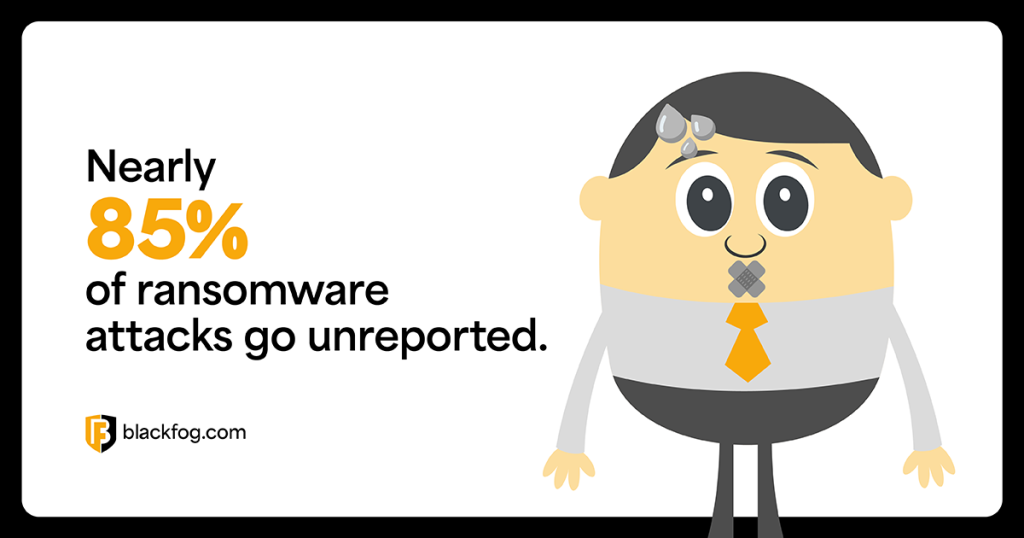
Cyberattacks in 2025 evolved into a fast-moving threat with a particular focus on targeting data. In Q3, for instance, our data recorded a 36 percent year-on-year increase in publicly-disclosed attacks. However, this is likely to be only a fraction of the true impact, as our research indicates nearly 85 percent of all ransomware attacks go unreported.
Most groups now focus on stealing data to support double or triple extortion attacks, as these tactics have proven highly effective in recent years at persuading victims to pay up. In turn, this increases the financial, reputational and regulatory risks for businesses. In this environment, ransomware protection must be adaptive, preventative and able to stop data from leaving the network at all stages of an attack.
“Ransomware has evolved from a disruptive nuisance into a highly efficient data-theft and extortion business model. Attackers are now using AI to move faster, hide better, and extract value before organizations can respond. As we move into 2026, effective ransomware protection is no longer about recovery alone, it’s about preventing data from leaving the network in the first place. If attackers can’t exfiltrate data, they lose their leverage.”
– Darren Williams, CEO and Founder, BlackFog
How Ransomware Attacks Work Today
Ransomware attacks are typically carefully planned operations. They follow a structured lifecycle designed to identify the best targets in order to maximize disruption, extract sensitive data and apply pressure through multiple extortion tactics. Understanding how threat actors work is essential in developing effective ransomware protection plans that defend businesses at every stage. Most attacks will include the following five stages:
1. Targeting and reconnaissance: Attackers research industries for promising victims, considering factors such as the type of data firms hold and how mission-critical it is. Once high-value targets have been identified, reconnaissance may include researching suppliers and individuals to find weak points that can be exploited to gain entry.
2. Initial access: Threat actors may use phishing emails, compromised credentials, vulnerable remote access tools, unpatched software or vulnerable supply chain partners to gain an initial foothold in a network.
3. Lateral movement and privilege escalation: Once inside, attackers move through the network, escalate privileges and locate key assets like domain controllers and backup systems. This is a critical stage, as, if done successfully, it can allow full, unnoticed access to an entire network.
4. Data discovery and exfiltration: Once valuable data has been located, there are typically two goals. The first is to encrypt information or otherwise make it inaccessible in order to disrupt operations. The second is to exfiltrate it outside the network, where it can be used as extortion material or sold on the dark web.
5. Extortion and ransom demands: Finally, systems are locked and ransom demands are issued, often with threats to leak stolen data if payment isn’t made.
Core Components Of Effective Ransomware Protection
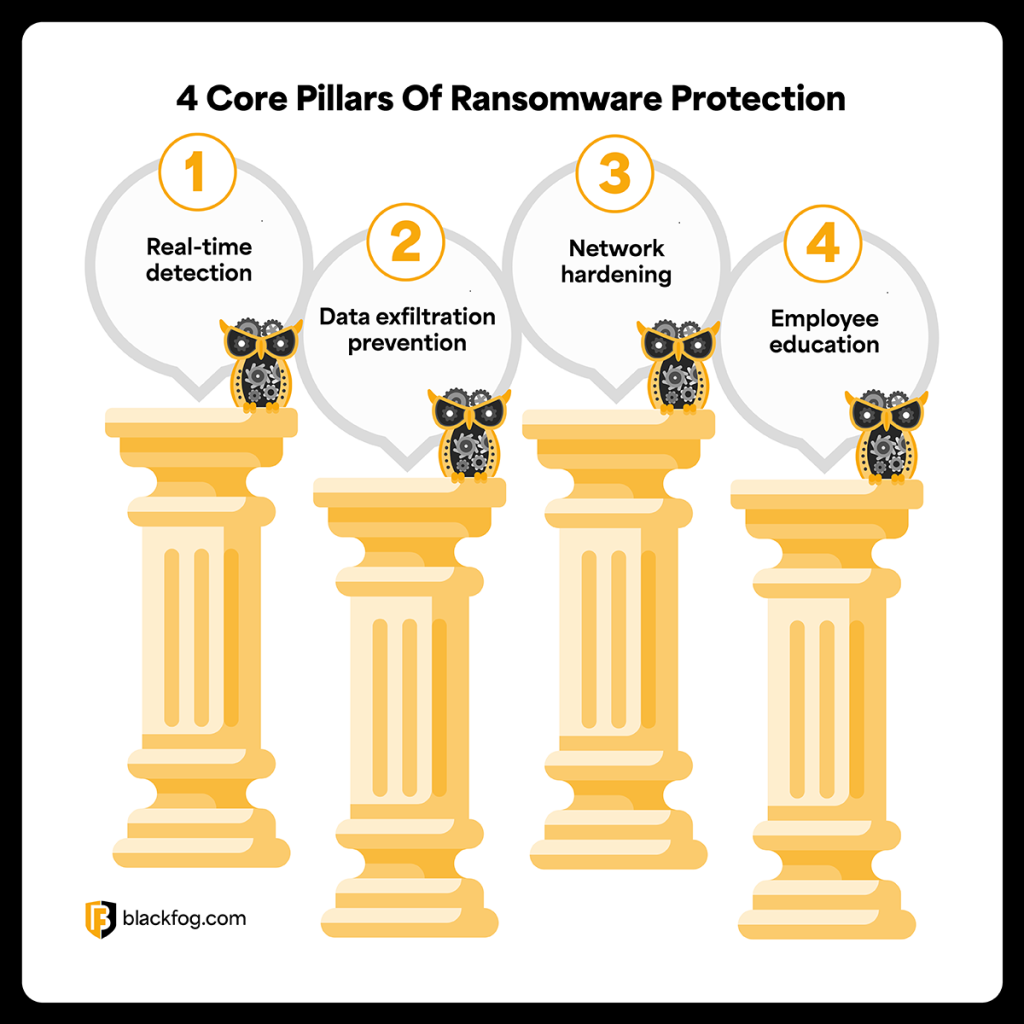
No matter the size of a business, industry or the type of data held, understanding the fundamentals of protection remain the same when planning how to prevent ransomware attacks. Defending against today’s sophisticated, stealthy attacks requires a layered approach that focuses on early detection, data control and endpoint resilience across every part of your infrastructure. The following principles are essential to any ransomware protection strategy.
Real-Time Threat Detection
To stop ransomware before it causes damage, threats must be identified the moment they appear. Real-time ransomware detection tools continuously monitor activity, flagging malicious behaviors like unauthorized access attempts or encryption processes. Immediate alerts allow security teams or automated defenses to act quickly to contain threats before data is stolen.
Data Exfiltration Prevention
Over 96 percent of ransomware attacks now involve data theft. Preventing this is critical to stopping extortion and minimizing legal exposure. Advanced anti data exfiltration (ADX) tools monitor and block suspicious outbound traffic in real-time, giving businesses a crucial layer of defense against both financial and reputational damage.
Network And Endpoint Hardening
Ransomware spreads quickly through weak configurations and overprivileged accounts. Hardening involves patching vulnerabilities, segmenting networks, enforcing least-privilege access and securing endpoints with anti-tamper protections. At the endpoint, on-device tools aim to prevent suspicious activity such as unauthorized data transfers or access requests.
Employee Security Awareness
Employees are still the most common entry point for ransomware. Well-crafted phishing emails, credential harvesting, reused passwords and social engineering can bypass even the most up-to-date technical defenses. Ongoing security training helps staff recognize threats, report suspicious activity and avoid common pitfalls.
Best Practices For Ransomware Protection In 2026
To stay ahead of ransomware in 2026, organizations need to move beyond legacy defenses. The following best practices turn the above principles into action and ensure systems are prepared for modern threats:
- Implement behavioral monitoring: Use machine learning tools that can establish baselines for normal activity and automatically raise alerts on unusual access patterns, file movements or privilege escalations.
- Block data exfiltration on the endpoint: Ensure outbound traffic is monitored at the device layer – especially in hybrid and mobile environments – to prevent data exfiltration without disrupting operations or breaking the encryption chain.
- Adopt Zero Trust architecture: Enforce strict identity verification and least-privilege access to limit lateral movement if a breach occurs.
- Segment critical systems and backups: Prevent ransomware from spreading to essential infrastructure by isolating it behind additional security controls.
- Regularly test incident response plans: Simulate ransomware scenarios and phishing attacks to identify weaknesses, improve response times and boost resilience.
- Train employees continuously: Deliver updated phishing awareness and response training to reflect current attacker tactics.
Ransomware Protection For Businesses Of All Sizes
Ransomware is not just a problem for large corporations. In 2025, small businesses and mid-sized firms were also frequently targeted, with many attacks designed specifically to exploit the limited defenses of smaller organizations and take advantage of sensitive data. For example, in one highly-publicized case, threat actors targeted a UK nursery chain, posting images of children and calling parents directly to add pressure.
In that case, police eventually arrested two teenagers, illustrating that threat actors are not always well-funded organized groups. Instead, with new technologies and Ransomware-as-a-Service tools widely available, the barrier to entry for cybercriminals is lower than ever. In turn, this can greatly increase the range of businesses targeted. This means that no matter the size of the enterprise, ransomware protection must be tailored, proactive and capable of adapting to evolving threats.
However, different firms will have varying requirements for their ransomware protection tools, which must be factored in when looking for solutions.
Small And Medium-Sized Businesses
For smaller companies, automated tools provide strong endpoint protection and real-time exfiltration prevention. Virtual CISO solutions are also often important, as these companies often lack the budget for in-house professionals. Security awareness training and managed detection services offer effective protection without overwhelming internal resources.
Mid-Market Firms
These companies benefit from centralized monitoring, behavioral analytics and segmented backups to help keep expanding network footprints under control. These firms should also focus on building an internal incident response plan and conducting regular simulations to strengthen readiness and recovery.
Large Enterprises
The largest enterprises are often targeted by the most organized, sophisticated groups, so must protect complex environments with layered defenses, Zero Trust frameworks and full visibility across endpoints and networks. Advanced threat hunting, supplier risk monitoring and compliance enforcement are essential at scale.
Comparing Ransomware Protection Solutions: What To Look For
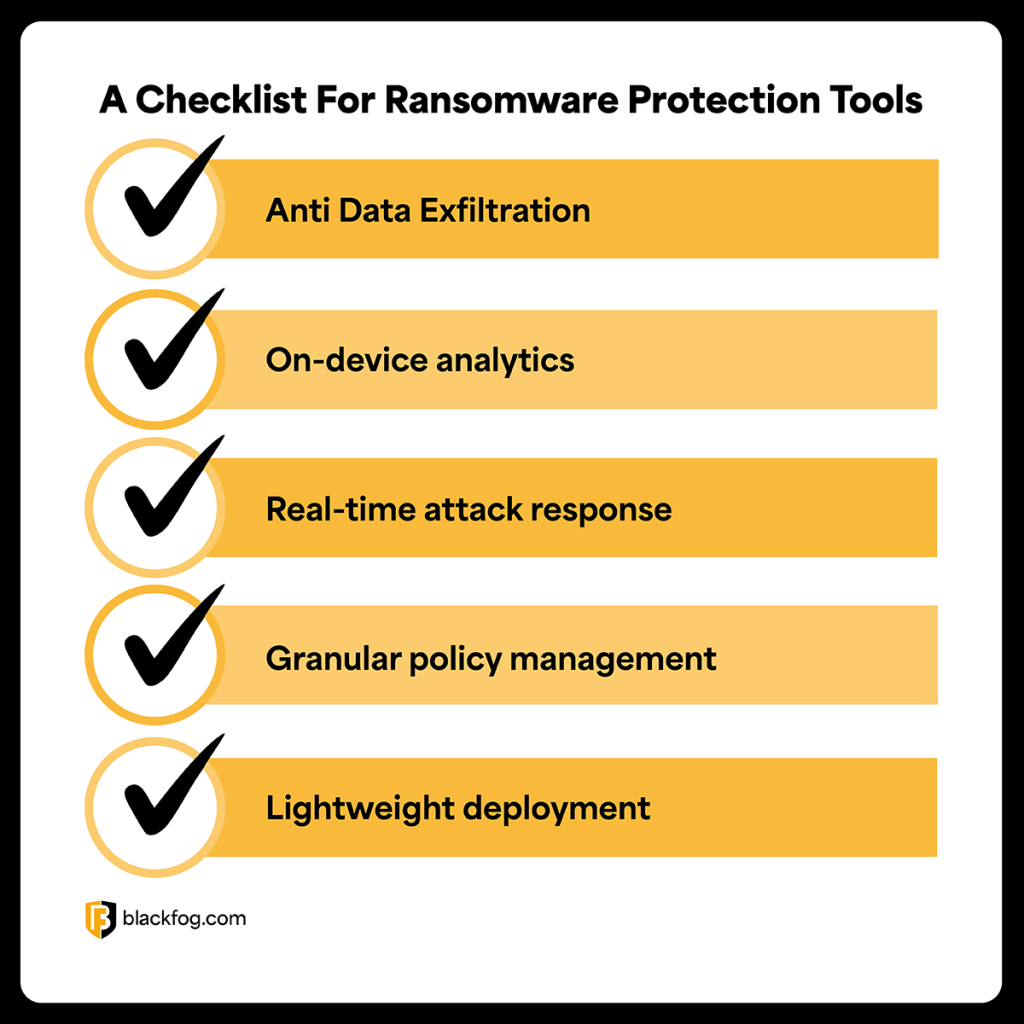
Many security platforms claim to offer ransomware protection. However, few are designed to prevent the full lifecycle of a modern attack. When evaluating solutions, businesses should look beyond basic detection. Key features to look for include:
- Anti Data Exfiltration (ADX): Blocks unauthorized outbound data transfers to stop extortion before encryption begins.
- On-device behavioral analysis: Detects unknown and emerging threats without relying on cloud signatures.
- Real-time attack containment: Automatically isolates compromised devices and terminates malicious processes.
- Granular policy controls: Applies protection rules based on user, device, location or role.
- Lightweight endpoint agent: Deploys quickly with minimal performance impact across all devices.
- Comprehensive forensic logging: Records all threat activity to support compliance and investigation.
Choosing a solution with these capabilities ensures ransomware is stopped early, before it leads to data loss, downtime or extortion.
What To Do If You’re Hit: Ransomware Protection During An Active Attack
Even with the strongest defenses, no organization is completely immune to ransomware. Human error, misconfigured systems or emerging technologies such as AI-assisted attacks can allow threat actors to bypass perimeter defenses and gain access. In these situations, speed is critical. Detecting the attack early and acting quickly, before data is exfiltrated or systems are encrypted, is essential to minimizing impact.
If an active ransomware attack is detected, these immediate steps are essential:
- Isolate affected systems: Disconnect compromised devices from the network to stop lateral movement.
- Activate incident response plan: Follow defined procedures and assign clear roles to key personnel.
- Notify security team or provider: Bring in internal experts or third-party support to assess and contain the threat.
- Preserve forensic evidence: Do not wipe or reimage systems until evidence has been collected.
- Assess for data exfiltration: Check for signs that data has been accessed or transferred.
- Report as required: Notify regulators, partners or insurers according to legal and policy requirements.
Long-Term Ransomware Resilience: Building A Future-Proof Security Stack
Ransomware threats will continue to evolve, using new technologies, tactics and delivery methods to outpace traditional defenses. For organizations to stay protected in 2026 and beyond, ransomware protection must be built for long-term resilience. This means adopting solutions that not only block known threats, but adapt continuously, detect abnormal behavior and prevent sensitive data from leaving the network.
As attackers focus increasingly on double and triple extortion, preventing data exfiltration is now the defining capability of effective ransomware defense. Without it, even a contained attack can still result in data loss, reputational damage and regulatory penalties.
BlackFog’s ADX technology is purpose-built to meet this challenge. By detecting behavioral anomalies at the device level and preventing outbound data transfers in real-time, BlackFog delivers the proactive protection businesses need to stay ahead of evolving ransomware threats and build a security stack that’s fit for the future.
Share This Story, Choose Your Platform!
Related Posts
Steaelite RAT Enables Double Extortion Attacks from a Single Panel
Steaelite is a newly emerging RAT that unifies credential theft, data exfiltration, and ransomware in a single web panel, accelerating double extortion attacks.
ClawdBot and OpenClaw: When Local AI Becomes A Data Exfiltration Goldmine
ClawdBot stores API keys, chat histories, and user memories in plaintext files, and infostealers like RedLine, Lumma, and Vidar are already targeting it.
West Harlem Group Assistance Stops Ransomware and Cryptojacking with BlackFog ADX
West Harlem Group Assistance secures its community mission by preventing ransomware and cryptojacking with BlackFog ADX.
Why Traditional Security Fails To Deal With Advanced Persistent Threats
Learn why advanced persistent threats remain a growing cybersecurity risk in 2026 and where organizations must focus to address them.
What Does Advanced Threat Protection Really Mean In 2026?
Find out why businesses need advanced threat protection to cope with the new era of sophisticated, persistent cyber risks.
How Can You Prevent Viruses And Malicious Code Today?
Preventing viruses and malicious code is harder than ever in a landscape where APTs are a growing threat. Here's what you need to know to stay safe.