 Skip to content

Who’s Really In Charge? Why AI Governance Is Now A Business Imperative
As AI becomes embedded in everyday business operations, the pressure to keep these systems compliant, secure and ethically sound has never been greater. Without close oversight, AI can expose organizations to a range of issues: data misuse, biased outcomes and regulatory breaches, to name a few.
That’s why strong AI governance is no longer optional. This provides the structure, accountability and visibility needed to manage AI responsibly across its entire lifecycle. For any business looking to minimize risk and maintain trust in an AI‑driven environment, implementing a clear governance process is essential. The sooner firms can start this process, the safer and more effective AI becomes.
What Is AI Governance?
The first step is understanding what AI governance involves. Broadly, this refers to the framework of systems, policies and processes that ensure AI is used responsibly, ethically and in compliance with regulations. It plays a crucial role within a business’ broader data privacy, AI compliance and cybersecurity efforts, providing targeted oversight across the entire AI lifecycle, from the development and deployment of new models to monitoring and upgrading, as well as regulating use of off-the-shelf solutions like ChatGPT.
What sets AI governance apart from general IT or data governance is the complexity of AI itself. These systems can adapt, operate autonomously and generate decisions that are difficult to explain or audit. As a result, AI governance must account for risks like bias, drift and lack of transparency.
Why AI Governance Matters
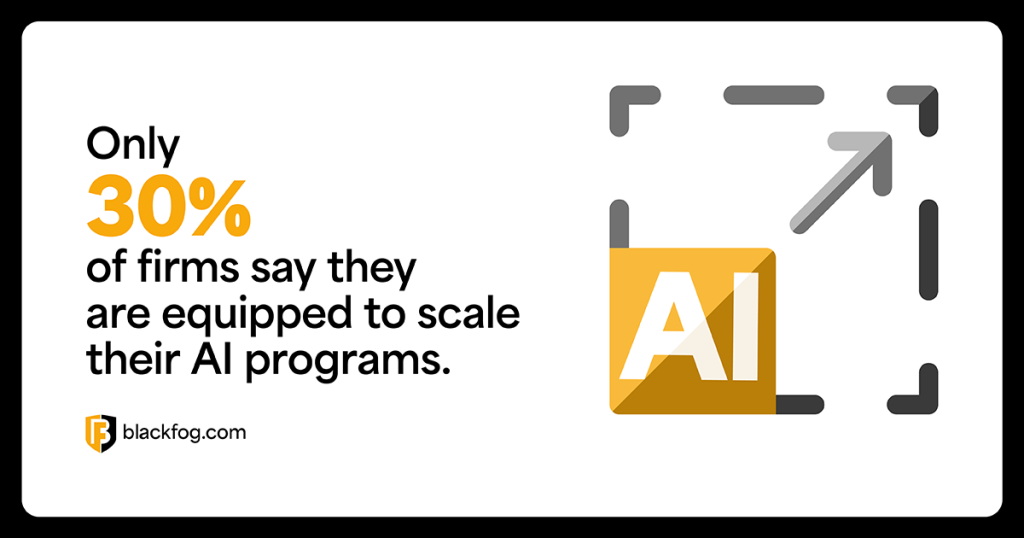
AI adoption is soaring, yet complexity and risk are growing in tandem. A recent McKinsey survey, for example, found that 88 percent of organizations report regular use of AI in at least one business function, up from 78 percent in 2024. However, while it noted around a third of enterprises are looking to scale up their solutions, this often proves challenging. Indeed, separate research by Kore.ai indicates just 30 percent of companies are equipped to scale their AI programs effectively, with the most common issues being a lack of skills, unpredictable costs and ongoing concerns surrounding data privacy and compliance.
These figures highlight a common issue: while AI is now embedded in enterprise operations, many businesses lack governance frameworks that match the pace of deployment. This gap creates several pain points. For instance, unmonitored tools may access sensitive data, opaque models can make unfair decisions and evolving regulations put organizations under mounting pressure.
Strong AI governance addresses these issues and provides the traceability, oversight and consistency needed to scale AI responsibly. This helps firms overcome potential risks such as AI data exfiltration and turn these deployments into a competitive asset that safeguards trust, data and compliance.
Core Elements Of AI Governance
Effective AI governance isn’t built on a single policy or control. It requires a coordinated framework of processes, roles and oversight mechanisms working in harmony. Below are the core elements that underpin responsible, scalable governance across the AI lifecycle. Together, these pillars create a governance framework that’s not only robust, but adaptable to future demands.
- Ownership and accountability: Define who is responsible for AI systems and deployments. Clear accountability ensures decisions are traceable and that risks don’t fall through the cracks.
- Model lifecycle oversight: Governance must cover every stage of the AI lifecycle, from design and training of AI models to deployment and monitoring. This helps identify risks early and ensures ongoing compliance as systems evolve.
- Documentation and version control: Maintaining accurate records of datasets, algorithms, decisions and updates allows for meaningful audits, regulatory compliance and internal transparency.
- Risk and impact assessment: Establish processes to evaluate the potential consequences of AI use whenever a new technology is built or adopted. This is particularly important when systems will impact people, critical infrastructure or regulated data.
- Stakeholder inclusion: Governance must be cross-functional. Legal, compliance, IT, data science and business teams all need a voice to ensure AI is aligned with broader organizational values.
Practical Tips For Implementing AI Governance
Putting AI governance into practice requires structure, collaboration across teams and integration into existing operational workflows. Here are a few key tips on how to get started effectively:
- Create a formal policy for AI use: Define how AI tools are selected, approved and monitored. This should outline principles for ethical use, compliance requirements and approval processes for new AI systems.
- Appoint a dedicated AI risk owner: Assign responsibility for overseeing AI management to a named individual or team. This ensures there’s a clear point of accountability and reduces ambiguity when risks emerge or decisions need escalation.
- Classify AI systems by risk level: Not all AI needs the same level of scrutiny. Establish criteria to differentiate high-risk systems such as customer-facing tools and those with critical decision-making capabilities from low-risk tools and prioritize oversight accordingly.
- Ensure traceability and audit readiness: Use documentation templates, logs and review checkpoints to make governance visible and defensible.
- Train employees on their governance role: Everyone interacting with AI, from developers to business users, should understand how governance affects their work and where to escalate issues.
Governance As An Enabler, Not A Barrier
IT governance – and, by extension, AI governance – is often misunderstood as a limiting force. It can be viewed as a set of controls that slow innovation or introduce unnecessary red tape. In reality, the opposite is true. Effective governance lays the foundation for faster, more confident AI adoption by ensuring systems are secure, compliant and aligned with business goals from the start.
With clear oversight, organizations can scale these tools without compromising trust or adding to AI security risks, opening up new opportunities for automation, insight and growth. It also provides the transparency needed to meet customer expectations and satisfy regulators.
Businesses that embrace governance early will be better positioned to innovate responsibly and lead in an AI-enabled future with control and clarity.
Share This Story, Choose Your Platform!
Related Posts
LotAI: How Attackers Weaponize AI Assistants for Data Exfiltration
What happens when attackers use your approved AI tools as a data exfiltration channel? New research reveals how the LotAI technique turns Copilot and Grok into covert C2 relays.

The State of Ransomware: February 2026
BlackFog's state of ransomware February 2026 measures publicly disclosed and non-disclosed attacks globally.

Steaelite RAT Enables Double Extortion Attacks from a Single Panel
Steaelite is a newly emerging RAT that unifies credential theft, data exfiltration, and ransomware in a single web panel, accelerating double extortion attacks.

ClawdBot and OpenClaw: When Local AI Becomes A Data Exfiltration Goldmine
ClawdBot stores API keys, chat histories, and user memories in plaintext files, and infostealers like RedLine, Lumma, and Vidar are already targeting it.

West Harlem Group Assistance Stops Ransomware and Cryptojacking with BlackFog ADX
West Harlem Group Assistance secures its community mission by preventing ransomware and cryptojacking with BlackFog ADX.

Why Traditional Security Fails To Deal With Advanced Persistent Threats
Learn why advanced persistent threats remain a growing cybersecurity risk in 2026 and where organizations must focus to address them.