 Skip to content

Understanding Generative AI Risks For Businesses
The adoption of generative AI has been one of the biggest trends across all sectors in the last couple of years. These tools have found their way into almost every core business function, from marketing content creation and customer service automation to code development and data analysis.
There are several clear advantages to this. For instance, faster workflows, increased productivity and enhanced innovation are all frequently touted as reasons for investments in AI. However, the technology also comes with significant risks, making generative AI a double-edged sword for modern enterprises.
Improper use can lead to sensitive data leaks, the misuse or exposure of intellectual property and new attack surfaces for cybercriminals to exploit. As adoption accelerates, businesses must treat these tools with care. Understanding and managing the associated security and privacy concerns is now a critical part of responsible deployment.
The Promise And Peril Of Generative AI
Generative artificial intelligence (GenAI) refers to advanced models capable of producing original content such as text, images, audio and code. Common models include OpenAI’s ChatGPT, Google Gemini, Microsoft Copilot and X’s Grok. In the enterprise, GenAI tools are being adopted across many functions, with almost every firm now at least testing the waters.
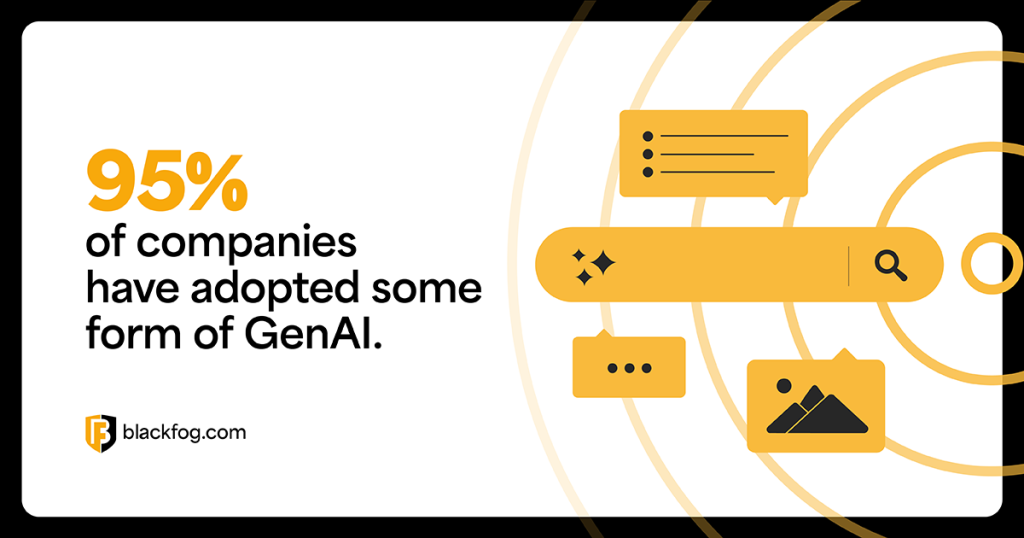
For example, one study by Bain & Company found 95 percent of US companies had adopted some form of GenAI by the start of 2025, with the number of production use cases doubling in just over a year. What’s more, over 80 percent of organizations said their deployments had met or exceeded expectations. In a separate report, McKinsey & Company estimated that GenAI could add between $2.6 trillion and $4.4 trillion to the global economy annually, with marketing, customer operations, software engineering and R&D the most impacted functions.
However, this transformative potential comes with real risks. GenAI models can generate inaccurate outputs, reinforce existing biases and create false or misleading information. Legal and compliance concerns are also growing as businesses grapple with intellectual property misuse and data privacy violations.
Yet in many cases, these risks are not being managed effectively. McKinsey, for example, found only 27 percent of companies say they have human oversight of all GenAI-created outputs before use, and 30 percent report reviewing less than a fifth. Without strong governance, GenAI may do more harm than good.
“Generative AI can deliver real value when it’s integrated securely into day-to-day operations, but without the right guardrails, it quickly becomes a new pathway for data exposure and loss of trust. The good news is organizations don’t have to choose between innovation and security.
By putting practical controls in place, clear usage policies, real-time visibility into AI activity, and protections that stop sensitive data from leaving the organization, teams can adopt GenAI confidently without compromising data security, privacy, or public trust.”
– Darren Williams, CEO and Founder, BlackFog
What Could Go Wrong? The Top 5 Risks You Should Know
As adoption of generative AI accelerates, businesses face a broad and evolving risk landscape. These tools introduce operational efficiencies and creative opportunities, but without the right oversight, they can also expose firms to new vulnerabilities.
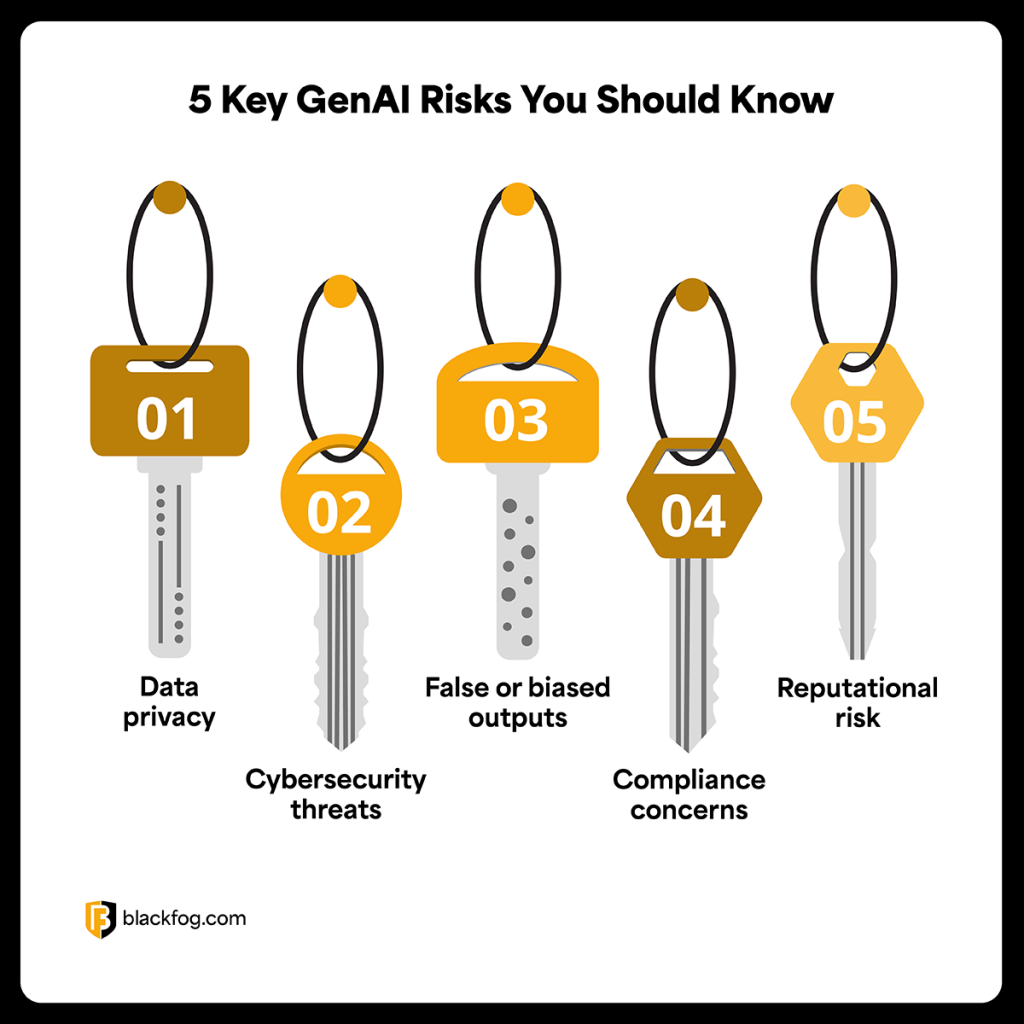
To use GenAI safely and effectively, companies must understand where things can go wrong and implement safeguards to prevent lasting damage. Below are five of the most pressing risks that organizations should be aware of when integrating GenAI into daily operations.
1. Data Privacy Leaks
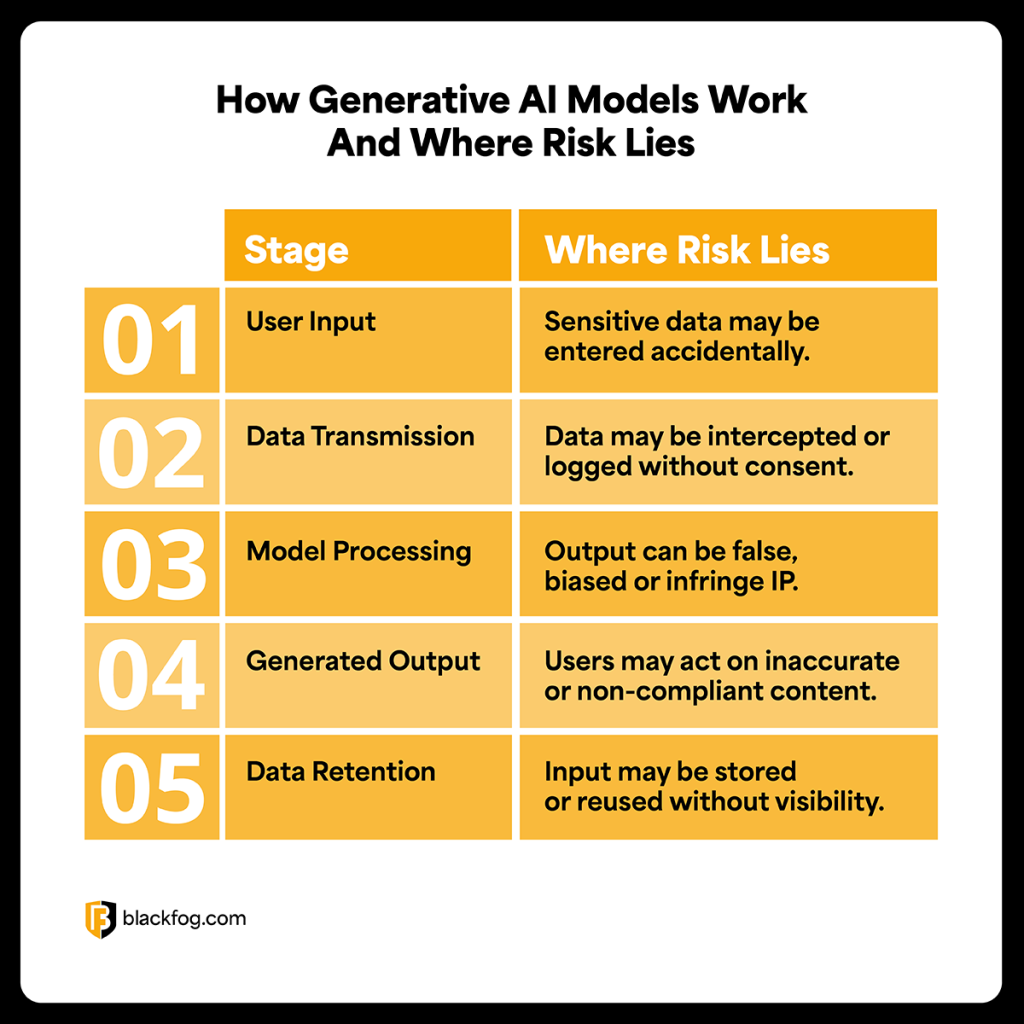
A major issue for many firms will be what information is shared with the technology. Staff may input sensitive or proprietary data into public GenAI tools without considering where and how it is stored or if it may be used to retrain external models. In fact, recent research from BlackFog found that only 53 percent of employees understand how the data they input into AI tools is saved, analyzed, or stored. This can lead to the exposure of confidential information such as personal data, trade secrets or intellectual property if conversations are not private.
Such leaks not only violate internal policies, but may breach privacy regulations such as GDPR or HIPAA. Once data is shared with third-party platforms, it’s often impossible to remove or retrieve, posing serious long-term risks to compliance, confidentiality and competitive advantage.
2. Security Threats
Generative AI offers new opportunities for cybercriminals. Threat actors can use it to craft more convincing phishing emails, write malware code or automate attacks with greater efficiency and scale. This significantly lowers the barrier to entry for cybercrime, allowing less sophisticated attackers to produce professional-looking scams.
AI-generated attacks may bypass traditional defenses by mimicking human tone or exploiting known vulnerabilities. Without updated detection strategies and employee training, businesses face a higher risk of falling victim to AI-powered threats that appear more legitimate and harder to detect.
3. False Or Biased Information
It’s easy for GenAI systems to produce fluent, confident-sounding responses. But sometimes, the information they provide can be entirely false. Known as ‘hallucinations’, these outputs can mislead employees or customers, introduce misinformation into workflows or result in bad decisions. Additionally, models trained on biased or unbalanced data may reinforce stereotypes or produce outputs that discriminate or offend. Left unchecked, this undermines trust in business communications and can lead to reputational or legal consequences. Organizations must therefore implement validation processes to detect and correct false or biased content before it causes damage.
4. Compliance And Copyright
There are several unresolved legal questions related to the use of GenAI. Platforms are trained on vast amounts of public web data, some of which may be copyrighted. If your organization publishes AI content that unknowingly reproduces protected work, you could be liable for infringement.
Elsewhere, regulated industries have the added risk of failing to meet disclosure or data handling obligations. Without legal guidance and clear internal policies, companies risk violating copyright law or falling foul of industry-specific compliance standards.
5. Reputation And Trust Damage
A single AI-related mistake, such as publishing false information or leaking confidential data, can have a disproportionate impact on brand reputation. If customers lose trust in a company’s ability to manage its technology responsibly, the damage can extend beyond short-term criticism. Investors, partners and regulators may also question the firm’s risk controls.
Public errors involving GenAI are often highly visible and fast-moving, spreading quickly on social media or news channels. The cost of repairing trust can be far greater than the investment required to prevent these issues in the first place.
Real-World Incidents: When Generative AI Backfires
While generative AI tools offer powerful capabilities, they’ve also caused real-world problems. These often result in financial, legal or reputational consequences. The following cases illustrate how things can go wrong when AI systems are deployed without adequate oversight.
1. Hallucinated Cases In Legal Briefs
The legal profession has been an enthusiastic adopter of AI to help draft briefs and summarize complex documentation. But there have been cases where its accuracy has fallen short. In one such example in the UK, 18 out of 45 citations in one brief for an £89 million damages case turned out to be fictitious, leading the High Court to issue an urgent warning to lawyers against relying on the technology.
2. Chatbot Misadvice Leads To Compensation Claim
Customer service chatbots are another common use for generative AI, but this also comes with risks. In one case, Air Canada was ordered to compensate a passenger after its website chatbot offered false information, incorrectly promising a bereavement fare refund. A tribunal ruled that the airline was liable for the misinformation, setting a legal precedent that companies are responsible for errors generated by their AI systems.
3. Samsung’s Public ChatGPT Use Leads To Data Leakage
In 2023, several Samsung Electronics employees used a public version of the ChatGPT platform to upload information such as meeting notes and source code for products. This highly confidential data was retained by the tool and could not be retrieved. As ChatGPT uses submitted data on its public-facing servers to train its own data, this means trade secrets could potentially appear in other results, prompting a company‑wide ban on the tool and structural changes to AI use.
4. AI-Powered Ordering Goes Wrong At McDonald’s
In 2024, McDonald’s trialed the use of AI by installing an AI-powered drive-thru voice ordering system. However, it was forced to abandon the scheme after repeated misfires that went viral. Customers experienced issues including unwanted items like bacon-topped desserts and bulk orders, leading to major user frustration.
Simple Ways To Stay Safe With Generative AI
Generative AI can deliver real value when integrated securely into business operations. However, as we’ve seen in the above examples, without the right guardrails, it also introduces risk. These steps offer practical, actionable guidance for organizations looking to adopt GenAI without compromising data security, privacy or trust.
- Know where your data goes: Use only approved, enterprise-grade AI tools that clearly disclose how they manage and store your data. Public platforms may retain or reuse submitted content, potentially exposing confidential information. Avoid using free tools for anything sensitive and ensure all usage aligns with internal IT and compliance policies.
- Train employees: Most data security risks start with people, as human error is one of the most common causes of data leakage. Provide regular training on safe GenAI use, including what types of data must never be entered and which platforms are authorized. Reinforcing these boundaries through policy and awareness is critical to reducing everyday risks.
- Review contracts with AI vendors carefully: Ensure all supplier agreements include clear terms around data ownership, usage rights, retention policies, liability and security obligations. Don’t assume third-party tools meet your standards by default.
- Use privacy-first platforms focused on data control: Prioritize solutions that align with Zero Trust and zero-retention models wherever possible. Business-focused products like enterprise ChatGPT offer more control and reduce exposure risks. This approach is essential for regulated sectors and firms with high-value IP.
- Monitor usage and make AI ethics part of company culture: Track how GenAI tools are used across teams and integrate ethical considerations into everyday use. As well as promoting open conversations about potential risks like bias, inaccuracy or misuse, firms should embed accountability into internal processes through reviews, audits and oversight.
The Future Of AI Risk: What To Watch Next
As generative AI evolves, so too will the risks facing businesses. One key challenge will be ensuring transparency. As models become more complex and powerful, understanding how decisions are made will be critical for building trust and accountability.
At the same time, regulatory pressure is mounting. Governments and industry bodies are moving toward stricter rules on data privacy, model accountability and acceptable use, and businesses will need to adapt quickly to ensure they remain compliant.
Finally, in regard to the threat landscape, AI-generated attacks are expected to grow. Tools that can mimic writing styles or generate synthetic voices are already in use by threat actors to create highly convincing phishing campaigns or social engineering scams. AI may even be used to create autonomous ransomware that adapts and changes its code to evade detection.
The combination of opaque models, evolving regulation and more advanced threat vectors means organizations must take a forward-looking approach and build flexibility and vigilance into their AI governance from the start.
Balancing Innovation And Responsibility
Generative AI holds enormous promise for enterprise innovation. Done well, it can drive efficiency, creativity and business growth. But without the right protections in place, it can just as easily expose sensitive data, amplify bias or create costly compliance failures.
As AI becomes more embedded in business operations, success will depend on more than tools. It will rely on a clear company culture and a privacy-first approach, supported by clear governance and informed teams. This ensures GenAI works for the business, not against it. In a threat landscape that’s evolving fast, the firms that thrive will be those that treat AI responsibility as a strategic priority.
Share This Story, Choose Your Platform!
Related Posts

The State of Ransomware: February 2026
BlackFog's state of ransomware February 2026 measures publicly disclosed and non-disclosed attacks globally.

Steaelite RAT Enables Double Extortion Attacks from a Single Panel
Steaelite is a newly emerging RAT that unifies credential theft, data exfiltration, and ransomware in a single web panel, accelerating double extortion attacks.
ClawdBot and OpenClaw: When Local AI Becomes A Data Exfiltration Goldmine
ClawdBot stores API keys, chat histories, and user memories in plaintext files, and infostealers like RedLine, Lumma, and Vidar are already targeting it.

West Harlem Group Assistance Stops Ransomware and Cryptojacking with BlackFog ADX
West Harlem Group Assistance secures its community mission by preventing ransomware and cryptojacking with BlackFog ADX.

Why Traditional Security Fails To Deal With Advanced Persistent Threats
Learn why advanced persistent threats remain a growing cybersecurity risk in 2026 and where organizations must focus to address them.

What Does Advanced Threat Protection Really Mean In 2026?
Find out why businesses need advanced threat protection to cope with the new era of sophisticated, persistent cyber risks.