 Skip to content

AI Compliance: A Roadmap For Addressing Risk And Building Trust
Artificial intelligence has rapidly become embedded in the everyday operations of modern enterprises. AI offers a wide range of advantages, from streamlining workflows and automating repetitive everyday tasks to accelerating decision-making, but it also introduces significant risks.
As adoption grows, so too does the potential for data misuse, regulatory breaches and security vulnerabilities. These are issues that every cybersecurity and compliance professional will need to deal with as a matter of urgency. Indeed, BlackFog research indicates that nearly half of respondents (49 percent) reported using AI tools not sanctioned by their employer at work.
This means that in all likelihood, sensitive business data has already been shared with these platforms. As such, enterprises must evolve to meet this reality by implementing clear governance frameworks that ensure responsible AI use, protect sensitive data and uphold compliance with privacy, security and regulatory standards. Without this, the promise of AI could quickly become a liability.
What Is AI Compliance?
To address these risks, a clear AI compliance strategy is a must. This refers to the frameworks, policies and practices that ensure the responsible use of artificial intelligence across an enterprise. As well as addressing legal requirements such as data privacy regulations like GDPR, it must also encompass ethical standards and cybersecurity best practices.
As AI tools increasingly handle sensitive company data, including intellectual property and personally identifiable information, compliance becomes critical to mitigating risk. But AI compliance isn’t just a checkbox exercise. It should be viewed as foundational to building a culture of trust, accountability and security that will be essential in an AI-first future.
With AI now touching everything from customer service to strategic planning, enterprises must approach compliance proactively, embedding governance across people, processes and platforms. Done right, it not only reduces risk but enhances credibility, resilience and long-term business value. A strong framework ensures AI systems are made transparent, decisions are explainable and data is protected at every stage of processing.
Why AI Compliance Matters Now
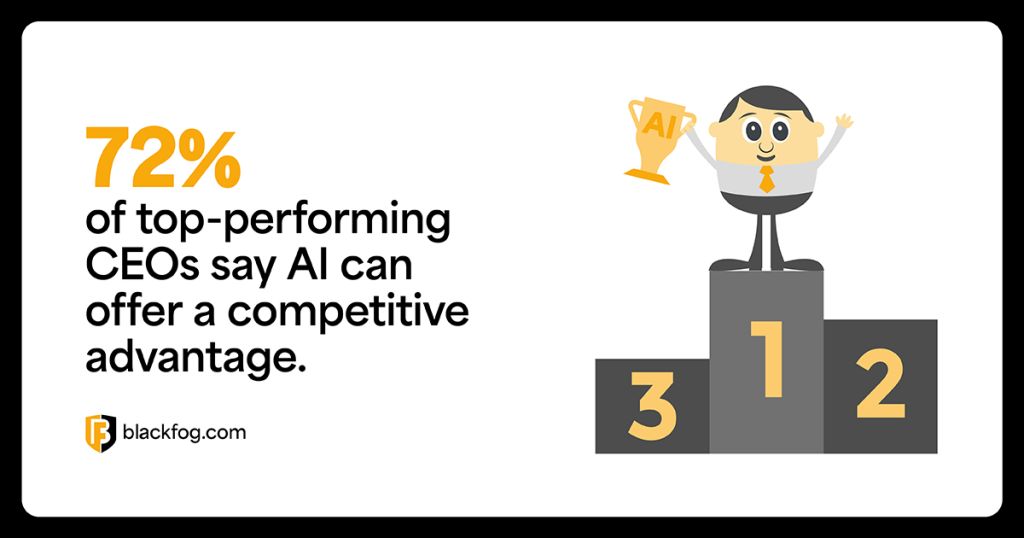
AI has passed the experimental stage and is now a core business enabler. Across industries, enterprises are integrating artificial intelligence into daily operations, from customer service chatbots and predictive analytics to automated decision-making and product development. In fact, figures highlighted by IBM note that 73 percent of businesses are already using analytical and generative AI, while almost three-quarters of top-performing CEOs (72 percent) believe that using the most advanced tools can provide a competitive advantage.
But with this rapid adoption comes increased risk. AI is now being used to process vast volumes of sensitive and confidential data. Without strong compliance and governance frameworks, this opens the door to data breaches, privacy violations and serious legal consequences. In particular, highly regulated sectors such as healthcare, finance and government services need to ensure they are using this technology responsibly.
This means having clear oversight over where and how AI is deployed, ensuring all tools meet regulatory and ethical standards and protecting the sensitive data AI systems are trained on and operate with.
“Shadow AI isn’t a future problem, it’s happening right now. When employees adopt AI tools independently, organizations lose visibility and control over where sensitive data is going, creating real exposure across privacy, security, and regulatory compliance.
The answer isn’t to ban AI, but to govern it with the right technology, solutions that discover unsanctioned AI use, monitor data movement, and enforce policies in real time, so organizations and employees can benefit from the productivity gains AI delivers. With clear governance and effective controls, businesses can unlock AI’s value without turning innovation into liability.”
– Darren Williams, CEO and Founder, BlackFog
The Risk Landscape: What Happens If You Get It Wrong
As AI adoption accelerates, so too do the risks for businesses that fail to govern its use properly. When AI systems are deployed without adequate oversight, security controls or ethical guardrails, the consequences can be far-reaching. This can not only impact an enterprise’s regulatory compliance, but lead to operational issues, reputational damage and, ultimately, harm to the bottom line.
Enterprises must understand that AI is only as safe and fair as the data it’s trained on and the controls surrounding it. Without a clear framework, firms may encounter a range of risks, including:
- Regulatory breaches: Violating data protection laws like GDPR or HIPAA due to improper handling or storage of personal data by AI systems.
- Cybersecurity threats: AI tools can introduce new attack surfaces, making it easier for bad actors to exploit unmonitored or unsanctioned applications.
- Data leakage and exfiltration: Sensitive data can be exposed through poor model training practices or unsecured endpoints.
- Bias and discrimination: Unchecked AI models may generate outputs that reinforce societal or systemic biases, leading to unfair outcomes.
- Reputational damage: Missteps in AI governance can rapidly erode public and stakeholder trust, especially if customer-facing services give inaccurate or misleading results.
- Financial penalties and litigation: Compliance failures that result in data breaches can lead to regulatory fines, class-action lawsuits and costly remediation.
Key Pillars Of Effective AI Compliance
Strong AI compliance is the best defense if companies are to avoid the above issues. In order to achieve this – and ensure AI is used safely, ethically and in line with regulations –
enterprises must build a strong compliance and governance framework.
Good AI usage demands more than a single policy or tool. It requires enterprises to embed responsibility and accountability across systems, processes and people. The following pillars form the foundation of an effective AI compliance strategy:
- Clear governance structures: Define ownership and accountability for AI use across the business. Establish cross-functional oversight that involves key stakeholders from legal, IT, security and compliance to guide decision-making and take control of AI management.
- Data privacy and protection: Ensure AI systems meet all relevant data protection regulations (e.g., GDPR, HIPAA). This includes clear data minimization processes, anonymization and user consent throughout model training and deployment.
- Model transparency and explainability: Use tools and techniques that allow AI decisions to be audited and explained. This is especially important when outcomes directly affect customers or employees. Explainability is essential for ethical use and being able to defend AI decision-making if challenged by regulators.
- Bias detection and mitigation: Implement checks to identify and reduce bias in datasets and model outputs. This prevents unfair outcomes and helps avoid reputational and legal consequences.
- Security integration: AI systems must be protected like any other digital asset, with robust endpoint protection, access controls and monitoring to detect anomalies and prevent AI data exfiltration.
- Ongoing monitoring and auditing: AI compliance isn’t a one-time task. Establish continuous monitoring of system performance, risks and regulatory changes to ensure ongoing alignment.
A Practical Roadmap: How To Build An AI Compliance Program
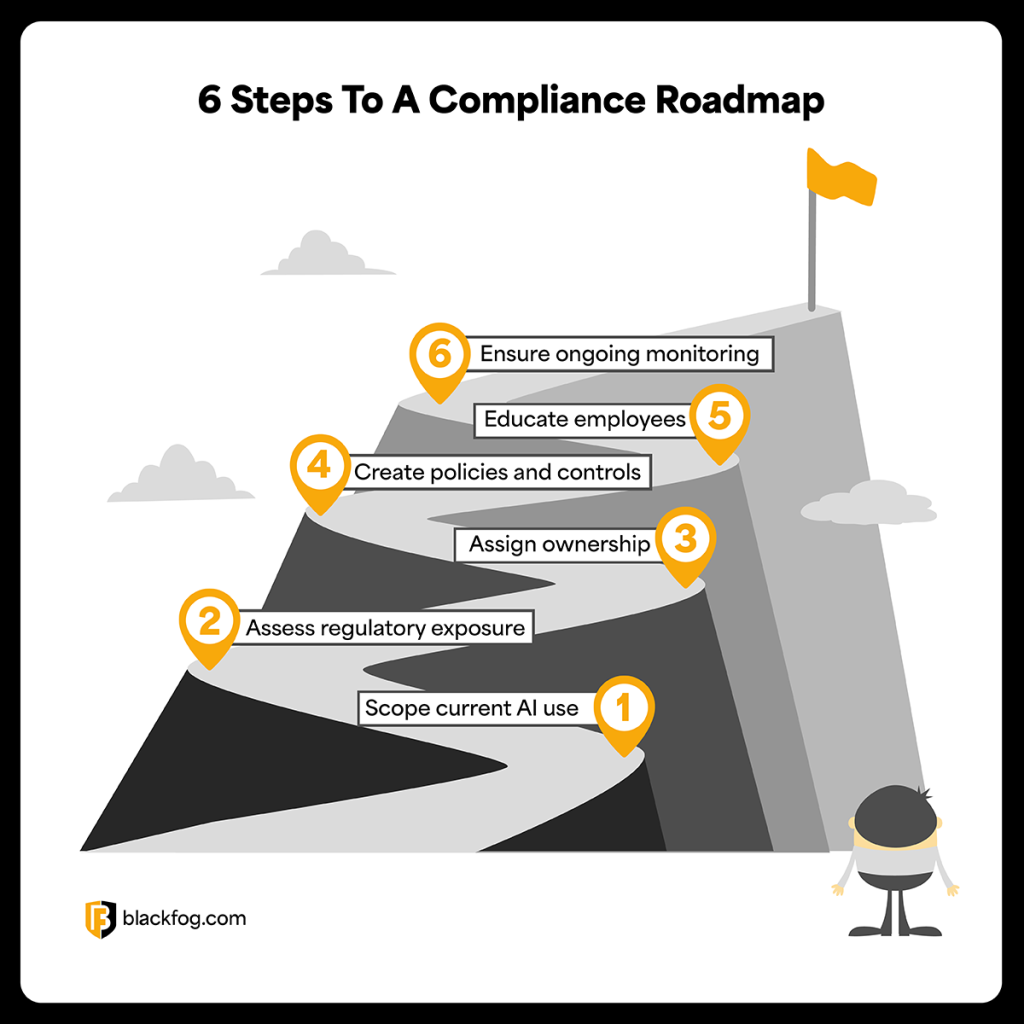
A good AI compliance program keeps usage visible, measurable and under control at all times. This is vital if systems are to remain secure, ethical and compliant as they evolve. To do this, be sure to take the following steps in order to build a comprehensive AI governance framework.
- Scope and audit current AI use: Start by identifying every AI tool in use across the organization. This must not be limited to official deployments, but also consider employee-adopted tools like consumer-grade ChatGPT or image generators. Understand what each system does, what data it processes and where existing gaps in oversight may exist.
- Assess regulatory and risk exposure: Cross-reference AI use cases with regulatory requirements such as GDPR, HIPAA or other sector-specific rules. This helps determine what type of compliance, ethical or AI security risks your organization is exposed to and where immediate remediation is needed.
- Establish ownership and governance structures: Assign clear responsibility for AI oversight. All stakeholders involved in this should understand their own requirements – whether this is from a legal, security or IT standpoint – and work together to create a clear plan for reviewing AI usage and compliance.
- Develop policies and enforce technical controls: Draft clear internal guidelines for data handling, model documentation, approved tools, explainability and ethical use. It’s also important to have the right tools to ensure these standards can be consistently enforced. For instance, the use of access controls, endpoint protection and encryption are vital to minimize the risk of data breaches.
- Invest in employee training and awareness: Provide tailored education for different teams. Developers of AI tools need to understand the potential for bias and how to mitigate this, while general staff should know what tools are approved, what data they can and cannot provide AI models with and the risks of unsanctioned AI use.
- Monitor, audit and adapt: AI compliance is never finished. Regularly track AI performance, data flow and usage trends, including auditing for bias, model drift and compliance issues. Policies and controls should then be updated accordingly.
Challenges And Common Pitfalls
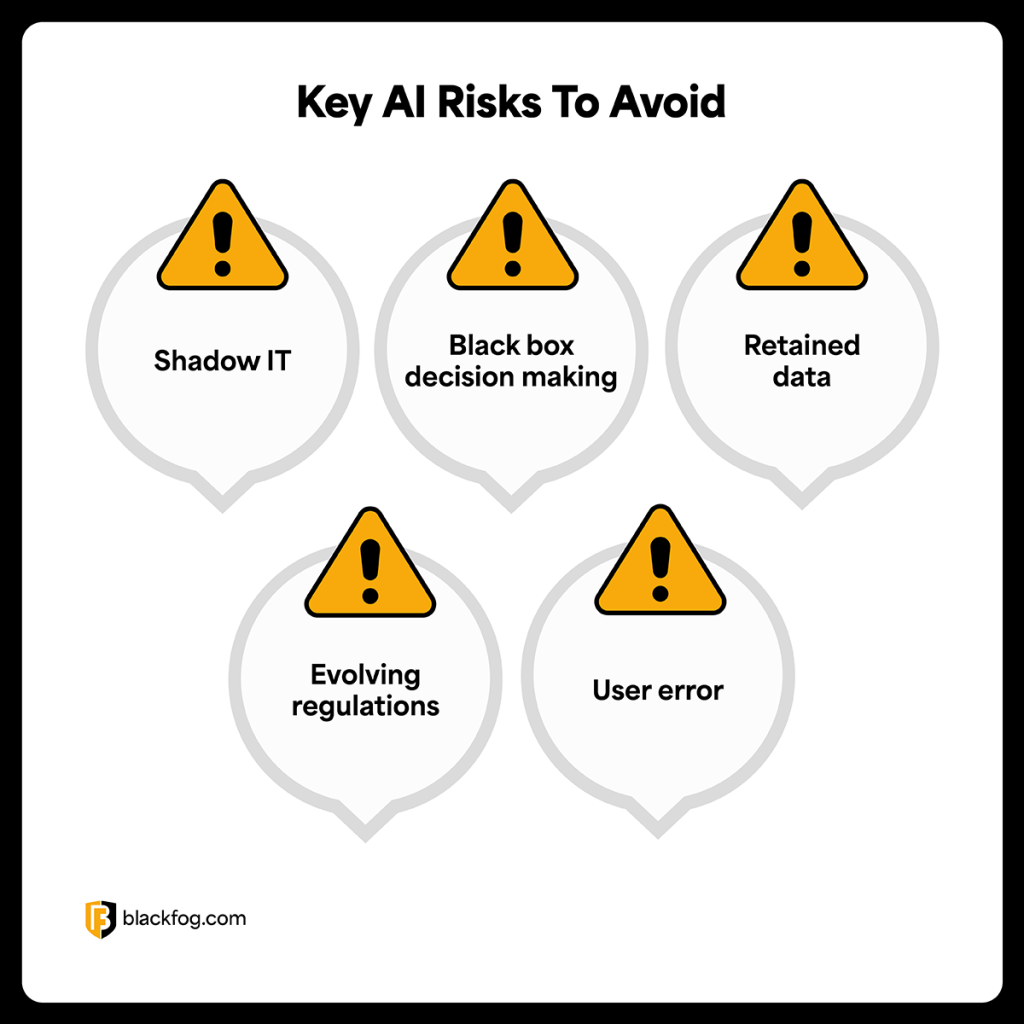
Even with the best intentions, many organizations encounter challenges when deploying AI at scale. Such missteps can quickly expose firms to compliance failures, reputational damage or security breaches. By recognizing the following pitfalls early, firms can take the right steps to avoid issues before they become a problem, helping build AI systems that are both compliant and secure by design.
- Shadow IT and unapproved tools: Employees often adopt AI tools without IT approval, bypassing corporate controls. In fact, recent research from BlackFog found that 71 percent of employees believe the productivity benefits of using unapproved AI tools at work outweigh the potential data privacy risks. These may process sensitive data or introduce vulnerabilities. To avoid this, enforce clear policies on approved tools and monitor usage through endpoint security and data loss prevention systems.
- Lack of transparency and explainability: Many AI models, particularly deep learning systems, operate as “black boxes”, making it difficult to understand or explain decisions. This undermines accountability and regulatory defensibility. Prioritize explainable models and require robust documentation.
- Data privacy blind spots: AI systems can unintentionally process or retain personal or regulated data without the knowledge of businesses. Without minimization and anonymization, this poses risks under laws like GDPR and HIPAA.
- Failure to keep up with evolving regulations: The AI regulatory landscape is shifting rapidly. Without regular compliance reviews, organizations may unknowingly fall out of alignment. Appointing a compliance lead to monitor updates and drive policy changes is a good way to ensure accountability and keep up to date with any new requirements.
- Overreliance on vendors or third-party tools: Trusting external AI platforms without proper due diligence can introduce hidden risks. Always vet third-party tools for compliance, data handling practices and security posture.
Insufficient training and awareness: Employees may not fully understand the risks of AI misuse. Run targeted training for technical and non-technical teams to reinforce secure, responsible usage.
The Future Of AI Compliance: Emerging Trends And What Enterprises Must Prepare For
As enterprise adoption of AI deepens, the compliance landscape is evolving rapidly. Businesses must prepare for new risks, new rules and increased scrutiny to ensure they don’t fall out of compliance.
One of the most significant developments is the EU AI Act, which is set to fully come into force for most purposes in 2026 and will be one of the most comprehensive global benchmarks for AI regulation. Applying to any company providing or deploying an AI system within the EU, this introduces a risk-based framework that places strict obligations on high-risk systems, including requirements for transparency, human oversight and data governance. Enterprises deploying AI in areas like healthcare, recruitment or finance must be ready for mandatory compliance with these rules or face significant penalties.
Beyond regulation, other emerging challenges are coming into focus. Model risk, where AI tools produce flawed, biased or unpredictable outputs, poses a serious threat to trust and compliance. To avoid this, enterprises will need to strengthen validation, testing and monitoring across the AI lifecycle to maintain control.
With AI systems increasingly making decisions that affect people, processes and profits, the case for strong governance has never been clearer. Acting now to establish a robust compliance framework is vital. However, it isn’t just about avoiding penalties and ticking boxes. Strong governance and control of AI deployments can be a strategic differentiator. Firms that embed security, accountability and transparency into their AI operations will be better equipped to navigate future risks and stand out in a competitive, regulated landscape.
Share This Story, Choose Your Platform!
Related Posts
LotAI: How Attackers Weaponize AI Assistants for Data Exfiltration
What happens when attackers use your approved AI tools as a data exfiltration channel? New research reveals how the LotAI technique turns Copilot and Grok into covert C2 relays.

The State of Ransomware: February 2026
BlackFog's state of ransomware February 2026 measures publicly disclosed and non-disclosed attacks globally.

Steaelite RAT Enables Double Extortion Attacks from a Single Panel
Steaelite is a newly emerging RAT that unifies credential theft, data exfiltration, and ransomware in a single web panel, accelerating double extortion attacks.

ClawdBot and OpenClaw: When Local AI Becomes A Data Exfiltration Goldmine
ClawdBot stores API keys, chat histories, and user memories in plaintext files, and infostealers like RedLine, Lumma, and Vidar are already targeting it.

West Harlem Group Assistance Stops Ransomware and Cryptojacking with BlackFog ADX
West Harlem Group Assistance secures its community mission by preventing ransomware and cryptojacking with BlackFog ADX.

Why Traditional Security Fails To Deal With Advanced Persistent Threats
Learn why advanced persistent threats remain a growing cybersecurity risk in 2026 and where organizations must focus to address them.