 Skip to content

Why AI Governance Is Now A Business Imperative
As AI becomes embedded in everyday business operations, the pressure to keep these systems compliant, secure and ethically sound has never been greater. Without close oversight, AI can expose organizations to a range of issues: data misuse, biased outcomes and regulatory breaches, to name a few.
That’s why strong AI governance is no longer optional. This provides the structure, accountability and visibility needed to manage AI responsibly across its entire lifecycle. For any business looking to minimize risk and maintain trust in an AI‑driven environment, implementing a clear governance process is essential. The sooner firms can start this process, the safer and more effective AI becomes.
What Is AI Governance?
The first step is understanding what AI governance involves. Broadly, this refers to the framework of systems, policies and processes that ensure AI is used responsibly, ethically and in compliance with regulations. It plays a crucial role within a business’ broader data privacy, AI compliance and cybersecurity efforts, providing targeted oversight across the entire AI lifecycle, from the development and deployment of new models to monitoring and upgrading, as well as regulating use of solutions like ChatGPT and AI agents.
What sets AI governance apart from general IT or data governance is the complexity of AI itself. These systems can adapt, operate autonomously and generate decisions that are difficult to explain or audit. As a result, AI governance must account for risks like bias, drift and lack of transparency.
Why AI Governance Matters
AI adoption is soaring and complexity and risk are growing in tandem. A recent McKinsey survey, for example, found that 88 percent of organizations report regular use of AI in at least one business function, up from 78 percent in 2024. However, while it noted around a third of enterprises are looking to scale up their solutions, this often proves challenging.
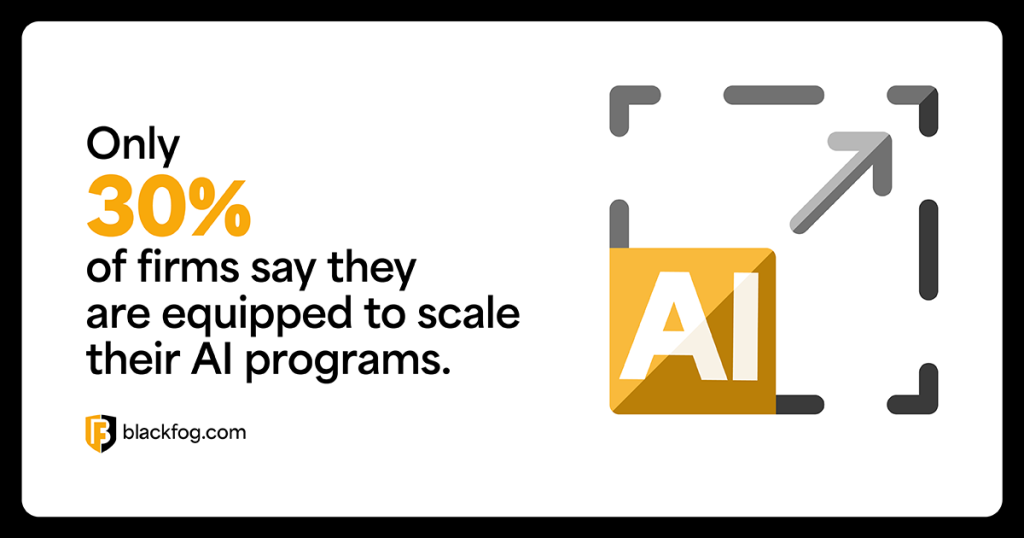
Indeed, separate research by Kore.ai indicates just 30 percent of companies are equipped to scale their AI programs effectively, with the most common issues being a lack of skills, unpredictable costs and ongoing concerns surrounding data privacy and compliance.
These figures highlight a common issue: while AI is now embedded in enterprise operations, many businesses lack governance frameworks that match the pace of deployment. This gap creates several pain points. For instance, unmonitored tools may access sensitive data, opaque models can make unfair decisions and evolving regulations put organizations under mounting pressure.
AI Governance And Shadow AI
One of the biggest governance challenges is shadow AI: the use of AI tools without IT approval, often through personal accounts on consumer platforms. Because this activity happens outside official oversight, security teams cannot see what data is being shared or hold anyone accountable for it, leaving sensitive information dangerously exposed.
AI governance counters this by establishing clear policies on which tools are sanctioned and how they may be used, backed by the visibility needed to enforce them. This brings shadow AI into the open, allowing firms to manage the risk rather than ignore it.
AI Governance Vs AI Compliance
AI governance is often spoken about in the same conversations as AI compliance. But while related, they are not the same thing. Governance is the internal framework an organization builds to manage AI responsibly. It covers the policies, roles and oversight that determine how AI is developed, deployed and monitored across its lifecycle, including key areas like data protection. Compliance, meanwhile, is outward-facing, focused on meeting the external legal, regulatory and industry requirements that apply to AI, such as GDPR or the EU AI Act.
The two work hand in hand. Strong governance is what makes compliance achievable, providing the documentation, accountability and visibility needed to prove obligations are being met. Compliance alone confirms the minimum is satisfied, but only governance ensures AI is used safely and securely day to day. Both are essential.
Benefits Of AI Governance
While compliance is often the trigger for adopting AI governance, its value extends much further. Done well, governance strengthens security, protects privacy and reduces operational risk across the business, turning a perceived obligation into a genuine source of advantage. Key benefits include:
- Improved security posture: Clear oversight of how AI tools access and handle data closes the gaps attackers exploit, reducing the risk of breaches and AI data exfiltration.
- Greater accountability: Defined ownership means every AI system has a responsible party, so risks are managed rather than overlooked.
- Visibility into AI usage: Governance surfaces which tools are in use across the business, sets a basis for clear AI monitoring and brings shadow AI into the open where it can be managed.
- Stronger user and customer trust: Demonstrating responsible, transparent AI use reassures customers and partners that their data is handled with care.
- Reduced operational risk: Consistent processes limit errors, model drift and unpredictable outcomes that could disrupt critical business activities.
Core Elements Of AI Governance
Effective AI governance isn’t built on a single policy or control. It requires a coordinated framework of processes, roles and oversight mechanisms working in harmony that helps protect against both internal failures and AI cyberattacks. Below are the core elements that underpin responsible, scalable governance across the AI lifecycle. Together, these pillars create a governance framework that’s not only robust, but adaptable to future demands.
- Ownership and accountability: Define who is responsible for AI systems and deployments. Clear accountability ensures decisions are traceable and that risks don’t fall through the cracks.
- Model lifecycle oversight: Governance must cover every stage of the AI lifecycle, from design and training of AI models to deployment and monitoring. This helps identify risks early and ensures ongoing compliance as systems evolve.
- Documentation and version control: Maintaining accurate records of datasets, algorithms, decisions and updates allows for meaningful audits, regulatory compliance and internal transparency.
- Risk and impact assessment: Establish processes to evaluate the potential consequences of AI use whenever a new technology is built or adopted. This is particularly important when systems will impact people, critical infrastructure or regulated data.
- Stakeholder inclusion: Governance must be cross-functional. Legal, compliance, IT, data science and business teams all need a voice to ensure AI is aligned with broader organizational values.
Practical Tips For Implementing AI Governance
Putting AI governance into practice requires structure, collaboration across teams and integration into existing operational workflows. Here are a few key tips on how to get started effectively:
- Create a formal policy for AI use: Define how AI tools are selected, approved and monitored. This should outline principles for ethical use, compliance requirements and approval processes for new AI systems.
- Appoint a dedicated AI risk owner: Assign responsibility for overseeing AI management to a named individual or team. This ensures there’s a clear point of accountability and reduces ambiguity when risks emerge or decisions need escalation.
- Classify AI systems by risk level: Not all AI needs the same level of scrutiny. Establish criteria to differentiate high-risk systems such as customer-facing tools and those with critical decision-making capabilities from low-risk tools and prioritize oversight accordingly.
- Ensure traceability and audit readiness: Use documentation templates, logs and review checkpoints to make governance visible and defensible.
- Train employees on their governance role: Everyone interacting with AI, from developers to business users, should understand how governance affects their work and where to escalate issues.
Governance As An Enabler, Not A Barrier
IT governance – and, by extension, AI governance – is often misunderstood as a limiting force. It can be viewed as a set of controls that slow innovation or introduce unnecessary red tape. In reality, the opposite is true. Effective governance lays the foundation for faster, more confident AI adoption by ensuring systems are secure, compliant and aligned with business goals from the start.
With clear oversight, organizations can scale these tools without compromising trust or adding to AI security risks, opening up new opportunities for automation, insight and growth. It also provides the transparency needed to meet customer expectations and satisfy regulators.
Businesses that embrace governance early will be better positioned to innovate responsibly and lead in an AI-enabled future with control and clarity.
AI Governance FAQs
What are the core components of an effective AI governance framework?
Key components include clear ownership and accountability, model lifecycle oversight, documentation and version control, risk and impact assessment and cross-functional stakeholder inclusion.
How does AI governance help manage shadow AI risks?
Governance sets clear policies on which AI tools are approved and how they may be used, backed by the visibility needed to detect unsanctioned tools and bring shadow AI under control.
Who should be responsible for AI governance within an organization?
Responsibility should sit with a named AI risk owner or team, supported by legal, compliance, IT, data science and business stakeholders to keep governance cross-functional.
How does AI governance support regulatory compliance?
It provides the documentation, accountability and oversight needed to demonstrate that obligations under frameworks like GDPR and the EU AI Act are being met.
What is the difference between AI governance and AI risk management?
Governance is the broad framework guiding responsible AI use, while risk management is one part of it, focused on identifying and mitigating specific AI-related risks.
How can organizations implement AI governance without slowing innovation?
Apply risk-based controls that focus oversight on high-risk systems, letting low-risk AI use proceed freely while keeping innovation moving.
Share This Story, Choose Your Platform!
Related Posts

QTFY: Industrializing Cyber Exploitation Against Critical Infrastructure
QTFY: Industrializing Cyber Exploitation Against Critical Infrastructure
Stopping Data Exfiltration Through LLM Prompts And Responses
Data can leave through LLM prompts, responses or agent actions. Learn how each path works and what actually stops it.

The 7 Layers Of Prompt Poisoning Protection Every AI Application Needs
Discover the seven layers of prompt poisoning protection every AI application needs, from input validation to endpoint monitoring.
What Is Zero Trust In Cybersecurity And How Does It Apply To Shadow AI?
Zero Trust means never trust, always verify. Learn how this principle applies to shadow AI and closes the gaps legacy security misses.
What Are The Main Features Of Shadow AI Applications?
Shadow AI applications share five distinct traits, from unapproved access to free-text input. Learn what to look for and why it matters.

How To Avoid Shadow AI In Enterprises
Learn how to avoid shadow AI in enterprises through continuous discovery, fast-tracked approvals and endpoint-level monitoring.