Skip to content

AI Monitoring: Gaining Control Over Enterprise AI Usage
The past two years have reshaped enterprise IT faster than almost any period since the introduction of the internet. One of the biggest changes has been the transformative effect of generative AI tools on how employees handle data every day. AI assistants, agents and chatbots have swiftly moved beyond the hype and experimental stage and are now woven into everyday workflows.
While these tools drive real productivity gains, they also introduce serious data security and data protection challenges. In many cases, tools like ChatGPT and Gemini are adopted by individual teams or employees long before security leaders are even aware they are in use. This can result in organizations losing visibility into what AI applications are accessing, processing and sharing.
As the usage of these tools continues to accelerate across the workplace, effective AI monitoring has become an essential part of any modern cybersecurity strategy.
What Is AI Monitoring?
AI monitoring is the practice of tracking, analyzing and controlling how artificial intelligence is used and behaves across an organization. In practice, it covers two distinct but connected disciplines.
The first is monitoring AI usage. This means observing which tools employees are accessing, what data they are feeding into them and where that information ends up. This is vital as without it, businesses can expose themselves to a range of shadow AI risks. The second is monitoring AI models themselves: watching how an organization’s own models perform, whether their outputs stay accurate and reliable and whether they are being manipulated or drifting over time.
Both are essential in guarding against the most common cybersecurity risks that AI usage can create. Usage monitoring protects against sensitive data leaving the business through unsanctioned tools. Model monitoring guards against attacks like prompt injection, where hackers manipulate an AI model to access sensitive data, as well as issues that can lead to biased or unpredictable AI decisions. Together they give security teams the visibility needed to manage AI safely.
Why Enterprise AI Adoption Creates New Security Blind Spots
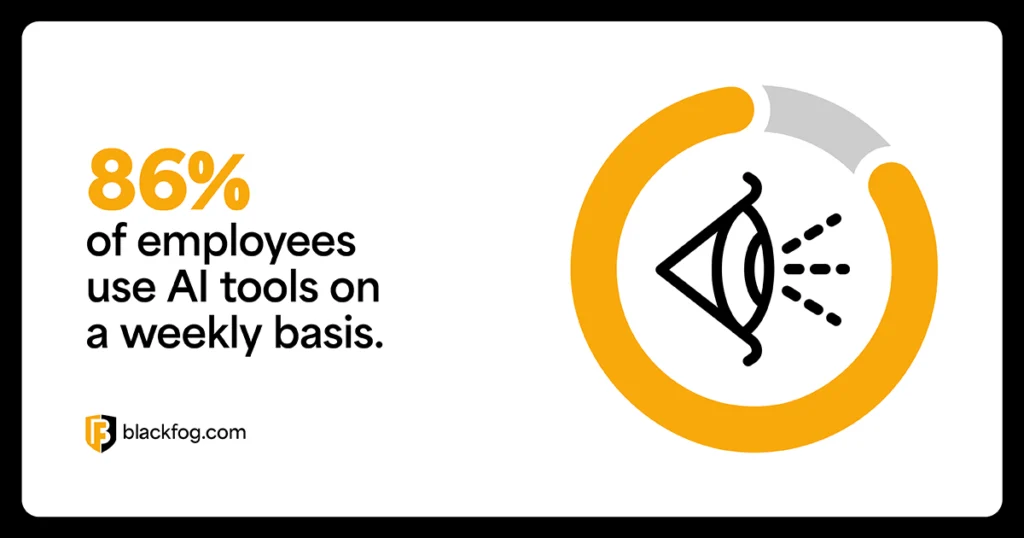
AI is now embedded in daily work, with our research finding that 86 percent of employees use AI tools at least weekly. However, many people do so without authorization, with 49 percent admitting to using tools their employer has not sanctioned. The result is a widening visibility gap, where although organizations know AI is being used somewhere across their workforce, they often can’t say exactly which tools are being deployed, by whom or what data is being shared. Various factors are driving this.
The Growth Of Shadow AI
Shadow AI is the use of AI tools without IT approval, often through personal accounts on consumer platforms, accessed through users’ own devices. These free services rarely match the data protection of sanctioned tools, leaving data stored in unknown locations or resulting in confidential data being used to train public AI models.
Lack Of Visibility Into AI Activity
Even where AI use is known, security teams rarely see the full detail. They often have no insight into which prompts employees enter, what files are uploaded or how AI is embedded in mission-critical workflows. Without that visibility, risky activity goes unnoticed until it causes harm.
Sensitive Data Leaving The Organization
Employees often paste customer details, financial records or intellectual property into AI tools to speed up tasks like drafting reports or summarizing documents. Once submitted, that data can be stored, used for training or exposed in a breach, placing confidential information beyond the organization’s control.
The Risks Of Operating Without AI Monitoring
Losing control of sensitive data is only part of the problem. When AI activity goes unmonitored across the workforce, organizations expose themselves to a much wider set of risks that can carry serious legal, financial and operational consequences:
- Compliance failures: Feeding personal or regulated data into unsanctioned tools can breach frameworks like GDPR, HIPAA or the EU AI Act, leaving organizations open to fines, audits and reputational damage they cannot easily undo.
- Expanded attack surfaces: Every unmonitored AI tool, integration and account creates another entry point for attackers, widening the network footprint that security teams are expected to defend without ever seeing it.
- Exposure to new threats: Unmonitored models are vulnerable to AI cyberattacks such as prompt injection and data poisoning, where adversaries manipulate inputs or training data to extract sensitive information, corrupt outputs or move deeper into connected systems and exfiltrate data.
- Unreliable or inaccurate outputs: Without oversight, models can drift, hallucinate or produce flawed results that feed directly into important business decisions, introducing errors that may go undetected until they cause real harm.
- Loss of governance and audit trails: When AI use happens in the shadows, organizations cannot demonstrate how data was handled or how decisions were reached, undermining accountability and making AI governance, regulatory reporting and internal audits almost impossible.
What Organizations Need To Monitor In Their AI Environment
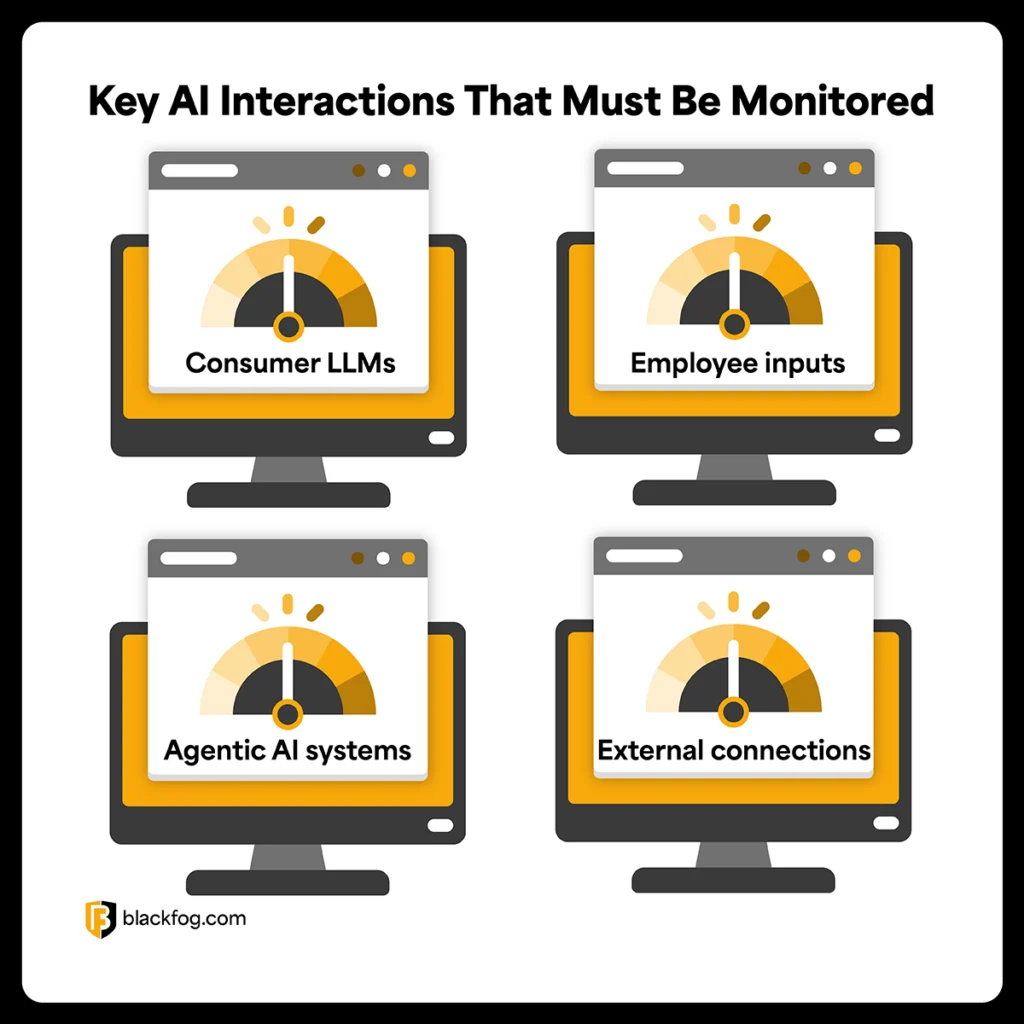
Effective AI monitoring depends on knowing exactly what activity to look for, including platforms and user interactions. A complete picture spans several distinct areas, each requiring its own form of visibility and its own controls. Key elements of enterprise AI use that must be considered in an effective monitoring plan include:
- AI platforms and apps: Track every AI tool in use across the organization, particularly consumer-grade LLMs such as ChatGPT, Gemini, Claude, Copilot and DeepSeek, which employees often access through free personal accounts that sit entirely outside IT oversight and offer weaker data protection.
- User interactions and prompts: Monitor what employees actually submit, watching for sensitive data entering prompts, file uploads containing confidential information and risky usage patterns that signal data is leaving the business.
- AI agents and autonomous systems: Keep visibility over agents that act independently across connected systems, since these can access files, trigger actions and move data with little human oversight once deployed, dramatically widening the potential impact of a single misstep.
- External integrations: Audit how AI tools connect to other applications and services, as unapproved integrations can quietly extend access to sensitive systems and create hidden pathways for data to flow out without anyone noticing.
- Data movement and exfiltration: Watch how information travels to and from AI tools at the endpoint, identifying when sensitive data is being copied, transmitted or exfiltrated before it leaves the organization for good.
How AI Monitoring Helps Detect Shadow AI Activity
AI monitoring works by giving security teams continuous, real-time visibility into activity that would otherwise stay hidden. Rather than relying on employees to self-report, it detects unknown applications and unsanctioned tools as they are used, surfacing shadow AI the moment it appears rather than weeks after the fact.
The most effective approach combines behavior-based and endpoint-level monitoring. By observing activity directly on the device, where prompts are entered and files are uploaded, organizations can see exactly what data is being shared and flag risky patterns in real-time, even when the tool itself is unknown. This catches threats that traditional network or cloud-based monitoring miss entirely.
However, effective AI monitoring has benefits that extend well beyond detecting risky activity. These solutions can also reveal how AI is being used in practice across the business, showing how employees actually engage with the tools and where the real risks lie. This insight allows organizations to move from blanket bans to informed AI governance by developing practical policies that reflect how employees actually work. Ultimately, this allows for the safe adoption of AI at scale.
AI Monitoring And Data Protection: Why Visibility Alone Isn’t Enough
Visibility is the foundation of AI monitoring, but on its own it is not enough. Knowing that sensitive data has reached an AI tool does little good if the exposure has already happened. Effective protection means pairing monitoring with controls that can act the instant a risk appears.
Monitoring Versus Prevention
Many solutions stop at reporting. They log AI activity and flag concerns but leave it to security teams to investigate and respond after the fact. In an environment where many professionals are already stretched for resources, this can enable risky behavior to go unchecked. Prevention goes further, using the intelligence gained to act automatically, blocking or containing risky activity in real-time before it can turn into a breach.
Stopping Data Exposure Before It Happens
The goal is to stop sensitive data leaving the business in the first place. This means deploying solutions that block harmful AI use as it occurs, not simply record it. Combining monitoring with AI data protection and masking solutions lets organizations strip or obscure sensitive information before it reaches an AI model, sharply reducing the risk of exposure through everyday AI interactions.
Building An Effective AI Monitoring Strategy
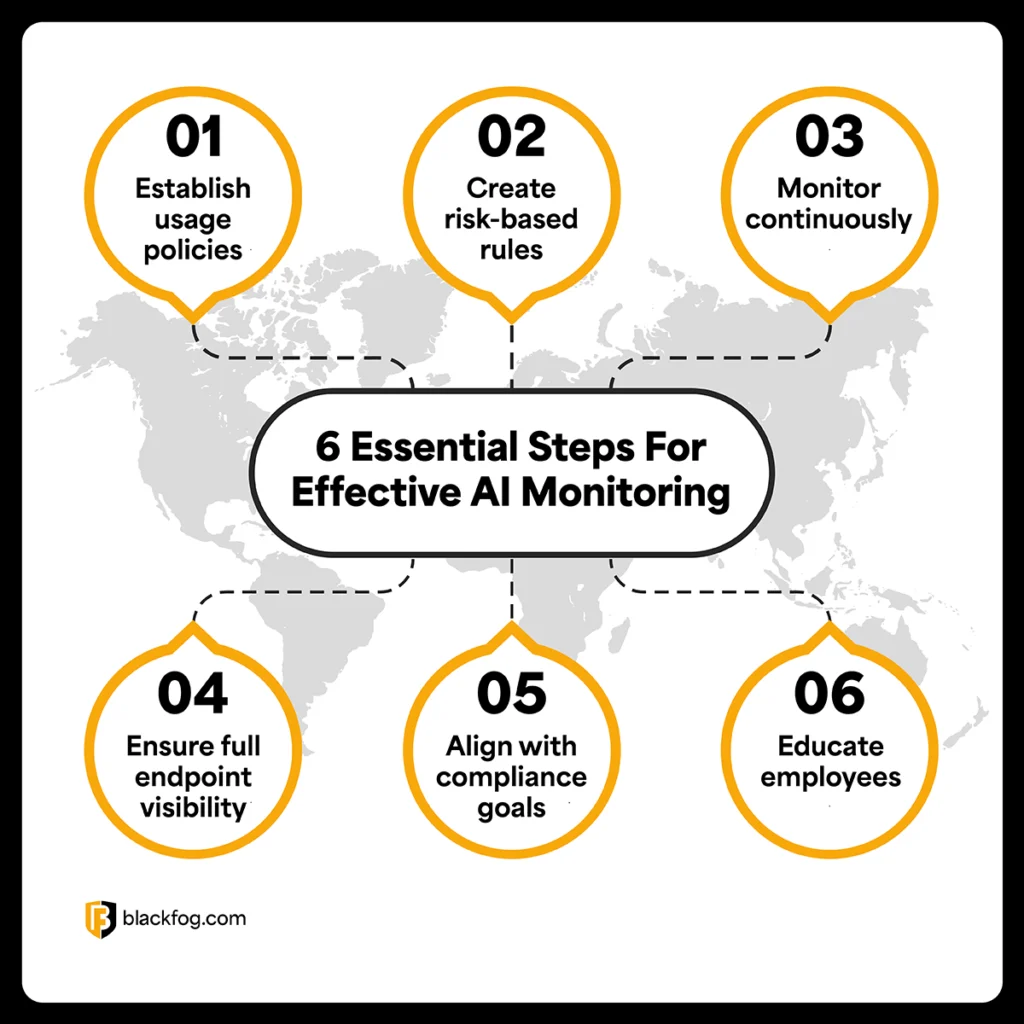
Effective monitoring needs to be treated as a key part of any AI strategy, not an afterthought or something that is only considered once a problem has occurred. Including it in planning from the start means businesses stand the best chance of crafting a mature, secure approach to AI in the enterprise. Practical steps to help organizations ensure lasting visibility and control include:
- Establish AI usage policies: Define clearly which tools are approved, what data can be shared and how AI should be used across the business.
- Create risk-based monitoring rules: Focus oversight where it matters most, applying tighter controls to high-risk activities like uploading sensitive files.
- Monitor continuously: Treat monitoring as an ongoing process rather than a one-off audit, since new tools and behaviors emerge constantly.
- Ensure visibility across all endpoints: Extend monitoring to every device where employees work, as AI use increasingly happens on laptops and personal machines that sit beyond traditional network defenses.
- Align with compliance goals: Map monitoring to the regulations the business must meet, so AI oversight reinforces obligations under frameworks like GDPR and the EU AI Act.
- Educate employees: Help staff understand the risks of unsanctioned AI use, turning policy into practice and reducing shadow AI driven by people simply trying to do their jobs faster.
Why AI Monitoring Will Become A Core Security Function
As AI adoption accelerates, shadow AI is sure to become a more pressing issue. The gap between what employees do with AI and what security teams can see will only widen, in turn increasing the risk of sensitive data slipping beyond the organization’s control. Strong visibility is the first and most essential line of defense.
Yet this alone is only the first step. To be successful in an AI-first world, businesses must opt for approaches that combine monitoring with prevention, so they can spot risks and act on them in real-time. This will become increasingly urgent as the AI landscape shifts.
In the coming years, firms should expect greater use of autonomous agents that make decisions and move data without human input, while at the same time, regulators will demand clearer accountability for how AI is used and employees will grow ever more reliant on these tools in their daily work.
Organizations that treat AI monitoring as a core security function today will therefore be the ones ready to adopt AI safely tomorrow.
AI Monitoring FAQs
What is AI monitoring in cybersecurity?
AI monitoring is the practice of tracking, analyzing and controlling how AI tools are used and how AI models behave across an organization. In cybersecurity, it gives teams visibility into AI activity so they can spot risks and protect sensitive data.
Why is AI monitoring important for businesses?
Employees increasingly use AI tools that handle sensitive data, often without approval. Monitoring gives businesses visibility into this activity, helping prevent data leaks, meet compliance obligations and adopt AI safely rather than banning it outright or losing control entirely.
What is shadow AI and how can organizations detect it?
Shadow AI is the use of AI tools without IT approval, often through personal accounts on consumer platforms. Organizations detect it using endpoint-level monitoring that identifies unknown applications and risky usage as it happens, rather than relying on employees to report it.
What types of AI activity should organizations monitor?
Organizations should monitor the AI platforms and apps in use, user prompts and file uploads, autonomous AI agents, external integrations and how data moves to and from AI tools. Together these reveal where sensitive information is exposed and where risks concentrate.
How does AI monitoring help prevent data leaks?
AI monitoring spots sensitive data entering AI tools in real-time, at the endpoint where it happens. When paired with prevention and masking controls, it can block or obscure that data before it reaches an AI model, stopping leaks rather than just recording them.
What is the difference between AI monitoring and AI governance?
AI monitoring is the technical practice of observing and controlling AI activity in real-time. AI governance is the broader framework of policies, roles and standards that guide how AI is used. Monitoring provides the visibility that makes effective governance possible.
Can AI monitoring help with regulatory compliance?
Yes. Monitoring shows how AI tools handle personal and regulated data, helping organizations meet obligations under frameworks like GDPR, HIPAA and the EU AI Act. It also creates audit trails that demonstrate accountability and support regulatory reporting.
Is AI monitoring only relevant for large enterprises?
No. Businesses of any size use AI tools and face the same risks of data exposure and shadow AI. Smaller organizations are often more exposed, with fewer security resources, making clear visibility into AI activity just as important for them.