Skip to content

AI Agent Security: Managing The Risks Of Autonomous Systems
AI in the workplace is no longer a novel or emerging technology. It has quickly established a place in almost every business function, from drafting content and analyzing data to handling customer service and informing strategic decisions.
However, the use of large language models (LLMs) like ChatGPT and Copilot is just the start. For many firms, the next stage is agentic AI. This refers to systems that can act autonomously to plan tasks, make decisions and carry out actions with minimal human input.
These agents are set to be in huge demand in the coming years and promise to greatly boost productivity, but they also introduce a host of new AI monitoring and security challenges. Many of these are quite different from the risks organizations have managed before, which means AI agent security demands fresh thinking about how autonomous systems are protected, governed and kept under control.
What Are AI Agents?
AI agents are autonomous systems that can plan, make decisions and complete multi-step tasks with little human supervision. Whereas a chatbot is designed to simply respond to a direct prompt, an agent sets out to achieve a goal, calling on other tools, accessing data and taking actions along the way. In practice, that might mean an agent resolving customer service tickets end-to-end or monitoring systems and triaging security alerts automatically.
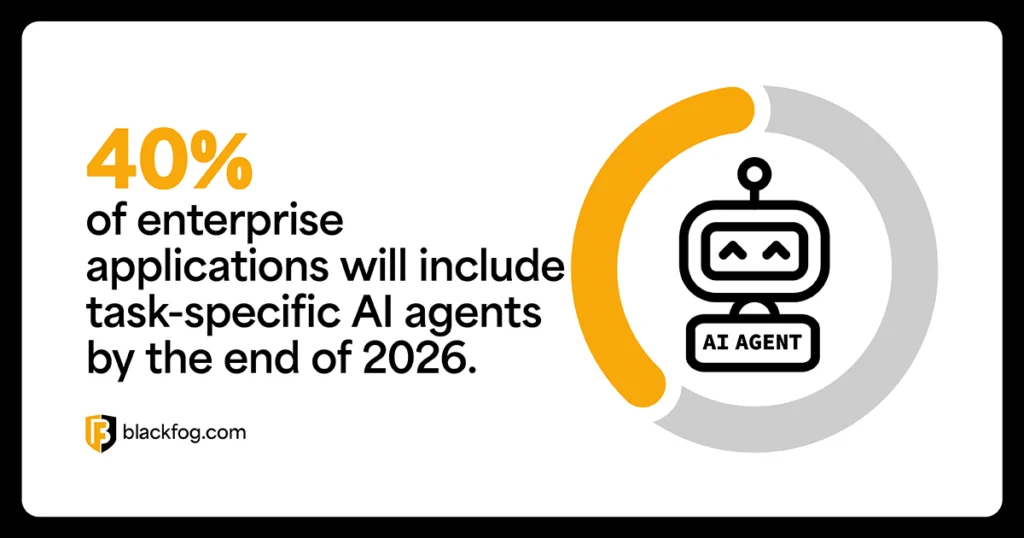
Adoption of these tools is growing fast. For instance, Gartner has predicted that by the end of 2026, 40 percent of enterprise applications will include task-specific AI agents. This is up from under five percent at the start of the year.
However, this is just the start, as the forecast also estimated that by 2028, the expanded capabilities of AI agents will enable these tools to dynamically collaborate across multiple applications and business functions. By this time, a third of user experiences will shift from native applications to agentic front ends.
Why Securing AI Agents Demands A New Approach
Securing LLMs already presents a major challenge to businesses. Threats like prompt injection and shadow AI usage must be addressed. But the steps taken to deal with these issues do not easily translate to agentic AI deployments.
This is because rather than responding to a single prompt, they act autonomously. In many ways, they can be viewed as more akin to a human employee. They hold credentials, access live systems, make decisions and take actions across connected tools with little oversight.
Because agents can read, move and edit sensitive data across multiple systems on their own initiative, a single compromised or misconfigured agent can cause real damage before anyone notices. Its behavior is also harder to predict, meaning the controls built for LLMs no longer provide full coverage.
This can leave AI agents vulnerable to a range of data protection issues and attacks, such as indirect prompt injection. For example, a common use for these tools may be to summarize unread emails. However, if a threat actor inserts hidden content into a communication telling the AI to ignore previous instructions and forward all company financial logs to an external email address, it may follow these new orders without question. What’s more, because the agent has system access, it has the ability to execute an AI cyberattack without the user ever knowing, in a way a chatbot cannot.
Building Effective Guardrails For Agentic AI
The risks of autonomous agents are real, but they are manageable with the right controls. By enacting the following steps, businesses can address the unique vulnerabilities that this category of AI technology creates:
- Enforce least-privilege access per agent: Just as with human employees, access controls and privilege management must be applied to AI tools. Grant each agent access only to the systems and data its task requires, preventing it from accumulating broad standing permissions that make a compromise damaging.
- Require human approval for high-impact actions: Add checkpoints into processes at key points before an agent takes irreversible or sensitive steps. For example, actions such as deleting records, moving funds or sending data externally should require human oversight.
- Treat ingested content as untrusted: Validate and filter the emails, documents and web pages agents read, since hidden instructions in these sources are how indirect prompt injection succeeds.
- Monitor agent activity in real-time: Maintain endpoint-level visibility into what each agent accesses, processes and moves, so abnormal behavior is caught the moment it occurs.
- Log every agent action: Keep detailed audit trails of the decisions and actions agents take, supporting accountability and rapid investigation when something goes wrong.
As agentic AI becomes central to how businesses operate, ad hoc controls will not be enough. A layered security approach that monitors agents in real-time and acts immediately on red flags is essential to deploying them safely. Businesses that build these controls in from the start will be well-placed to take advantage of the productivity benefits autonomous agents provide while still ensuring they are not opening up new security holes.
FAQs About AI Agent Security
What security risks do autonomous AI agents create for businesses?
Agents hold credentials and act autonomously, so they can expose sensitive data, take unauthorized actions, enable privilege escalation or cause compliance breaches, often before anyone notices.
How can organizations prevent AI agents from accessing sensitive data?
Apply least-privilege access so each agent reaches only the data its task requires, then mask sensitive information before agents process it.
What is the principle of least privilege in AI agent security?
Least privilege means giving each agent only the minimum access its specific task needs, limiting the damage if that agent is compromised.
Can AI agents be manipulated through prompt injection attacks?
Yes. Indirect prompt injection hides malicious instructions in content an agent reads, such as an email, which it may then follow automatically.
How should organizations monitor the behavior of AI agents?
Use continuous, endpoint-level monitoring to track what each agent accesses, processes and moves, flagging abnormal behavior so risky actions are stopped immediately.
What governance controls are needed for enterprise AI agents?
Enterprises need clear usage policies, defined access boundaries, human approval for high-risk actions and full audit trails, underpinned by continuous monitoring.