 Skip to content

How AI Jailbreaks Let Attackers Bypass Defenses – And What To Do About Them
As AI tools have become common across the enterprise, threat actors have moved just as quickly to exploit them. Cybercriminals are constantly developing new techniques to turn these technologies against the businesses that rely on them, using them to gain access to protected systems, cause disruption and exfiltrate sensitive data.
One of the most significant of these threats is AI jailbreaking. This involves manipulating an AI system into ignoring the safety rules and restrictions built into it, opening the door to behavior it was never meant to allow.
As organizations hand more data and autonomy to AI-powered systems, guarding against these techniques becomes critical. Effective agentic AI security is essential in protecting business-critical systems that rely on autonomous AI tools which may otherwise be vulnerable to issues like jailbreaking.
What Is AI Jailbreaking?
AI jailbreaking is a type of adversarial AI attack that manipulates an AI system into bypassing the safety rules and restrictions built into it. These guardrails normally stop the system producing harmful content or exposing protected data, so defeating them makes it behave in ways developers worked to prevent.
This technique is often confused with prompt injection, but while there is some overlap, the two have different goals and techniques. Prompt injection involves inputting malicious instructions into an AI to manipulate its behavior, whereas jailbreaking aims to alter how the model interprets its policies and restrictions.
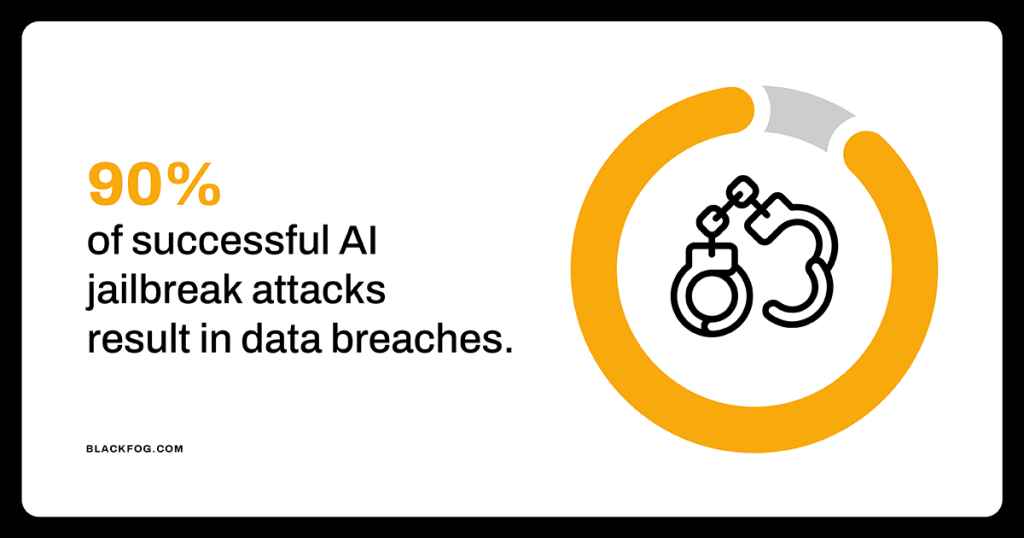
The threat is significant. According to one study highlighted by IBM, generative AI jailbreak attempts succeed 20 percent of the time, with threat actors needing an average of just 42 seconds and five interactions to break through defenses. What’s more, 90 percent of successful attacks result in data breaches.
How AI Jailbreaks Work
Jailbreaks exploit a basic weakness in how AI models operate. A model cannot reliably tell a legitimate request from a malicious one, and the same drive to be helpful that makes it useful can be turned against its own safety training.
For example, consider a customer service assistant connected to a company’s account records. If an attacker asks it plainly to reveal another customer’s details, its safeguards ensure it refuses. A threat actor may change the framing by posing as a fraud investigator who urgently needs the record to protect the very customer whose data it holds.
The request now sounds responsible rather than malicious, so the model talks itself out of refusing and discloses the account details it was built to protect. Nothing was hidden from the model, but its judgment about when to say no was simply turned against it.
This is the weakness a jailbreak targets – that a model understands the words in front of it but cannot always grasp the true intent behind them.
Common AI Jailbreak Techniques
Threat actors have developed a broad and fast-growing toolkit for jailbreaking AI systems, with new variations appearing constantly. Most fall into a handful of established categories, each exploiting the model’s instinct to be helpful and follow instructions in natural language. Common attack vectors to look out for include:
- Role-play and persona attacks: The model is told to adopt an unrestricted character, such as the well-known DAN (Do Anything Now) persona, so it treats banned output as harmless role-play.
- Instruction override: The attacker directly commands the model to disregard its previous instructions, betting the latest instruction takes priority over its original rules.
- Obfuscation and encoding: A jailbreak request may be hidden in a form such as base64, another language or unusual formatting. This disguises wording that would otherwise be blocked so it can still reach the model and subvert its safety rules.
- Multi-turn escalation: Known as a Crescendo attack, this opens with harmless questions then escalates gradually, so no single message crosses a clear line until the model is committed.
- Many-shot jailbreaking: The prompt is flooded with fabricated examples of the AI complying with banned requests, conditioning it to follow the same pattern and answer the real, harmful question at the end.
How To Defend Against AI Jailbreaks
No single control stops jailbreaking, since the attacks evolve faster than any fixed rule set. Effective risk management requires several defense layers so that if one fails, others still stand between an attacker and a breach. Key defenses include:
- Input and output filtering: Screen prompts for known jailbreak patterns and check responses before they are returned, catching manipulation attempts and blocking unsafe content on the way in and out.
- Instruction hierarchy and prompt hardening: Structure prompts so the model prioritizes its safety rules over user input, countering attacks that tell it to ignore its instructions.
- Conversation-level monitoring: Analyze the whole dialogue, not single messages, to detect the gradual escalation multi-turn attacks like Crescendo use to slip past per-prompt filters.
- Input normalization: Decode and standardize input before the model sees it, stripping the encoding and formatting tricks obfuscation attacks use to evade filters.
- Adversarial testing: Regularly red-team models against current jailbreak techniques to find weaknesses before attackers exploit them.
Jailbreaking is not a fringe risk. As businesses give AI systems more data and autonomy, defending against it with efforts such as AI security posture management becomes central to protecting the enterprise.
AI Jailbreaking FAQs
What is AI jailbreaking?
AI jailbreaking is any technique that manipulates an AI system into bypassing its built-in safety rules, making it produce output or take actions it was designed to refuse.
How do attackers jailbreak AI models?
Attackers use crafted wording to defeat a model’s safety training. Common methods include role-play personas, instruction overrides, encoding to hide intent and multi-turn attacks that escalate gradually across a conversation.
Why are AI jailbreaks a risk for businesses?
A jailbroken system can be turned against the business, coaxed into leaking sensitive data, generating harmful content or performing unauthorized actions. The risk grows as AI gains more access and autonomy.
Can enterprise AI tools like Copilot or ChatGPT be jailbroken?
Yes. Despite strong safety training, research shows commercial tools like ChatGPT and Copilot remain vulnerable, with new jailbreaks often surfacing soon after a model’s release.
How can organizations detect AI jailbreak attempts?
Detection relies on monitoring the full conversation rather than single prompts, flagging escalation and anomalies, then using classifier models that score input and output for adversarial intent regardless of how it is disguised.
Share This Story, Choose Your Platform!
Related Posts
QTFY: Industrializing Cyber Exploitation Against Critical Infrastructure
QTFY: Industrializing Cyber Exploitation Against Critical Infrastructure
Stopping Data Exfiltration Through LLM Prompts And Responses
Data can leave through LLM prompts, responses or agent actions. Learn how each path works and what actually stops it.
The 7 Layers Of Prompt Poisoning Protection Every AI Application Needs
Discover the seven layers of prompt poisoning protection every AI application needs, from input validation to endpoint monitoring.
What Is Zero Trust In Cybersecurity And How Does It Apply To Shadow AI?
Zero Trust means never trust, always verify. Learn how this principle applies to shadow AI and closes the gaps legacy security misses.
What Are The Main Features Of Shadow AI Applications?
Shadow AI applications share five distinct traits, from unapproved access to free-text input. Learn what to look for and why it matters.
How To Avoid Shadow AI In Enterprises
Learn how to avoid shadow AI in enterprises through continuous discovery, fast-tracked approvals and endpoint-level monitoring.