 Skip to content

What Enterprises Need To Know To Defend Against Adversarial AI Attacks
Adversarial AI has become one of the fastest-growing threats facing modern businesses. As organizations embed models, assistants and autonomous agents deeper into their operations, this presents attackers with a new set of targets that can be manipulated against the businesses that rely on them.
Firms that fail to defend this growing AI footprint face serious consequences. A successful attack can trigger a major data breach, erode customer trust or cause critical systems to produce unexpected and inaccurate outcomes the business then acts on.
What’s more, conventional cybersecurity was not built with AI in mind. Legacy tools often cannot see or stop threats aimed at AI models, so defending against adversarial AI attacks demands a new, more focused approach, tailored to the way these systems work.
What Are Adversarial AI Attacks?
Adversarial AI attacks are threats that aim to take advantage of the way AI models process information. When directed at enterprise AI deployments, these look to alter how a system behaves in ways that benefit the attacker. Rather than breaking into infrastructure, they target the model itself. Common goals include:
- Producing incorrect, harmful or attacker-chosen outputs
- Extracting sensitive or proprietary data from the model
- Driving autonomous agents to take unauthorized actions
- Degrading the reliability of systems the business depends on
What sets these apart from traditional cyberattacks is the target. Conventional methods exploit flaws in networks, endpoints or code, whereas adversarial AI attacks take advantage of how a model processes input, learns and makes decisions without human input.
Any form of AI can be targeted this way, from customer-facing chatbots to autonomous agents acting across critical systems. That breadth is why dedicated protections such as agentic AI security are now essential.
How AI Deployments Become Attack Surfaces
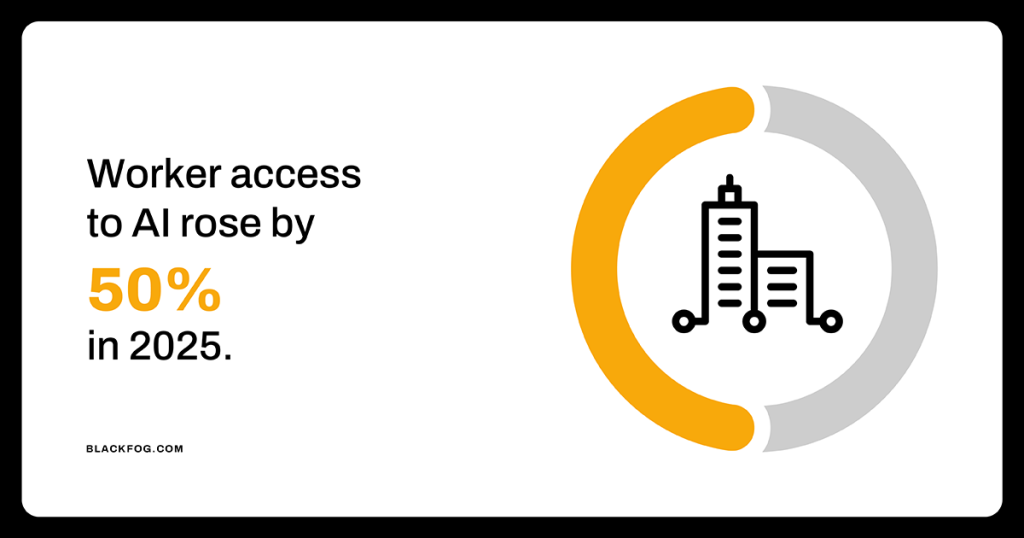
AI deployments are multiplying rapidly across the enterprise. Research from Deloitte has found that worker access to AI rose by 50 percent in 2025, with production deployments accelerating sharply. Agentic AI is expected to have its greatest impact in customer support, alongside supply chain management, knowledge management and R&D.
To deliver that value, these systems reach deep into internal databases, applications and sensitive records across the business, often with broad permissions and little oversight. Every connection is a potential way in for an attacker.
The risk is greatest with shadow AI: tools adopted without approval that quietly ingest confidential data outside the security team’s view, widening the attack surface to places no one is watching.
Common Adversarial AI Attack Methods
Adversarial AI covers a broad and evolving range of techniques, but most attacks fall into a handful of well-documented categories. Some target a model at the point of use by feeding it malicious input. Others corrupt it earlier during training or probe it to steal the data it holds. The most important methods to understand include:
- Direct prompt injection: An attacker types malicious instructions straight into the prompt, overriding the model’s intended task and making it follow their commands.
- Indirect prompt injection: Malicious instructions are hidden in external content the AI reads, such as a web page or email, so it acts on commands the user never issued.
- Jailbreaking: Crafted wording defeats the model’s built-in safety rules, talking it into producing output or taking actions it would normally refuse.
- Data poisoning: Attackers corrupt the training or fine-tuning data so the model learns flawed or attacker-controlled behavior that surfaces once it is deployed.
- Model extraction and inversion: Repeated queries are used to reconstruct a model’s inner workings or extract the sensitive data it was trained on.
The Business Impact Of Adversarial AI Attacks
The more businesses rely on AI for decision-making, the greater the consequences of a successful attack may be. Increased automation offers the promise of greater productivity, but it also means more opportunities for attackers to expose data or disrupt operations. The most serious outcomes include:
- Data breaches: Extraction or inversion attacks expose sensitive customer records, proprietary data or the information a model was trained on.
- Incorrect outcomes: Poisoned or manipulated models produce flawed results that the business acts on, from bad decisions to failed fraud checks.
- Operational disruption: A compromised agent takes harmful actions across connected systems, such as deleting records, sending payments or halting a business-critical process.
- Compliance failures: An AI that leaks regulated data or behaves improperly can breach data protection and industry rules, bringing fines and legal exposure.
- Reputational damage: Public AI failures erode the customer trust a business depends on.
The Importance Of Effective AI Risk Management
Adversarial attacks turn a business’ own AI against it. This exposure only grows as models take on more data and autonomy. To prevent this, effective AI risk management is required, which takes a clear, focused approach that reflects the way AI actually works.
There are several steps that must be taken to achieve this. Firstly, AI security posture management gives continuous visibility into every model and agent and how secure each one is. Agentic AI security protects autonomous systems from manipulation and misuse as they act across the business. Tackling shadow AI brings unsanctioned tools into view before they can quietly leak sensitive data.
Together, these measures let businesses adopt AI with confidence rather than blind faith. Without them, the danger is not just that attacks succeed, but that they go unnoticed. An organization with no visibility into its AI estate may not discover it has been compromised until the damage is already done.
Adversarial AI Attack FAQs
What are adversarial attacks in AI?
Adversarial attacks are deliberate attempts to make an AI system behave incorrectly by exploiting how it processes input, learns or reasons. Rather than targeting infrastructure, they target the model itself.
How can adversarial AI attacks be defended against?
Defense means protecting the AI layer directly, through adversarial testing, input validation, training data integrity checks, restricted model access and continuous monitoring, backed by controls that limit the damage if a model is compromised.
What is the concept of adversarial attacks in generative AI?
In generative AI, adversarial attacks manipulate a model into producing harmful, false or restricted output. Techniques such as prompt injection and jailbreaking exploit the model’s tendency to follow instructions in natural language.
Why is continuous AI monitoring important for AI security?
Because AI acts autonomously and at speed, threats can unfold before anyone notices. Continuous monitoring detects manipulation, anomalies and data movement in real-time, catching attacks that periodic checks would miss.
How do adversarial attacks impact enterprise AI applications?
They can trigger data breaches, corrupt the outputs a business relies on, drive agents into harmful actions and cause compliance failures, with impact growing as AI gains access and autonomy.
Share This Story, Choose Your Platform!
Related Posts
QTFY: Industrializing Cyber Exploitation Against Critical Infrastructure
QTFY: Industrializing Cyber Exploitation Against Critical Infrastructure
Stopping Data Exfiltration Through LLM Prompts And Responses
Data can leave through LLM prompts, responses or agent actions. Learn how each path works and what actually stops it.
The 7 Layers Of Prompt Poisoning Protection Every AI Application Needs
Discover the seven layers of prompt poisoning protection every AI application needs, from input validation to endpoint monitoring.
What Is Zero Trust In Cybersecurity And How Does It Apply To Shadow AI?
Zero Trust means never trust, always verify. Learn how this principle applies to shadow AI and closes the gaps legacy security misses.
What Are The Main Features Of Shadow AI Applications?
Shadow AI applications share five distinct traits, from unapproved access to free-text input. Learn what to look for and why it matters.

How To Avoid Shadow AI In Enterprises
Learn how to avoid shadow AI in enterprises through continuous discovery, fast-tracked approvals and endpoint-level monitoring.