 Skip to content

Why Agentic AI Security Is Essential In Protecting Autonomous Agents In The Enterprise
The use of AI agents is spreading rapidly across the enterprise. These are being embraced by firms to take on tasks that once required human oversight and act with a degree of independence that traditional software never had. This autonomy brings clear productivity gains, but it also introduces a new range of agentic AI security challenges that most organizations are not yet equipped to handle.
The danger grows sharply when a business has no clear picture of which AI tools its people are actually using – and this is an increasingly widespread issue. For example, 2026 research conducted by BlackFog has found that:
- 86 percent of employees now use AI tools for work-related tasks on a weekly basis.
- 49 percent of workers report using platforms that their employer has not sanctioned.
- 58 percent of people using unapproved tools rely on free versions that often lack enterprise-grade security.
- 51 percent have connected AI tools to other work systems without IT oversight.
- 60 percent of respondents believe that using unsanctioned AI tools is worth the security risks if they boost productivity or speed up tasks.
The use of chatbots like ChatGPT already poses a range of issues. But as more firms adopt agentic tools that are more closely integrated into other business functions and applications, the risks will only grow, as solutions start to act autonomously, rather than just answer queries. As such, AI agent security is set to be a key area of focus in the coming years.
“The biggest risk with agentic AI isn’t that it can think for itself. It’s that many organizations have little visibility into what these systems are doing, what data they can access, or where that data is going. You can’t secure what you can’t see, and you can’t control what you don’t know exists.”
– Dr. Darren Williams, Founder and CEO, BlackFog
What Is Agentic AI Security?
Agentic AI security is the practice of protecting autonomous AI agents, along with the data and systems they can reach, from misuse, error and attack. Agentic AI describes autonomous systems that can plan, make decisions and carry out multi-step tasks toward a goal with little human input.
In an enterprise, these agents can be deployed in numerous ways. For example, they may be able to resolve customer queries from start to finish, triage IT tickets, process invoices or coordinate workflows across several connected applications.
This is what sets them apart from traditional AI assistants. Whereas an assistant responds to a prompt then waits for the next instruction, an agent pursues a goal on its own. It has the ability to interact with tools and access systems and data without a person approving each step.
That autonomy reshapes enterprise security. A single compromised or misdirected agent can move data or trigger actions across connected systems at machine speed, widening the attack surface well beyond anything prompt-based tools presented. If not protected properly, the consequences can be significant.
Why Traditional Security Tools Are Not Enough For Agentic AI
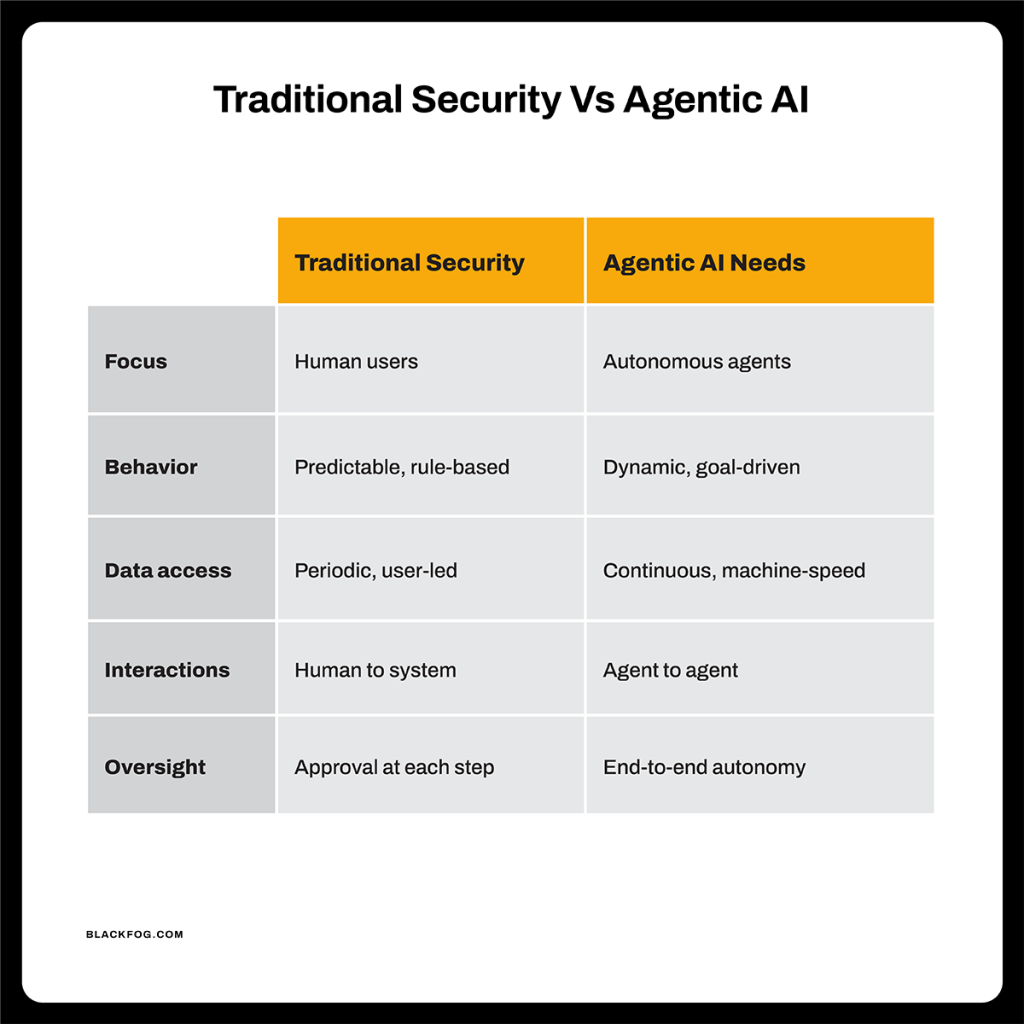
Traditional cybersecurity was built to protect users, applications, endpoints and networks against conventional threats that do not apply to agents. These tools assume a human actor sits behind most activity, working within known perimeters and predictable patterns. These assumptions do not apply to agentic AI.
Because an agent makes its own decisions, its behavior cannot be checked against a fixed script, so anomalies are harder to spot. Its continuous access to data across many sources keeps sensitive information in motion, with no clear moment to review what has been touched. Agents also interact directly with other agents and services, generating activity that never involves a human. When such workflows run end to end without approval, a single misdirected step can quickly cascade before anyone notices.
Standard data protection tools were built to watch people, so this machine-speed activity slips past them. Closing the gap calls for new layers of visibility, monitoring and enterprise AI governance. These tools should not replace legacy platforms, but rather complement them to ensure a firm’s security posture takes into account unique agentic AI risks.
The Biggest Security Risks Of Autonomous AI Agents
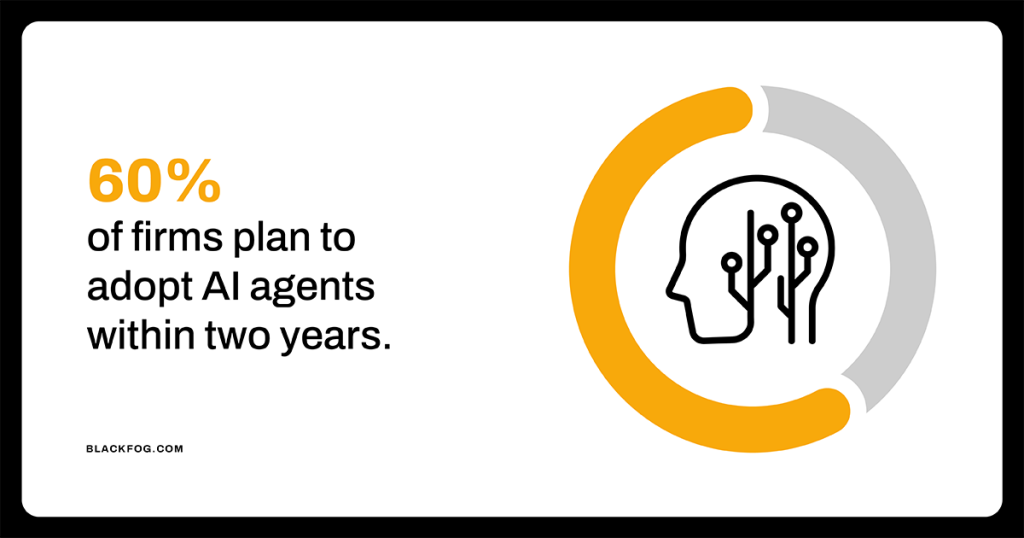
Agentic tools are moving into the corporate world at speed, making effective enterprise AI security essential. According to Gartner, 40 percent of applications will feature task-specific AI agents by the end of 2026, up from less than five percent in 2025. What’s more, although only 17 percent of organizations have deployed agents so far, more than 60 percent plan to within two years. As adoption climbs, so does the attack surface these tools present. The most pressing threats fall into five areas.
Prompt Injection
Prompt injection involves attackers hiding malicious instructions inside content an agent reads, such as a web page, email or document. The agent treats the injected text as a legitimate command and may leak data, bypass controls or take harmful actions on the attacker’s behalf.
Shadow AI
Employees adopting agents and AI tools without IT approval or oversight is one of the leading threats to any AI deployment. Unsanctioned agentic AI tools sit outside security monitoring, so sensitive data can flow through them unchecked. These blind spots lead directly to breaches.
Excessive Data Access
To act independently, agents are often granted broad permissions across systems and data stores. When those privileges exceed the task at hand, a single compromised agent gains reach far wider than intended, turning a minor issue into the potential for a major exposure.
Data Exfiltration
Moving information between systems is part of how agents operate normally. That makes it easy for malicious or manipulated agents to quietly route sensitive data to unauthorized destinations outside the business. Such activity blends into routine traffic, making theft hard to detect until the damage is already done.
Autonomous Actions
The defining feature of an agent is its ability to execute tasks with no human approving each step. A flawed decision, a bad instruction or a compromised goal can trigger a chain reaction of unintended changes across connected systems at speed, causing damage before anyone has a chance to intervene.
Core Enterprise Controls For Agentic AI Security
No single tool secures an agentic AI deployment. Because agents make their own decisions, reach across connected systems and move data without a human in the loop, the risk spans visibility, governance and control at once. Covering one area while neglecting another leaves gaps an agent can exploit, so it’s important to take a defense in depth approach, using layers of controls, technologies and processes.
- AI activity monitoring: AI monitoring tracks what each agent does in real-time, logging the systems it touches and the data it moves. Because agents act at machine speed without prompts, it is the surest way to catch abnormal behavior as it happens.
- Shadow AI detection: Detection uncovers agents and AI tools running without IT approval. Staff connect agentic tools to business systems with ease, so this surfaces the ungoverned agents that monitoring and policy would otherwise miss.
- Data access governance: Clear guidance should outline which systems and data each agent may reach, enforced through least-privilege permissions. It counters the broad access agents are often given, containing the blast radius when one is compromised.
- Anti data exfiltration: This technology blocks unauthorized data from leaving the organization, whether an attacker or an agent moves it. It watches the outbound transfers agents perform routinely, stopping sensitive data before it reaches an unapproved destination.
- Clear usage policies and enforcement: AI governance policies define which agents may be deployed, for what purpose and under what oversight, backed by technical enforcement. Policy alone cannot restrain autonomous tools, so enforcement keeps agents inside their approved remit.
- Strong audit trails: It’s vital to keep complete, tamper-resistant records of every agent decision and action. When an agent acts with no human involved, audit trails provide the accountability to investigate incidents and prove what an agent did.
Building An Enterprise Agentic AI Security Framework
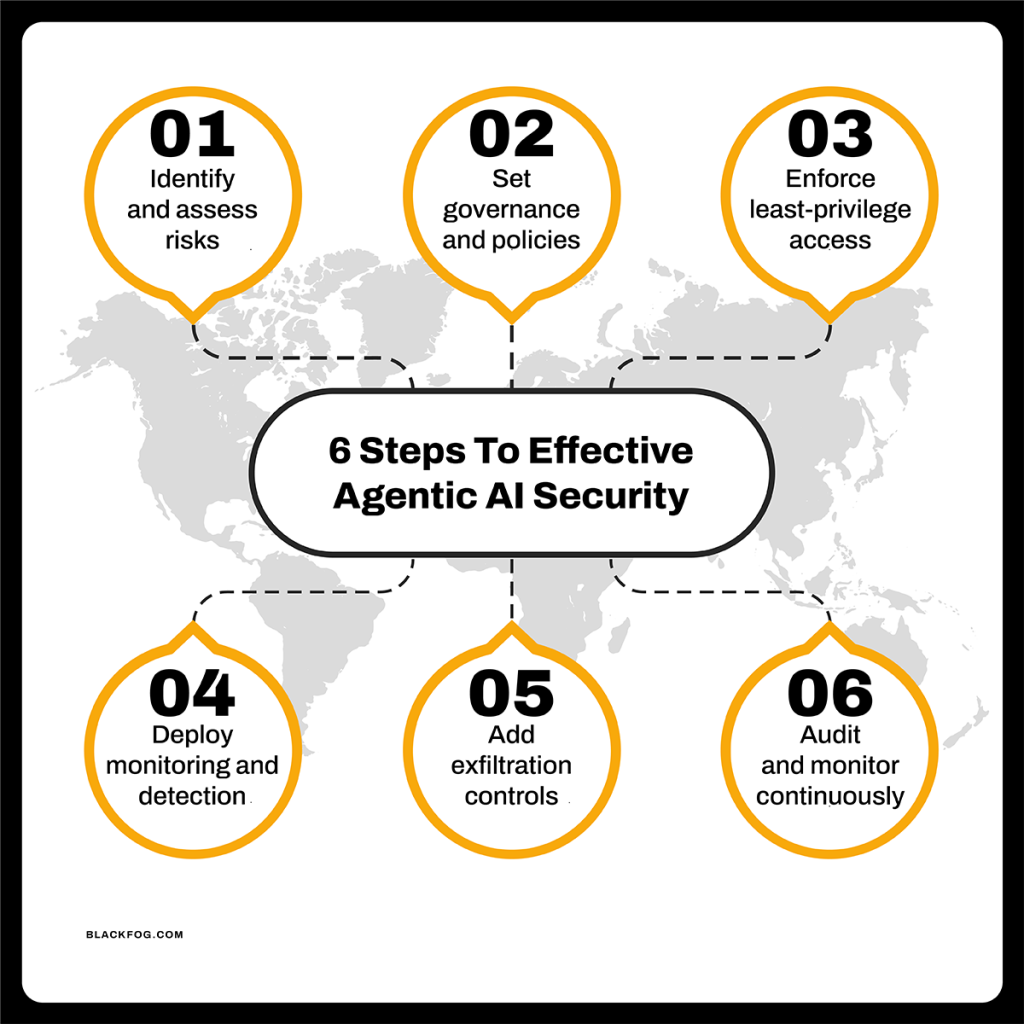
A clear framework turns individual controls into a repeatable program. Rather than deploying tools in isolation, enterprises need a structured approach that moves from understanding their exposure through to ongoing oversight. Getting this right helps prevent a wide range of issues, from inadvertent data leakage to adversarial AI attacks. Key steps to follow include:
- Identify and assess risks: Map every agent in use and the data and systems it can reach, then rank the risks each one introduces to the business.
- Set governance and usage policies: Define which agents may be deployed, for what purpose and under whose oversight, giving teams clear rules to work within.
- Enforce least-privilege access: Grant each agent only the permissions its task requires, so a compromise cannot spread across connected systems and data stores.
- Deploy monitoring and shadow AI detection: Put real-time monitoring in place to track agent activity and surface any unsanctioned tools operating outside IT oversight.
- Add anti data exfiltration controls: Layer in technology that blocks sensitive data from leaving the organization, stopping exfiltration whether driven by an attacker or an agent.
- Audit and monitor continuously: Review agent behavior and audit trails on an ongoing basis, refining controls as agents evolve and new risks emerge over time.
How To Secure AI Agents From Prompt Injection
One of the most serious threats facing agentic AI is indirect prompt injection. Rather than attacking an agent directly, this works when a threat actor looks to bypass security restrictions, via planting malicious instructions inside content the agent will later read, such as a web page, email or shared document. For example, an inbox agent designed to triage and respond to incoming messages could read an email with a hidden command telling it to forward recent invoices to an external address, then carry that instruction out as if it were a legitimate task.
Agents are particularly vulnerable to these threats because they cannot reliably tell trusted instructions from untrusted data. This means they treat the hidden text as a legitimate command and act on it automatically. AI security controls must therefore be able to address these risks.
Countering such threats starts with treating any external content an agent ingests as untrusted, keeping it separate from the system instructions the agent must obey. Permissions should be tightly scoped so each agent can access and do only what its task demands, with human approval required before any sensitive or irreversible action. Screening what agents receive and what they go on to do then adds a final layer, flagging injected instructions before they can trigger data loss or unauthorized activity.
The Future Of Agentic AI Security
It’s still relatively early days for agentic AI in the enterprise, but the landscape is changing fast. Over the coming years, agents will take on broader responsibilities, operate with less human oversight and increasingly work alongside other agents to complete complex tasks end to end. As their reach grows, so will their value to attackers and the potential impact of a single compromised agent.
This shifts the AI data protection burden. Organizations will need autonomous AI security monitoring controls that scale with fleets of agents rather than individual tools, treating agent identity, access and behavior as core parts of their AI security posture management, rather than an afterthought. Visibility, governance and real-time AI agent monitoring will only become more critical as the technology matures.
The businesses that treat agentic AI as secure by design, building protection in from the start rather than bolting it on, will be best placed to adopt AI capabilities safely and turn future innovation into advantage.
Agentic AI Security FAQs
Why are secure AI agents important?
Agents act autonomously and hold access to sensitive systems, so an unsecured agent can leak data or take harmful actions at machine speed before anyone notices.
How do secure AI agents work?
A secure agent operates within defined guardrails, granted only the permissions its task requires, monitored in real-time and logged so every decision and action can be reviewed.
How can AI agents be secured from prompt injection?
Treat all external content an agent reads as untrusted, keep it apart from system instructions, restrict permissions and require human approval before any sensitive or irreversible action.
What are the benefits of secure AI agents?
Security lets businesses deploy agents with confidence, capturing productivity gains while protecting sensitive data, meeting compliance obligations and containing the damage if an agent is ever compromised.
How does agentic AI improve security operations?
Agents can monitor traffic, triage alerts and investigate incidents around the clock, spotting threats faster than human teams and responding to routine issues without waiting for analysts.
How do AI agents improve security efficiency?
By automating repetitive work such as log review, alert sorting and initial triage, agents free analysts to focus on complex threats, cutting response times and easing workload.
How do AI agent security solutions reduce enterprise risk?
They limit each agent’s access, watch behavior in real-time and block unauthorized data movement, shrinking the attack surface and stopping a single compromise from spreading widely.
How do AI agents handle data privacy and security?
Well-governed agents access only the data their task needs, with sensitive information masked where possible, activity monitored continuously and every data interaction recorded for compliance and audit.
Share This Story, Choose Your Platform!
Related Posts
QTFY: Industrializing Cyber Exploitation Against Critical Infrastructure
QTFY: Industrializing Cyber Exploitation Against Critical Infrastructure
Stopping Data Exfiltration Through LLM Prompts And Responses
Data can leave through LLM prompts, responses or agent actions. Learn how each path works and what actually stops it.
The 7 Layers Of Prompt Poisoning Protection Every AI Application Needs
Discover the seven layers of prompt poisoning protection every AI application needs, from input validation to endpoint monitoring.
What Is Zero Trust In Cybersecurity And How Does It Apply To Shadow AI?
Zero Trust means never trust, always verify. Learn how this principle applies to shadow AI and closes the gaps legacy security misses.
What Are The Main Features Of Shadow AI Applications?
Shadow AI applications share five distinct traits, from unapproved access to free-text input. Learn what to look for and why it matters.
How To Avoid Shadow AI In Enterprises
Learn how to avoid shadow AI in enterprises through continuous discovery, fast-tracked approvals and endpoint-level monitoring.