Skip to content

AI Cyberattacks: How Hackers Are Breaching Defenses
AI is enhancing cybercrime by enabling threat actors to improve phishing campaigns, develop malware, identify vulnerabilities and steal sensitive data. These AI cyberattacks use artificial intelligence to automate, enhance or accelerate malicious activity.
For organizations, the greatest concern is that AI enables threat actors to locate, access and exfiltrate sensitive data faster than ever before, increasing the potential impact of a successful breach.
What Is An AI Cyberattack?
An AI cyberattack uses AI, machine learning or generative AI to breach secure systems. AI can assist with reconnaissance, phishing, credential theft, malware development and data exfiltration.
Rather than replacing traditional attack methods, AI enhances them by automating tasks, analyzing large amounts of information and improving efficiency. This allows threat actors to move more quickly from initial access to data theft, making AI-powered attacks a growing concern for organizations.
The Rise of AI-Driven Cybercrime
The rapid adoption of generative AI has created new opportunities for threat actors. AI tools can automate research, generate convincing content and analyze large datasets in seconds.
According to ENISA’s Threat Landscape 2025 report, AI-supported phishing and social engineering continue to increase as threat actors adopt generative AI technologies. Verizon’s 2025 Data Breach Investigations Report analyzed more than 22,000 security incidents and over 12,000 confirmed breaches.
As AI capabilities continue to evolve, organizations must prepare for increasingly sophisticated threats designed to gain access to sensitive data.
How AI Is Powering the Next Generation of Cyberattacks
Threat actors are using AI throughout the cyberattack lifecycle, from identifying targets to stealing sensitive data. Common examples include:
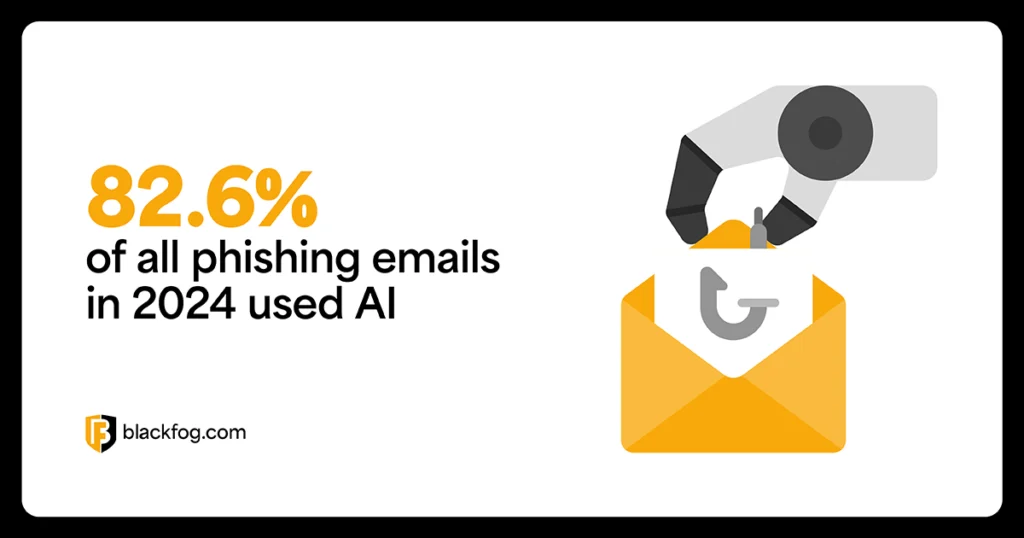
- Phishing automation: AI can generate phishing emails that mimic the tone, structure and language of legitimate business communication to create highly personalized, convincing messaging. According to KnowBe4, 82.6 percent of all phishing emails in 2024 used AI in some capacity.
- Malware creation and evasion: AI can help design malware that adapts to avoid detection by signature-based antivirus tools. It can also automatically change its code, use obfuscation techniques or simulate normal user behavior to bypass endpoint protection.
- Social engineering at scale: Tools that analyze social media, public records and leaked data can craft highly tailored scams. This includes creating dialogue for phone- or chat-based scams, impersonating executives to trick employees into giving hackers access to systems, or even handing over data directly.
- AI deepfake attacks: Threat actors can use realistic audio and video impersonations to trick employees into sharing information, approving transactions or granting access.
- Ransomware optimization: AI allows attackers to identify system vulnerabilities and determine the most disruptive time to launch encryption. It can also craft customized ransom messages that use company-specific language or data to appear more credible. This makes ransomware more effective, increases pressure on victims and improves the chance of payment.
- Credential theft and automated exploitation: AI can support credential theft by generating realistic login pages, identifying likely usernames and helping threat actors move more efficiently through compromised environments.
- AI data exfiltration attacks: AI can help identify valuable information, prioritize sensitive files and facilitate data exfiltration, allowing threat actors to focus on the data that matters most.
Why AI Cyberattacks Are More Dangerous Than Traditional Attacks
Many AI cyberattacks rely on familiar techniques, including phishing, malware and credential theft. The difference is that AI enhances these attacks in several ways:
- Greater speed: AI automates research, content generation and attack preparation, reducing the time needed to launch campaigns.
- Increased scale: Threat actors can generate large volumes of phishing emails, fake websites and malware variants with minimal effort.
- Personalization at scale: AI enables highly targeted communications that appear more legitimate and relevant to recipients.
- Lower barrier to entry: Less experienced threat actors can use AI tools to improve the sophistication of their attacks.
- Ability to adapt: AI helps threat actors test and refine tactics quickly, making attacks more flexible and effective.
Adversarial Attacks on AI Systems
As more businesses adopt AI models to drive decisions, they also face a new class of threats: adversarial attacks. These involve manipulating the inputs to AI systems to trick them into making incorrect or harmful decisions. For example, attackers might feed altered data into a machine learning model to evade detection, confuse classification algorithms or even extract sensitive training data.
Techniques like model inversion, data poisoning and prompt injection allow threat actors to reverse-engineer AI behavior, insert malicious data or trick it into revealing sensitive information. This poses serious risks in areas like fraud detection, content moderation and cybersecurity automation, where decisions must be fast and accurate.
Without proper controls, adversarial attacks can compromise business operations, corrupt decision-making or expose sensitive data. This makes it essential for organizations to secure both the data and the AI models they rely on.
Warning Signs of an AI-Powered Cyberattack
AI-powered attacks are often more subtle and convincing than traditional cyberthreats. Because they use automation and personalization, they can bypass standard detection tools and appear entirely legitimate on the surface.
However, there are early indicators that suggest something is wrong. Businesses should watch for the following red flags that can indicate an AI-powered cyberthreat:
- Sudden surge in targeted phishing attempts: If employees begin receiving a higher volume of realistic, well-written phishing emails or text messages, this may be the result of AI-generated content. These attacks often mimic company language and internal references, making them harder to spot.
- Unusual system behavior or errors: Unexpected performance issues or strange outputs from applications, especially AI-powered tools, could indicate prompt injection, data poisoning or system manipulation by attackers probing for weaknesses.
- Access to sensitive data from unfamiliar locations: Unexplained attempts to retrieve confidential files or databases from new IP addresses or user accounts could signal account compromise or AI-assisted credential attacks.
- Anomalous network activity: AI tools can disguise exfiltration traffic or mimic regular behavior to avoid standard monitoring tools, but there can still be telltale signs that advanced AI-based detection methods can spot.
- Suspicious voice or video communications: Deepfake audio or video content used to impersonate executives, especially in time-sensitive requests, is an emerging tactic. If a communication seems slightly off, it could be synthetically generated.
- Multiple failed login attempts or strange account activity: Automated login attempts from AI scripts can overwhelm systems or guess credentials. If this is followed by successful logins under unusual circumstances, it may indicate an active intrusion.
AI has changed the way cyberattacks are planned and executed, giving attackers new tools to launch faster, more targeted and more convincing campaigns. Whether it is phishing, malware or data exfiltration, these threats are growing harder to spot with traditional security tools.
To stay protected, businesses must adopt advanced, behavior-based detection technology that can identify unusual activity in real-time and stop attacks before damage is done. Understanding how AI is being used by cybercriminals is no longer optional. It is essential.
The Importance Of AI Monitoring
AI monitoring helps organizations identify unauthorized AI usage, risky data sharing and suspicious activity involving AI tools. It also supports AI governance by providing visibility into how AI applications interact with corporate data.
Combined with behavioral analysis and anti data exfiltration controls, AI monitoring can help reduce AI privacy risks and improve detection of AI-driven threats.
How Organizations Can Defend Against AI Cyberattacks
Organizations should take a proactive, data-focused approach to defending against AI-driven threats.
Key measures include:
- Implementing multi-factor authentication and least-privilege access controls.
- Establishing clear AI governance policies.
- Updating security awareness training to cover deepfakes and AI-powered phishing.
- Using AI data protection and masking solutions to reduce exposure of sensitive information.
- Deploying AI monitoring and behavioral analysis tools.
Organizations should also assume that some attacks will bypass perimeter defenses. Preventing unauthorized data movement through anti data exfiltration technology remains critical for limiting the impact of a successful breach.
AI Cyberattack FAQs
How are cybercriminals using AI to improve phishing attacks?
Threat actors use AI to create convincing phishing emails, text messages and social engineering content that can be personalized for specific targets.
What are the most common examples of AI-powered cyberattacks today?
Common examples include AI-generated phishing, deepfake impersonation, credential theft, malware development and AI-assisted data exfiltration.
Why are AI cyberattacks harder to detect than traditional attacks?
AI cyberattacks are harder to detect because they often mimic legitimate communications and user behavior. They may use stolen credentials, personalized messaging and adaptive techniques that do not match known threat signatures.
Can AI be used to automate data theft and exfiltration?
Yes. AI can help threat actors locate valuable data, identify sensitive files and streamline data exfiltration. This makes data protection and anti data exfiltration controls critical.
How can organizations defend against AI-driven cyberthreats?
Organizations should combine strong access controls, employee awareness training, AI governance, AI monitoring, behavioral analysis and data protection technologies. The goal is to reduce both the likelihood and impact of compromise.
What role does AI monitoring play in detecting AI cyberattacks?
AI monitoring helps organizations identify unauthorized AI usage, risky data sharing and suspicious behavior involving AI tools. It improves visibility and supports earlier detection of activity associated with AI-driven threats.