 Skip to content

AI Data Exfiltration: The Next Frontier Of Cybercrime
Data exfiltration is one of the most urgent cybersecurity threats facing enterprises today. BlackFog’s latest quarterly ransomware report revealed 96 percent of ransomware attacks now use this tactic, indicating the high value of sensitive information to threat actors – whether this is to sell on or use directly, or as leverage for extortion.
However, as artificial intelligence becomes woven into enterprise systems, both attackers and defenders are adapting fast to incorporate this technology into their activities. AI is poised to fundamentally reshape how exfiltration attacks are executed. As a result, businesses must now rethink how they approach security risks to stop these attacks.
What Is AI Data Exfiltration?
AI data exfiltration is the use of artificial intelligence to locate, extract and move sensitive information out of a business environment without authorization. By automating tasks like data discovery, classification and transfer, AI enables attackers to exfiltrate information faster and more covertly than with traditional methods. This makes threats harder to detect and contain.
With most ransomware attacks now involving data theft, AI is becoming a natural tool for cybercriminals seeking to scale double extortion tactics. It allows them to exfiltrate more data with less effort, in turn enabling threat actors to more effectively pressure victims into paying.
Why This Threat Is Growing Fast
AI is quickly becoming a core tool for cybercriminals because it lowers the barrier to entry, speeds up attacks and helps them evade traditional security controls. Tasks that once required technical expertise, such as identifying valuable files, crafting scripts or mimicking legitimate traffic, can now be automated by AI models or generated instantly by malicious AI tools.
This means more attackers can operate at greater scale to launch faster, more adaptive exfiltration campaigns. Compounding the threat, traditional defenses often struggle to detect AI-powered behavior, as this often doesn’t follow the known patterns legacy tools rely on. As AI tools become more accessible and powerful, data theft is no longer limited to advanced threat actors. It’s now within reach of almost anyone with the right toolset.
How Cybercriminals Are Using AI Today
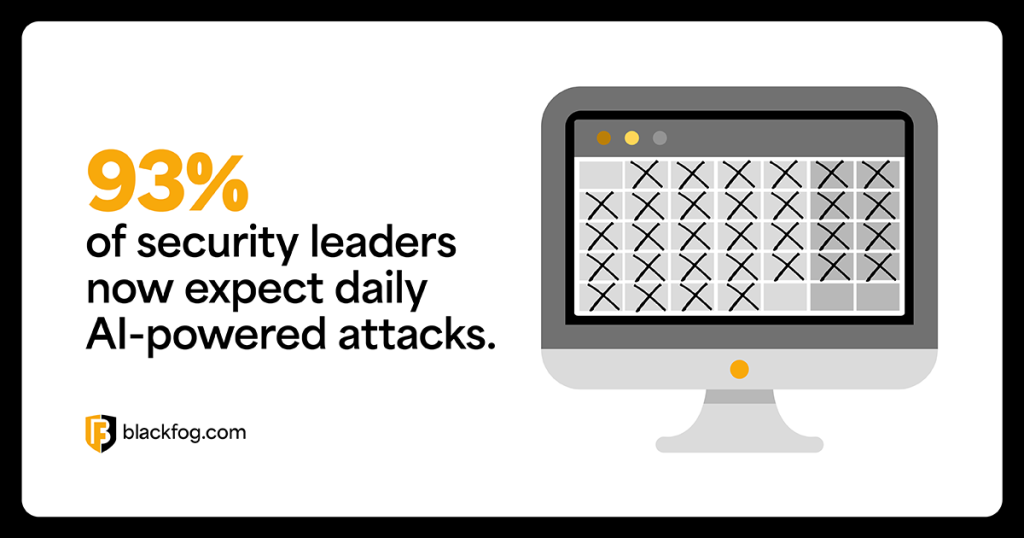
AI-driven attacks are already mainstream. According to Trend Micro, 93 percent of security leaders expect daily AI-powered attacks this year. There are several ways in which this technology can be adopted by threat actors to enhance data exfiltration attacks. Below are proven methods where AI plays a key role in compromising enterprises:
- Malicious AI chatbots: Tools such as WormGPT allow criminals to automate phishing and social engineering campaigns and generate malicious code, lowering the barrier for attackers to gain access and initiate exfiltration workflows.
- Prompt injection against enterprise LLMs: Attackers can exploit AI agents with malicious inputs to trick them into leaking internal files, credentials or proprietary data by manipulating the AI’s behavior.
- Compromised AI agents and automation workflows: Threat actors may target legitimate business AI agents to export sensitive data under the guise of authorized tasks.
- AI-guided extraction scripting and automation: AI rapidly generates code or scripts to compress, encrypt and transmit exfiltrated data at scale, enabling larger data thefts with lower human effort.
These tactics illustrate a shift in attack patterns. They mean data theft is no longer a slow, manual process, but a fast, AI-augmented operation. Security teams must recognize the evolving landscape and adopt more focused AI governance frameworks if they are to detect and stop these threats in time and address key privacy concerns.
Potential Future Applications Of AI In Data Exfiltration
While today’s AI-enabled attacks already pose significant challenges, researchers warn that more advanced applications are on the horizon. Many of these techniques have been demonstrated in controlled environments but have not yet been widely observed in criminal campaigns.
One emerging area is AI-guided traffic shaping, where machine learning models adjust outbound data flows to mimic legitimate network behavior. Researchers have also shown proof-of-concept autonomous exfiltration agents that use reinforcement learning to identify what data to steal and decide the safest exfiltration route out of a network without human instruction.
Other experimental findings show AI’s ability to reconstruct sensitive information from partial or obfuscated datasets. Additionally, model inversion attacks have been demonstrated against machine-learning models, allowing attackers to extract training data by probing model outputs.
Although not yet common in the wild, these developments highlight how quickly AI-assisted exfiltration could develop and why organizations must prepare now.
How Businesses Must Adapt Their Defenses
As AI transforms the tactics of cybercriminals, businesses must evolve just as quickly to stay ahead. This means going beyond perimeter-based defense models and adopting AI-powered security and management strategies of their own. This is especially vital when it comes to detecting, monitoring and stopping unauthorized data flows.
Purpose-built anti data exfiltration solutions are now essential for safeguarding sensitive data in real-time. However, other key steps organizations should take include:
- Deploying AI-powered monitoring tools that analyze outbound data in real-time.
- Restricting and auditing permissions granted to internal and external AI systems.
- Implementing behavioral analytics to detect AI data exfiltration patterns.
- Enforcing least privilege and Zero Trust access policies.
- Monitoring and controlling LLM and AI agent usage with strict guardrails.
- Segmenting sensitive datasets and limiting their exposure to AI workflows.
- Training employees to recognize signs of AI misuse or data leakage.
With AI making it easier for attackers to steal data at scale, the cost of inaction is rising fast. To maintain both AI compliance posture and long-term reputation, businesses must act now or risk falling behind in an AI-driven threat landscape.
Share This Story, Choose Your Platform!
Related Posts
LotAI: How Attackers Weaponize AI Assistants for Data Exfiltration
What happens when attackers use your approved AI tools as a data exfiltration channel? New research reveals how the LotAI technique turns Copilot and Grok into covert C2 relays.

The State of Ransomware: February 2026
BlackFog's state of ransomware February 2026 measures publicly disclosed and non-disclosed attacks globally.
Steaelite RAT Enables Double Extortion Attacks from a Single Panel
Steaelite is a newly emerging RAT that unifies credential theft, data exfiltration, and ransomware in a single web panel, accelerating double extortion attacks.
ClawdBot and OpenClaw: When Local AI Becomes A Data Exfiltration Goldmine
ClawdBot stores API keys, chat histories, and user memories in plaintext files, and infostealers like RedLine, Lumma, and Vidar are already targeting it.

West Harlem Group Assistance Stops Ransomware and Cryptojacking with BlackFog ADX
West Harlem Group Assistance secures its community mission by preventing ransomware and cryptojacking with BlackFog ADX.
Why Traditional Security Fails To Deal With Advanced Persistent Threats
Learn why advanced persistent threats remain a growing cybersecurity risk in 2026 and where organizations must focus to address them.