 Skip to content

Answering Key GenAI Security Questions: Are ChatGPT Conversations Private?
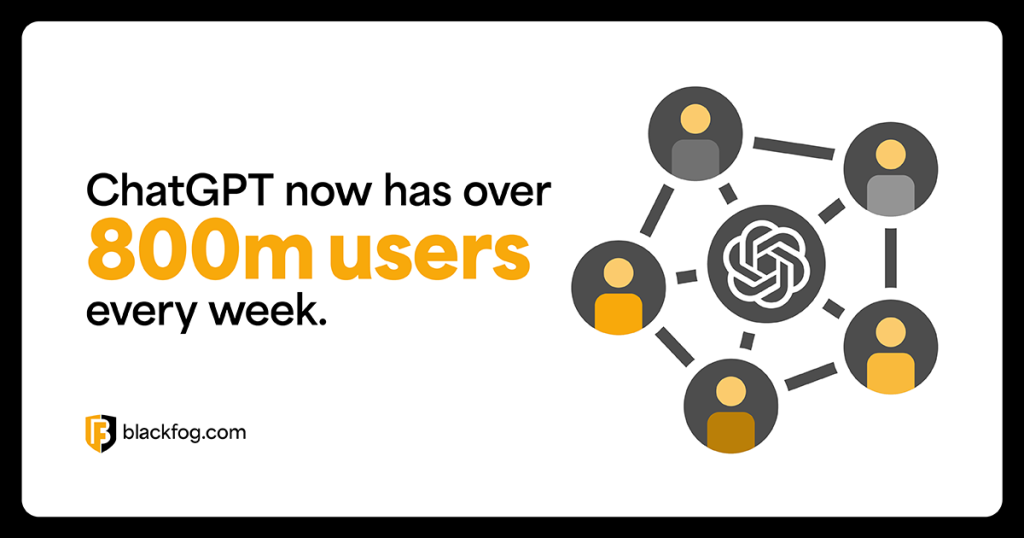
The use of generative AI services has surged in business environments over the last couple of years. But while employees have a range of options, one platform in particular stands out: ChatGPT. According to OpenAI CEO Sam Altman, as of October 2025, this platform now has more than 800 million users every week – up from 400 million in just six months. This translates to 3.2 billion interactions a month – more than double the number of users for Meta AI, Gemini, Grok, Perplexity and Claude combined.
A huge number of these sessions will be in the workplace, so IT teams must take a close interest. And one of the most common queries they have is: ‘Are these conversations really private?’ When corporate teams use these tools for document drafting, customer support or internal insights, it’s vital to understand what happens to the data they submit.
For compliance and cybersecurity teams especially, knowing whether ChatGPT sessions remain confidential or get reviewed and stored could make all the difference in managing risk. Here’s what to know about privacy on the platform.
What Happens To Your ChatGPT Conversations?
When a user submits a prompt or uploads a file to ChatGPT, the data is processed in OpenAI’s cloud-based infrastructure. For free and Plus accounts, these interactions are stored by default and may be reviewed by OpenAI staff to improve system safety and train future models. This can be avoided if users disable chat history, but even in this case, OpenAI may retain data temporarily for abuse detection or technical troubleshooting.
Enterprise ChatGPT users are treated differently: conversations are excluded from training by default and data handling is governed by stricter controls. However, privacy still depends on how the service is configured. Businesses must understand that unless enterprise-grade settings are in place, interactions may not be as private as users assume.
Who Can See Business Chats And When?
Visibility into ChatGPT conversations depends on the tier being used. In the free and Plus versions, OpenAI states that it may review conversations for safety monitoring or system improvement when chat history is enabled. These chats are not visible to an employer or IT team, meaning any business relying on unmanaged accounts has no way to see what employees are sharing or uploading.
Enterprise ChatGPT works differently. IT administrators have access to centralized controls that allow them to manage user accounts, enforce security settings, monitor usage volumes and configure data policies. For data privacy, Enterprise conversations are not used to train OpenAI models by default. Importantly, while there is no front-end view for administrators, the organization has control over workspaces, with admins able to access an audit log of conversation content through the Enterprise Compliance API. This ensures activity occurs under enterprise oversight rather than in isolated personal accounts.
If staff use unsanctioned or personal ChatGPT accounts, all administrative visibility within the business is lost – but conversations and uploaded data may be retained within the servers and be visible to external users. Enforcing enterprise-only usage is therefore essential to retain control, maintain audit trails and prevent sensitive information from being shared without oversight.
The Temptations To Threat Actors: Why ChatGPT Data Is Valuable
ChatGPT has become a prime target for cybercriminals because the information users input often contains high-value business intelligence. In many organizations, employees rely on the platform to draft internal communications, summarize documents, generate code or analyze sensitive material. For attackers, gaining access to these conversations can reveal strategy discussions, customer data, credentials or proprietary information that would normally be difficult to obtain.
One of the most common attack routes is credential misuse. Threat actors frequently rely on password reuse or stolen login details purchased on underground forums to compromise accounts, particularly when employees use personal accounts outside enterprise oversight.
The urgency of this risk was underscored in 2025, when a threat actor claimed to be selling millions of OpenAI account credentials online. Even though the data was later linked to older, unrelated breaches, the incident demonstrated how easily attackers can obtain access to LLM accounts.
More sophisticated methods target the AI systems themselves. For instance, prompt injection attacks can manipulate models into revealing information or performing unintended actions. Attackers may also exploit insecure plugins, browser extensions, API integrations or misconfigured deployments to extract sensitive conversations.
These risks highlight why ChatGPT data is so attractive: it centralizes business knowledge in one place, making it a valuable target that must be secured accordingly.
How To Keep Conversations Private And Secure
Keeping ChatGPT conversations private requires more than relying on the platform’s built-in protections. The most important step is establishing clear internal policies that define how generative AI can be used, what types of data are prohibited and which versions of the tool are approved. Without consistent processes, even enterprise-grade deployments can expose sensitive information through simple user mistakes.
Employees should therefore be trained to treat ChatGPT like any other external cloud service, where caution is essential. Good practice includes limiting what is shared, understanding how accounts are managed and ensuring activity remains visible to IT and security teams.
Key steps to improve privacy and security include:
- Use only enterprise-approved AI tools with centralized admin oversight.
- Avoid entering confidential, regulated or customer-identifiable data.
- Turn off chat history where appropriate and review retention settings regularly.
- Apply single sign-on and enforce strong authentication.
- Log and monitor usage to detect shadow or personal account activity.
- Provide regular training on safe prompt-writing and data handling.
Why Privacy Needs Oversight
ChatGPT conversations are not private by default. What’s more, relying solely on the platform’s built-in protections leaves businesses exposed to unnecessary risk. Sensitive information can be shared accidentally, retained for longer than expected or accessed through compromised accounts if proper safeguards are not in place.
This is why ChatGPT must be treated like any other IT service. It should be secured, monitored and governed through clear policies. With the right oversight, including access controls, data handling rules and continuous monitoring, organizations can prevent data exfiltration and ensure that generative AI supports the business without putting it at risk.
Share This Story, Choose Your Platform!
Related Posts
2025 Q4 Ransomware Report
BlackFog’s 2025 Q4 Ransomware Report - The Unrelenting Surge: Ransomware Closes Q4 at Record Levels
Data Breach Prevention: Practical Ways To Stop Data Loss
Data breaches are costly cyberthreats. Learn how data breach prevention strategies reduce risk and stop the most common causes in our guide.

How A Clear Data Loss Prevention Policy Reduces Risk
Find out what's needed to create a strong data loss prevention policy and why this matters in a complex environment.

Getting A Data Loss Prevention Strategy Right
A strong data loss prevention strategy can be the difference between stopping a potential breach early or a costly mistake. Here's what firms need to know when creating one.
How MCP Could Become a Covert Channel for Data Theft
Find out how Model Context Protocol (MCP) could be abused as a covert channel for data theft: five real risks, examples, and mitigations.
Why do Businesses Need Advanced Enterprise DLP Solutions?
Enterprise DLP systems play a key role in protecting businesses from both deliberate cyberattacks and accidental data breaches. Here's why all firms need one.