Skip to content

Setting formal rules is now essential for governing how AI is used inside the enterprise and for keeping the shadow AI economy in check. In many organizations, however, adoption of unapproved tools is running well ahead of any effort to manage it. This results in employees making their own decisions on which tools to use and what data to share.
The longer it goes unaddressed, the greater the risk of issues like costly data breaches. Establishing a clear AI usage policy gives employees defined boundaries and helps prevent risky behaviors from becoming everyday practice.
Why Your Organization Needs An AI Usage Policy
Uncontrolled AI use exposes a business in several ways. The most immediate is the loss of sensitive information, as confidential records or proprietary code entered into consumer tools can be retained on external servers or absorbed into the models themselves, well beyond the company’s reach. This can also result in compliance failures, since feeding personal or protected data through unapproved services can breach frameworks such as GDPR or HIPAA.
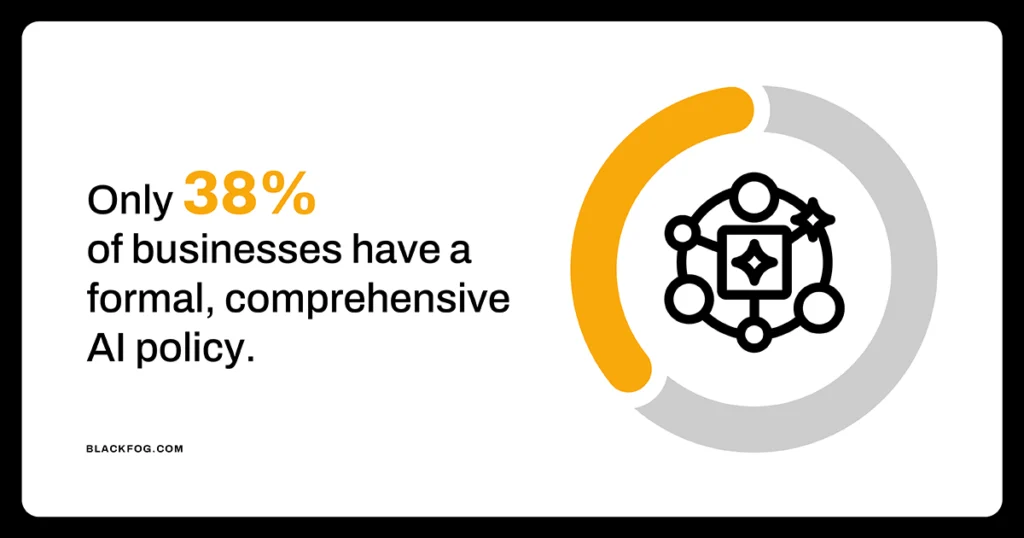
The use of shadow AI also expands the attack surface. Every unsanctioned tool is a weakness that the security team cannot see, secure or defend. Yet many firms are still failing to address these dangers. For instance, 2026 research from ISACA found that just 38 percent of businesses have a formal, comprehensive AI policy in place, while 30 percent only have more limited guidelines and one in four have no active policy at all.
What To Include In An AI Usage Policy
While the necessity of a policy is clear, businesses may still be uncertain of what an effective governance solution looks like in practice. To reduce the risks posed by the shadow AI economy, enterprises must ensure their policies cover a few key points in order to detect shadow AI and support secure usage. Key elements to highlight include:
- An approved tools list: Specify which AI tools are sanctioned, at what tier and for what purpose, so staff have secure options rather than defaulting to unvetted alternatives.
- Data classification rules: Define which categories of information can and cannot be entered into AI tools, with plain examples so employees can apply the rules without ambiguity.
- Acceptable use by role: Set out how appropriate AI use differs across functions, since a marketer drafting copy and a finance team handling regulated records need different boundaries.
- Consequences for violations: Outline what happens when rules are broken, distinguishing honest mistakes from deliberate misuse, then applying consequences consistently so the policy carries weight.
- A route to request new tools: Give employees a simple way to propose tools they find useful, turning unmet demand into sanctioned adoption rather than pushing it underground.
The Importance Of Clear Ownership
Responsibility for an AI usage policy is often handed to IT and security teams by default. However, these teams alone often cannot see the complete picture. Legal and compliance professionals are also essential in translating obligations under frameworks like GDPR into rules the policy can enforce. Department heads add a third view, grounding the policy in how teams actually work so it stays practical rather than theoretical.
This shared ownership matters because each group catches risks the others miss, whether technical, regulatory or operational. Just as important is defining who is accountable for what. When responsibilities are vague, gaps appear, but a clear split where each contributor has a defined remit, with one person accountable for pulling the threads together, ensures nothing falls through the cracks.
Keeping An AI Usage Policy Up To Date
AI tools evolve at a pace few other technologies match, with new models, features and providers appearing constantly. A policy written once and left untouched quickly falls out of step with the tools in daily use. Therefore, treating it as a living document is the only way to stay current. A full review every quarter is a sensible baseline, supported by triggered updates whenever a significant new tool emerges, an incident occurs or a relevant law changes. This keeps it aligned with changed real-world use rather than a one-time snapshot.
A Policy Is Only As Good As Its Enforcement
Knowing how to write an AI usage policy is only the start. To make certain that it works in practice, there are several steps that must be taken to communicate and enforce the guidelines. Start by explaining the rules clearly through onboarding and regular training, so every employee understands what is permitted and why. This should not just highlight what the rules are, but explain why they exist.
Back this with enforcement at the endpoint, where enterprise endpoint security solutions can detect and block unsanctioned AI use at the point data would otherwise leave the business. An AI usage policy should be further reinforced by having approved tools that are visible and easy to reach. Firms that act early keep control while adoption is still taking shape, protecting sensitive data, compliance and reputation while the task is still manageable.
AI Usage Policy FAQs
What should an AI usage policy include?
At minimum, a list of sanctioned tools, rules on what data may be entered, guidance on acceptable use for different roles and clear consequences for breaches. A simple route for staff to request new tools also helps curb unofficial workarounds.
Who should own the AI usage policy in an organization?
Not IT alone. Effective governance draws on security, legal and compliance, plus department leads who understand daily workflows. Each contributor needs a defined remit, with one person accountable for coordinating the whole and keeping it current.
How often should an AI usage policy be updated?
Treat it as a living document rather than a fixed one. A quarterly review works as a baseline, with extra updates triggered by major new tools, security incidents or changes to relevant regulations.
Does an AI usage policy alone prevent shadow AI?
No. On its own it is just a document. Preventing shadow AI depends on communicating the rules well and enforcing them at the endpoint, where unsanctioned tools can be detected and stopped before data leaves the business.