Skip to content

Tackling the shadow AI economy is no longer optional for cybersecurity teams. It has become a fundamental responsibility, alongside patching systems and defending against phishing.
However, viewing shadow AI purely as a security function is a mistake, as the consequences of failure will be felt throughout the business. A single unmanaged incident can trigger regulatory penalties, financial losses and lasting reputational harm, the kind of setback that can shape a company’s trajectory for years. Treating it as a core business priority, rather than a narrow IT concern, is now essential to protecting the organization’s future.
The Financial Cost Of Ignoring Shadow AI
Knowing why shadow AI matters is the first step in developing an effective solution. Without a clear understanding of the consequences, it may be looked at as merely a box-ticking exercise, when in fact, it needs to be viewed as a business priority.
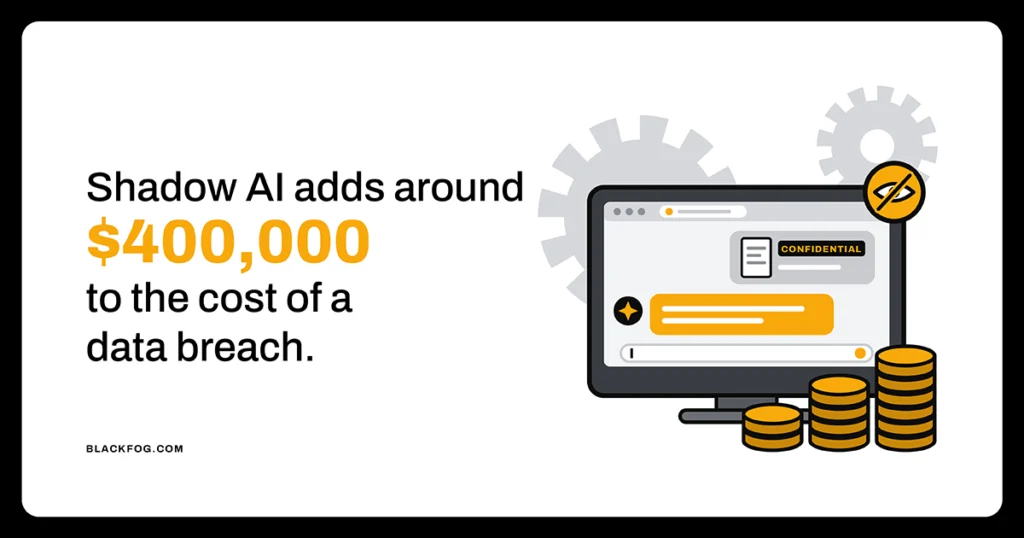
This is because a breach that begins with shadow AI comes at a premium. IBM’s 2026 research puts the typical cost of these incidents at $5.39 million, roughly $400,000 above the overall global average. That headline figure covers much more than just the technical cleanup bill. It also accounts for the range of longer-term costs a breach creates beyond the initial response. Among these expenses are:
- Detection and escalation: Including forensic investigation, containment and crisis management. The longer a shadow AI breach goes undetected, the greater these will be.
- Lost business: The biggest single component, covering losses related to customer churn, downtime and the cost of replacing lost clients.
- Post-breach response: Covers a wide range of expenses, including victim notification, helpdesk support, direct compensation and credit monitoring once the incident is known, as well as longer-term system hardening to prevent future incidents.
These all come in addition to regulatory and legal consequences, which may also involve monetary penalties and are set to be an increasing factor as jurisdictions around the world tighten their rules related to AI.
What Compliance Risks Come From The Shadow AI Economy?
Regulators worldwide are turning their attention to how businesses use AI. The EU AI Act is perhaps the most prominent example, setting binding obligations for firms doing business in the bloc. A breach might involve deploying AI without the required transparency, human oversight or record-keeping and could lead to heavy fines.
Penalties under the Act reach up to €35 million ($39.66 million) or seven percent of global annual turnover for the most serious breaches, with lower tiers for other failings. Running alongside it, GDPR applies in every sector, with fines of up to €20 million or four percent of turnover for mishandling personal data.
Shadow AI sharpens this risk, because tools the organization cannot see make those duties impossible to guarantee or to prove if challenged. However, the business will still be liable for any data handling errors made by individual employees, such as uploading sensitive information to a consumer-grade third-party tool.
Many individual sectors have specific rules on the use of sensitive information that shadow AI can easily breach. Examples include:
- Healthcare: In the US, HIPAA protects patient health information, so a clinician pasting case notes into a consumer chatbot would expose it to an outside service.
- Finance: The US Gramm-Leach-Bliley Act obliges institutions to safeguard customer financial data, which an adviser running account details through an AI tool would compromise.
- Legal: Client confidentiality and privilege bind lawyers in most jurisdictions, so summarizing a case file in a public AI tool risks disclosing privileged material.
- Education: In the US, FERPA protects student records, so entering grades or disciplinary notes into an AI assistant would share them without authorization.
Why Banning AI Outright Doesn’t Work
Given the above risks, it can be tempting for businesses to clamp down on shadow AI completely by imposing a blanket ban. However, this is unlikely to be effective, as it will not remove the demand for AI, but simply hide it, making shadow AI detection even more challenging.
Employees who rely on these tools to speed up their day tend to carry on regardless, only now beyond any oversight. It also denies the business the genuine gains AI offers, from quicker drafting to easier analysis. BlackFog’s research bears this out, with 60 percent of employees saying unsanctioned AI is worth the security risk if it helps them work faster.
Turning Shadow AI Into Safe AI Adoption
The financial, regulatory and reputational risks make it clear that shadow AI cannot be left unchecked. The goal, though, is not to stamp out AI but to bring it into the open where it can be used safely. That starts with a clear AI usage policy, setting out which tools are approved and how sensitive data should be handled. It also depends on enterprise endpoint security built for AI, capable of detecting and blocking unsanctioned use at the device before data leaves the business.
AI is now a permanent part of working life. The businesses that thrive will be those that give staff a secure way to adopt it, rather than leaving its use in the shadows.
Addressing Shadow AI: Frequently Asked Questions
Is shadow AI a serious risk or just an IT concern?
It is far more than an IT concern. Unmanaged AI use can trigger data breaches, regulatory fines and reputational damage, all of which affect the whole business. Treating it as a narrow technical issue understates a genuine, board-level risk.
What happens if a company ignores shadow AI?
Sensitive data can leak to external tools, raising the risk of costly breaches and compliance failures. IBM puts the average shadow AI breach at $5.39 million. Left unaddressed, the exposure only grows as usage spreads.
Does addressing shadow AI slow down AI adoption?
No, done well it enables it. Clear policies and secure tools give employees confidence to use AI openly, rather than resorting to risky workarounds. Addressing shadow AI is what makes safe, productive adoption possible.
Who should be responsible for addressing shadow AI risk?
Not security teams alone. Effective oversight combines security, legal and compliance with department leaders, supported by leadership. Shared responsibility ensures technical, regulatory and practical risks are all covered rather than falling through the gaps.