Skip to content
The Shadow AI Economy: Risks, Causes And How To Control It
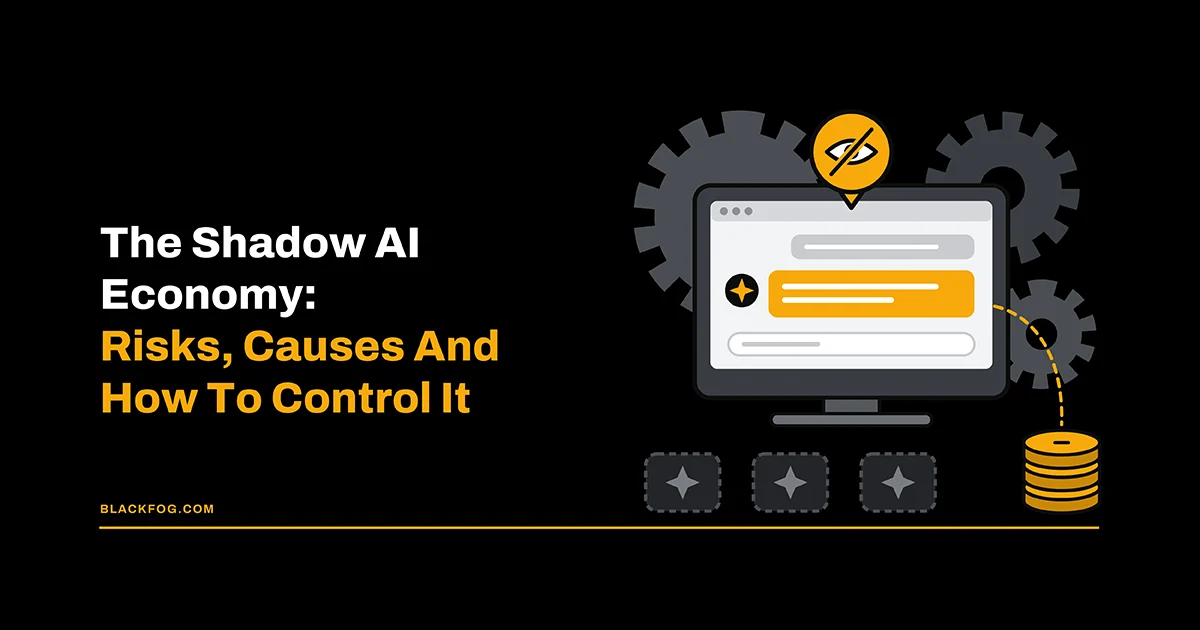
AI is now part of everyday life in the workplace – and many employees are adopting these tools faster than their employers can keep pace. Staff are signing up for personal chatbot accounts, pasting company data into consumer tools and using AI features built into everyday apps. Frequently, this is happening without IT’s knowledge or approval. This hidden layer of unsanctioned activity is known as the shadow AI economy.
This unsanctioned AI use usually starts with good intentions, as people are simply looking for quicker ways to get work done. Yet every tool that sits outside the security team’s view creates blind spots where sensitive data can leak, compliance obligations can be breached and risky decisions can go unchecked. As businesses move toward an AI-first way of working, understanding shadow AI and having a clear plan to control it has become essential.
What Is The Shadow AI Economy And What Risks Does It Create?
Shadow AI refers to any instance of an employee using an AI tool their organization hasn’t approved. However, the shadow AI economy describes something bigger: the pattern of this behavior spreading across businesses until unofficial AI usage becomes a routine part of daily operations.
Applications for these tools span almost every department. For example, marketers generate campaign copy and imagery, developers troubleshoot bugs with coding assistants and sales staff record calls through AI note-takers. Many of these applications can involve highly sensitive personal, customer or company data, from recruiters screening résumés, to finance analysts working on spreadsheet data and legal professionals summarizing contracts.
This can result in a wide range of problems that make it important to address shadow AI, with common challenges created by this trend including:
- Data leakage: Confidential or proprietary material, from personal records to source code, can be retained on third-party servers or used to train external models once it’s pasted into an unapproved tool.
- Compliance breaches: Handling personal or regulated records through unapproved services can expose organizations to regulatory action, especially those under HIPAA and GDPR.
- Uncontrolled sprawl: Tools accumulate independently across teams, leaving no consistent standards for what’s acceptable and no way to revoke access when staff leave.
- Unreliable outputs: Unchecked AI-generated content may introduce errors into decisions or customer-facing work.
- Visibility gaps: Unmonitored apps or browser extensions widen the attack surface without security teams knowing.
“Employees aren’t waiting for permission to use AI, and businesses can’t afford to pretend otherwise. The real risk isn’t AI adoption itself, but sensitive information leaving organizations without their knowledge. The priority now is to make AI use visible and stop unauthorized data from leaving the device, without standing in the way of innovation.”
– Dr. Darren Williams, Founder and CEO, BlackFog
The Numbers Behind The Shadow AI Economy
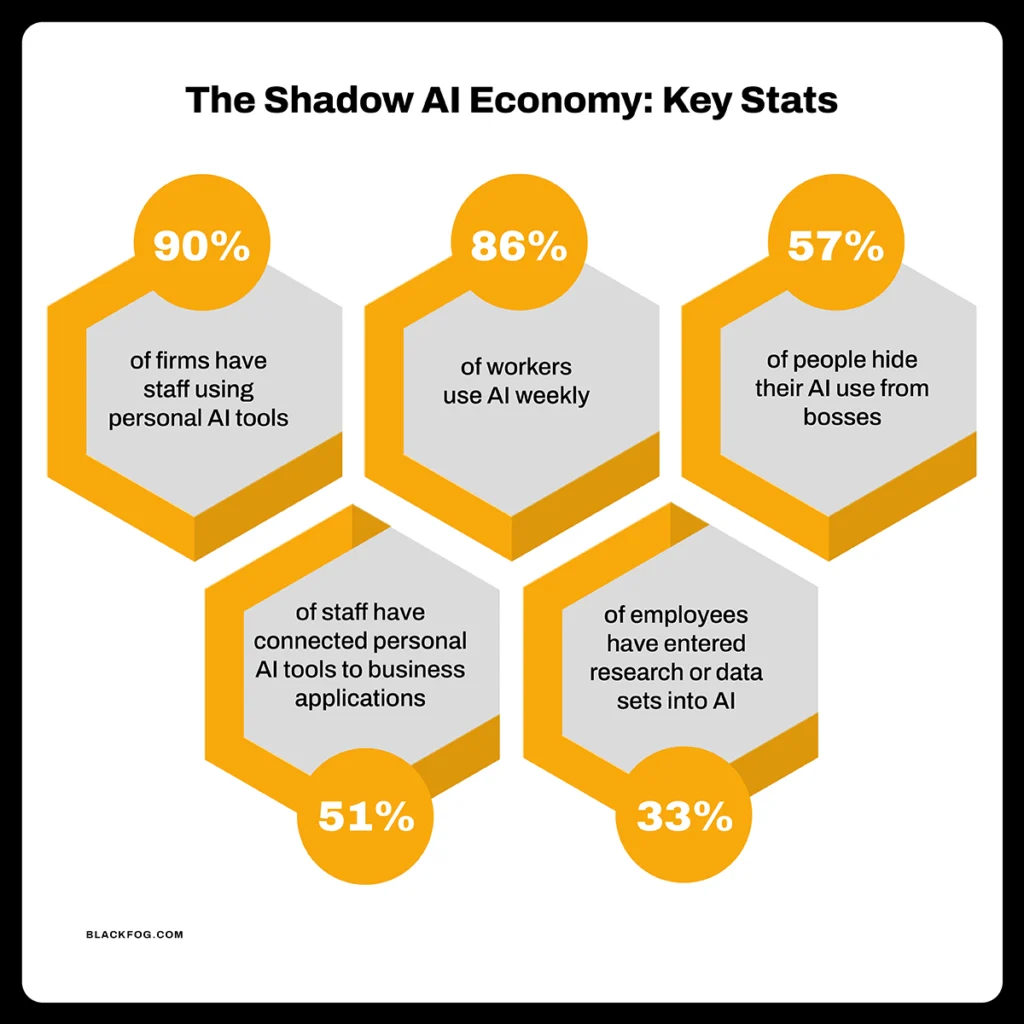
Unofficial AI use has surged over the last few years. For instance, 2025 figures from MIT’s Project NANDA found that while only 40 percent of companies had bought an official large language model (LLM) subscription, employees at 90 percent of businesses were already using personal AI tools for their jobs.
Our own research backs this up. Earlier this year, we found that some 86 percent of employees now turn to AI tools at least weekly, while nearly half (49 percent) are using services their employer has never approved, mostly free versions that lack enterprise-grade security.
This leads directly to increased risk of data breaches and loss of sensitive data. For instance, our research revealed that:
- 33 percent of employees have entered research or data sets.
- 27 percent have shared staff information such as payroll or performance records.
- 23 percent have shared financial or sales data.
- 51 percent have connected AI tools to other work applications without IT approval.
Much of this stays out of sight. According to KPMG, more than half of employees (57 percent) admit to hiding their AI use and passing off AI-generated work as their own. What’s more, just 47 percent have received any AI training and only 40 percent work in organizations that have a clear generative AI policy. This means many employees may not even be aware they are engaging in potentially risky behavior.
What The Shadow AI Economy Is Actually Costing Organizations
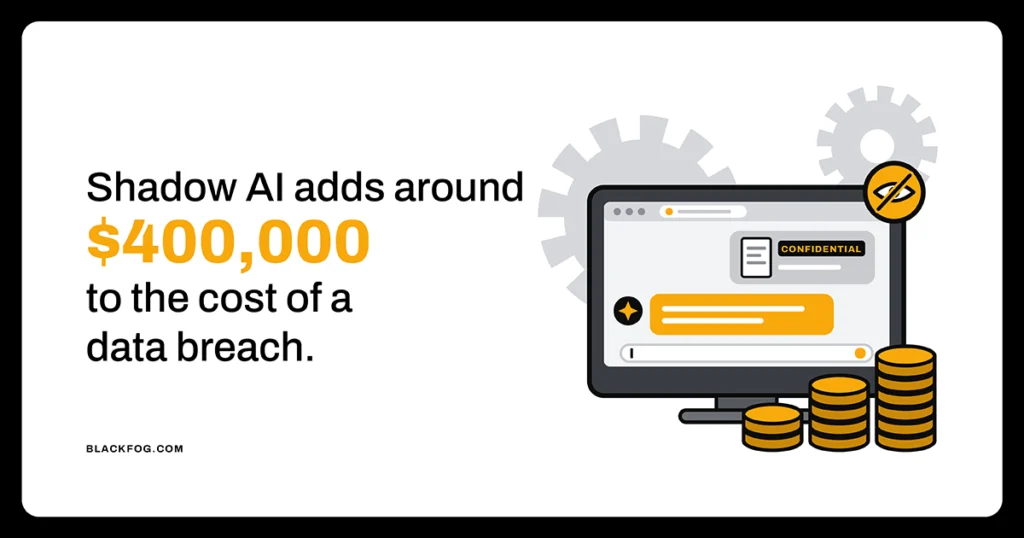
The impact that the shadow AI economy has on firms’ bottom lines is not just theoretical. In fact, IBM’s 2026 Cost of a Data Breach Report found that shadow AI was involved in 43 percent of breaches, more than double the 20 percent recorded a year earlier. Moreover, incidents involving shadow AI are significantly more expensive to remedy than other data breaches. The research found that incidents tied to shadow AI cost an average of $5.39 million, around $400,000 above the global average of $4.99 million.
According to the study, the most common impacts of shadow AI security incidents include:
- Data loss or compromise (cited by 49 percent of respondents)
- Operational disruption (42 percent)
- Reputational damage (35 percent)
- Increased security costs (32 percent)
- Regulatory fines (21 percent)
Part of what makes these incidents so damaging is their invisibility. When employees route company data through tools that security teams cannot see, breaches may go undetected for longer, giving attackers more time to exploit the exposure before anyone steps in.
Another problem is that because unsanctioned tools process and store information on third-party servers beyond the organization’s control, containing or retrieving sensitive material once it has left the business becomes extremely difficult. This combination helps explain why shadow AI breaches consistently land at the costlier end of the scale.
Why The Shadow AI Economy Keeps Growing
Personal AI tools solve real problems employees face daily. They can draft, summarize and analyze in seconds, potentially saving hours of tedious manual effort. Familiar consumer tools like ChatGPT also tend to feel faster and more flexible than the sanctioned alternatives, so once workers experience that boost, few are willing to give it up.
Our own research reflects this, with 60 percent of employees saying unsanctioned AI is worth the security risk if it helps them work faster. This is why the shadow AI economy cannot be ignored. Users regard personal tools as delivering real value to their work, so if firms fail to offer secure, capable options that give the same results, they will simply push staff further underground.
5 Signs Your Organization Already Has A Shadow AI Economy
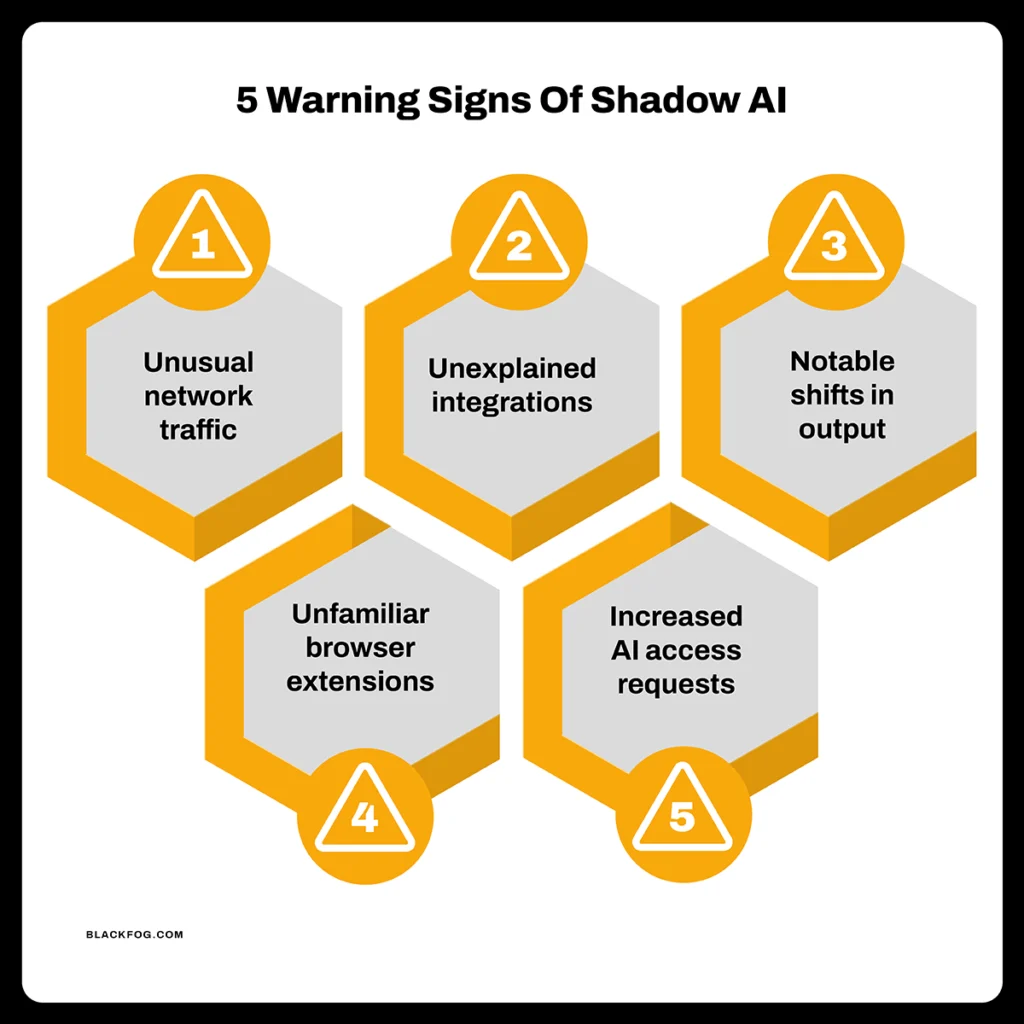
Detecting shadow AI is difficult, largely because staff adopt these tools discreetly and rarely flag them to anyone. Unofficial use can spread across whole teams long before IT notices, so being able to recognize a few key warning signs to detect shadow AI is the first step toward closing that gap. If any of the following red flags sound familiar, unsanctioned tools may already be embedded in daily workflows:
- Unusual network traffic: Logs show repeated connections to consumer AI domains that were never approved.
- Unexplained tool integrations: AI services appear linked to CRMs, inboxes or other work systems without IT sign-off or are switched on in approved applications..
- Sudden shifts in output: Work starts arriving faster or more polished, with a noticeable change in tone or style.
- Unfamiliar browser extensions: Unvetted AI plugins and add-ons turn up on company devices and browsers.
- A rise in access requests: More staff ask to use or approve AI tools, or attempt to make expense claims for AI subscriptions, which can be a sign many are quietly relying on them already.
Enterprise Policies To Control Shadow AI Economy Usage
Bringing shadow AI back under control takes more than a blanket ban, as such blunt force solutions tend to drive usage further out of sight rather than stop it. Instead, firms should apply a layered approach that combines clear rules, sanctioned tools and technical enforcement. This gives organizations a realistic path to managing the risk. The following steps form a practical starting point:
- Have clear guidelines for AI: A written AI usage policy should set out which tools are approved, what data can and cannot be entered into them and the consequences of ignoring the rules, in language every employee can follow.
- Provide capable approved alternatives: Give staff secure, enterprise-grade tools that match the speed and flexibility of consumer options, removing the main incentive to go unsanctioned.
- Enforce through technology, not memory: Back the policy with monitoring and controls that flag or block unapproved AI use automatically, rather than relying on staff to recall what is permitted.
- Gain visibility over AI activity: Continuously discover which tools are in use across networks and devices, so decisions rest on evidence rather than assumption.
- Classify and protect sensitive data: Identify your most critical information and apply guardrails that stop it reaching external tools in the first place.
Assign clear ownership: Make governance a shared responsibility between security, IT and business leaders, with someone accountable for keeping it current.
Reducing Shadow AI Risk With Endpoint-Level Visibility
Much of the shadow AI economy operates in places that network-level monitoring simply cannot reach. Employees work across personal laptops, home networks and mobile devices, where activity sits beyond the perimeter tools most organizations rely on. AI features are also increasingly being embedded directly into approved software, so unsanctioned use can occur inside tools that IT has already signed off.
Closing these gaps means placing visibility where the activity actually happens – at the device layer. Endpoint-level protection can detect when data is being fed into an AI tool – regardless of whether or not the user is connected to the corporate network – then step in before sensitive information leaves the business. ADX Vision is built around this principle, using enterprise endpoint security to automatically discover shadow AI use across endpoints and applications and enforcing governance at the point of risk.
Shadow AI is now a permanent feature of enterprise IT rather than a passing trend. For forward-thinking companies, the priority is no longer whether to address it but how quickly, since those that act now will keep control of their data while others scramble to catch up.
Shadow AI Economy FAQs
Is the shadow AI economy the same as shadow IT?
No, but they do overlap. Shadow IT covers any unapproved technology, from messaging apps to cloud storage. The shadow AI economy is the AI-specific subset. It carries distinct risks because AI tools actively process, retain and learn from the data entered into them, unlike most ordinary software.
How widespread is the shadow AI economy?
The shadow AI economy is now mainstream. BlackFog’s research found 86 percent of employees use AI at least weekly, with nearly half (49 percent) relying on tools their employer never approved. MIT separately put personal AI use at more than 90 percent of companies surveyed, so most organizations already have an active shadow AI economy.
Is using shadow AI against company policy illegal?
Not in itself. Breaching an internal policy is usually a disciplinary matter for the employer, not a criminal offense. It can cross into legal territory, however, when unsanctioned use breaks data protection laws such as GDPR, violates confidentiality agreements or ignores contractual obligations. The resulting exposure usually falls on the organization.
What are the biggest AI security risks for businesses?
Data leaking into external tools tops the list, alongside compliance breaches when regulated information is mishandled. Intellectual property loss follows, since proprietary material entered into AI services can be stored or used to train external models. Businesses also face rising AI-driven attacks such as deepfakes and automated phishing. Shadow AI worsens each by hiding activity from security teams.