Skip to content

Enterprise endpoint security solutions have long served as a key line of defense, protecting businesses from data breaches by monitoring at the device layer for signs of sensitive information leaving the network. However, in the AI-first era, the shadow AI economy is opening fresh avenues for data exposure that traditional tools were never built to handle.
In today’s environment, employees routinely share company information with consumer AI services that traditional security tools struggle to detect, leaving gaps in an organization’s protection. Closing these gaps requires a more modern approach that understands how data now moves between staff, devices and the AI tools they use.
Where Traditional Endpoint Security Falls Short
Most businesses rely on tools such as endpoint detection and response (EDR) and data loss prevention (DLP) software. EDR watches devices for the behavioral signatures of malware and intrusion, while DLP tracks predefined categories of data to stop them leaving the network without authorization.
Both of these work by recognizing known threat patterns, but this model struggles when users are interacting with AI. Pasting unstructured text into a browser-based AI tool triggers none of the malicious process alerts EDR looks for and easily bypasses standard DLP alerts. Much of this activity also happens beyond IT’s view entirely, on personal devices or networks the organization never sees.
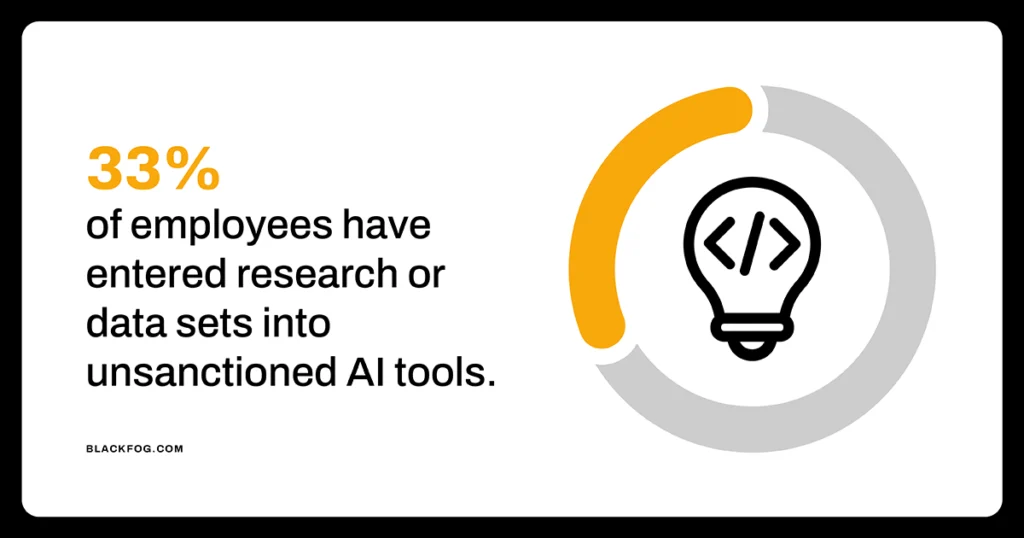
As a result, sensitive data can leave the organization without adequate oversight or protection. For example, BlackFog’s research found that 33 percent of employees have entered research or data sets into unsanctioned AI tools, while 27 percent have shared staff information such as payroll or performance records.
The Endpoint Risks Shadow AI Introduces
Shadow AI creates several distinct exposures at the device layer, each capable of slipping past the tools most organizations depend on. The most significant include:
- Native and embedded AI: Vendors are increasingly building AI directly into everyday software, as seen with Gemini in Chrome and Copilot in Microsoft 365. Because these features arrive already switched on and nothing is installed, they never appear in the application inventories that endpoint tools scan.
- User-installed AI extensions: Employees can add third-party AI assistants to their browsers in a couple of clicks. These extensions are able to read whatever appears on screen and send it to outside servers, yet the activity blends in as ordinary browsing that conventional tools do not question.
- Direct data entry into consumer tools: Even on a fully managed device, staff can copy sensitive text into a web-based chatbot or upload a confidential file in seconds. To traditional defenses this resembles routine web use, so the information leaves without ever being flagged as a loss.
- Unmanaged personal devices: Much AI use happens on home laptops or personal phones that carry none of the organization’s security software. These devices sit beyond corporate reach altogether, so whatever takes place on them is invisible from the outset.
What Endpoint Security Now Has To Do
Meeting these risks requires protection that sits at the exact point where data meets an AI tool. This is the only way that shadow AI activity can be detected before sensitive data escapes the organization’s control, whether the user is on the corporate network or working remotely.
To manage this, modern solutions must be able to identify AI tools as data exfiltration points, inspect unstructured information as it is entered into these platforms, assess and detect sensitive data in real-time and block unauthorized transfers before it reaches an external service. This has to reach every route AI takes onto a device, from native features inside approved software to the browser-based tools staff use daily.
Enforcing real-time inspection directly at the device layer provides the visibility necessary to catch these interactions at the point of use. This should also be combined with strict access controls that restrict unmanaged personal devices from reaching sensitive systems in order to create a dependable defense against data leaking into unsanctioned AI.
Enterprise Endpoint Security And Shadow AI FAQs
Can traditional enterprise endpoint security detect shadow AI?
Often not. Tools like EDR and DLP look for malware or defined file transfers, but pasting text into a web-based AI tool matches neither. The activity resembles ordinary browsing, so it passes through conventional defenses without raising any alert.
How is AI data leakage different from the breaches endpoint security usually stops?
Traditional breaches involve an outside attacker forcing entry. AI data leakage comes from employees themselves entering sensitive information into consumer tools. There is no intrusion to detect, just routine-looking activity that sends confidential data beyond the organization’s control.
Does enterprise endpoint security still work when employees use AI on personal devices?
Only if protection extends to those devices. Home laptops and personal phones carry no corporate security software, so activity on them stays invisible. Reaching it requires solutions built to work at the device level, not the network.
Can endpoint tools detect AI features built into browsers?
Not always. Features like Gemini in Chrome arrive switched on, with nothing installed for an inventory to flag. Detecting them means monitoring how data is used at the device, not just scanning for newly added applications or extensions.
How does shadow AI change the data leak risks at the endpoint?
Copying text into a chatbot or uploading a file to an AI service sends data outward in seconds, through routes traditional tools ignore. The device becomes the main place this leakage can realistically be caught.