 Skip to content


Organized Cybercrime Groups
There are different categories of cybercriminals that can come together to form organized cybercrime groups. These include bored teenagers getting involved in petty online crimes, individual actors primarily motivated by financial gain, politically or ideologically motivated hackers, and fully fledged organized crime syndicates. However, the most sophisticated and damaging cybercrime operations tend to be carried out by the latter.
Successful organized cybercrime groups have a role-based structure where individual members contribute different specialized skills. One of the most common roles is that of the “penetration tester,” hackers who are particularly adept at gaining unauthorized access to computer systems and networks through vulnerabilities. Groups may have a single top-tier penetration tester or a team working in coordination.
Other core roles include technical experts who develop malware payloads or configure ransomware, negotiators who communicate with victims during extortion scenarios, money launderers skilled at obscuring illicit proceeds, and organizers who coordinate the overall criminal operation. This specialization allows groups to efficiently carry out complex multi-stage attacks.
Reputation is everything
Online forums devoted to talking about hacking and digital crime are the birthplace of many collaborations and upcoming formalized cybercrime organizations. By offering services or samples of their work, willing specialists will gradually create a name for themselves.
For example, a skilled penetration tester might share technical details and evidence of successfully compromised systems to advertise their abilities. Others demonstrate skills like malware authoring that are highly valued within the criminal community. Gradually, as reputations are earned, direct business relationships form between regular forum members needing certain services filled and these individuals.
Restricted Membership
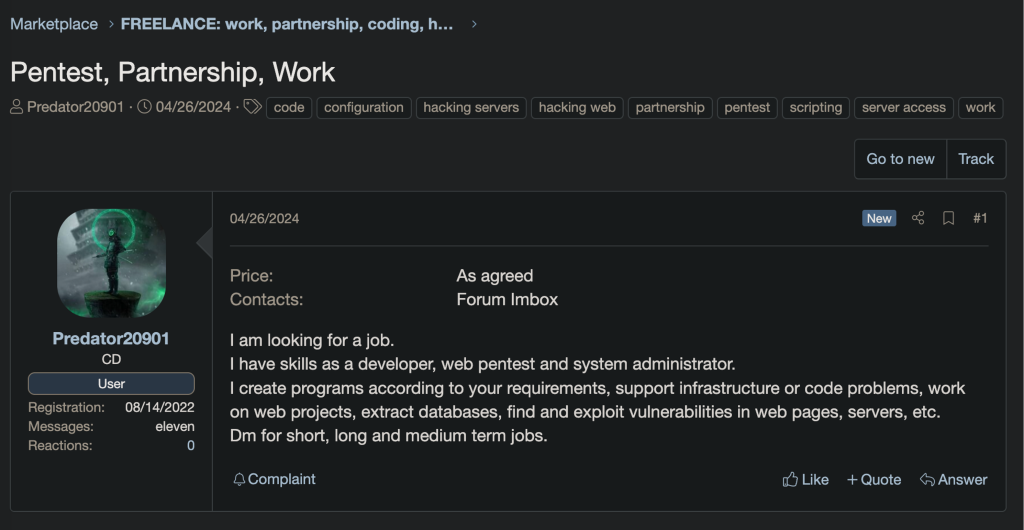
Partnerships
An example of a cybercriminal looking for a partnership
A notable example of the membership and ranking structure found on cybercrime forums can be observed in the Darkode archives leak. From 2007 to 2015, Darkode was an invite-only forum for cybercrime. It served as a platform for cybercriminals to exchange hacking techniques, buy and sell illegal goods and services, and work together on illegal schemes. Darkode was only accessible to invited members, and new users needed the endorsement of an existing user to be approved by administrators.

Darkode
An example of the membership system available on Darkode
After an administrator granted a user access to the forum, new members joined at level 0 or below, and they were frequently promoted from there after earning the trust of other members and offering helpful knowledge or skills.

Skillsets
An example of a cybercriminal offering a specific skillset
Ransomware Operations
One of the most visible and financially driven areas within organized cybercrime currently involves ransomware operations. Well-practiced cybercrime teams compromise systems, deploy ransomware payloads, and demand payments, often in cryptocurrency, in exchange for decryption keys.

Ransomware as a Service
Example of a RaaS affiliate program
The most formidable ransomware syndicates function like modern businesses with defined corporate structures, marketing, customer service protocols, and common diversification into extortion affiliate models.
Typical roles include programmers, distributors, negotiators, money launderers, and even “help desk” technicians. These hacking enterprises can generate hundreds of millions annually from worldwide victims and have grown into transnational networks that span continents.
Frequently Asked Questions
Below are some common questions people have about the formation and operations of organized cybercrime groups:
Prevent Cybercrime with BlackFog ADX
BlackFog provides a solution with a focus on preventing data exfiltration with ADX technology. This next generation cybersecurity solution has been designed to help organizations protect themselves from ransomware attacks and extortion 24/7, without the need for human intervention.
Don’t wait for the next ransomware attack wave; take proactive action now and secure your most valuable asset.
Learn how our solutions can strengthen your cybersecurity posture and prevent ransomware incidents.
Share This Story, Choose Your Platform!
Related Posts
The Gentlemen: How GentleKiller Clears the Path to Encryption
The Gentlemen turns ransomware, data theft, and defense evasion into a managed service for affiliates, with cross-platform encryptors and a 90 percent revenue share.

WEBINAR: The First Half Of 2026 In Ransomware – Register Now!
Webinar: The first half of 2026 in ransomware - 4,757 Attacks, One Real Story.
How Can Adversarial AI Attacks Be Detected And Prevented?
Learn how to detect and prevent adversarial AI attacks through behavioral monitoring, model validation, data security and governance.

What Are The Recent Developments In AI Jailbreaking?
Explore recent developments in AI jailbreaking, from jailbreak-as-a-service to attacks on enterprise AI assistants and autonomous agents.

How Does AI Security Posture Management Differ From Traditional Security Management?
Discover how AI security posture management differs from traditional security management and why conventional tools fall short.

What Are The Best Practices For Implementing AI Security Posture Management In An Organization?
A practical checklist for AI security posture management, covering AI discovery, monitoring, risk assessment and governance best practices.