Skip to content

As businesses build more of their operations around AI, prompt injection attacks have become a serious and growing threat, giving attackers a way to hijack assistants and agents from the inside. The potential consequences are wide-ranging, from stolen data to unauthorized actions, which is what makes early detection so important.
An attack caught while it is still unfolding can be contained, but once data has been exfiltrated, the damage is already done. The trouble is these attacks are built to blend in, hiding inside ordinary content and legitimate activity. Spotting them reliably is why a dedicated prompt injection detection strategy matters.
What’s The Difference Between Prompt Injection Detection And Prevention?
Prompt injection detection is the practice of identifying attacks that are already underway or have landed, rather than stopping them before they start. That is how it differs fundamentally from prevention. Because 100 percent prevention is unrealistic, firms need detection to catch the threats that get past their first lines of defense. In brief, the two disciplines involve:
- Prevention: Hardening systems up front, through input filtering, least privilege and human approval, to stop attacks landing.
- Detection: Watching inputs, outputs and system behavior for signs an attack is in progress, so it can be caught and contained quickly.
Why Is Prompt Injection So Hard To Detect?
Catching a prompt injection attack while in progress is far harder than identifying malware. There is no malicious code, file or signature to match against, because the attack is written in plain language. An attack can also be reworded endlessly, so any rule or keyword filter is sidestepped by fresh phrasing that means the same thing.
The most difficult threat to stop is indirect prompt injection, where malicious content hides in places the employee never reads, such as documents, web pages or tool responses the assistant processes for them. Attackers also keep testing and refining their payloads specifically to slip past the detection tools defenders deploy, so what works today may miss new variants tomorrow. Reliable prompt injection detection therefore cannot rely on signatures.
How Prompt Injection Detection Works: 5 Common Techniques
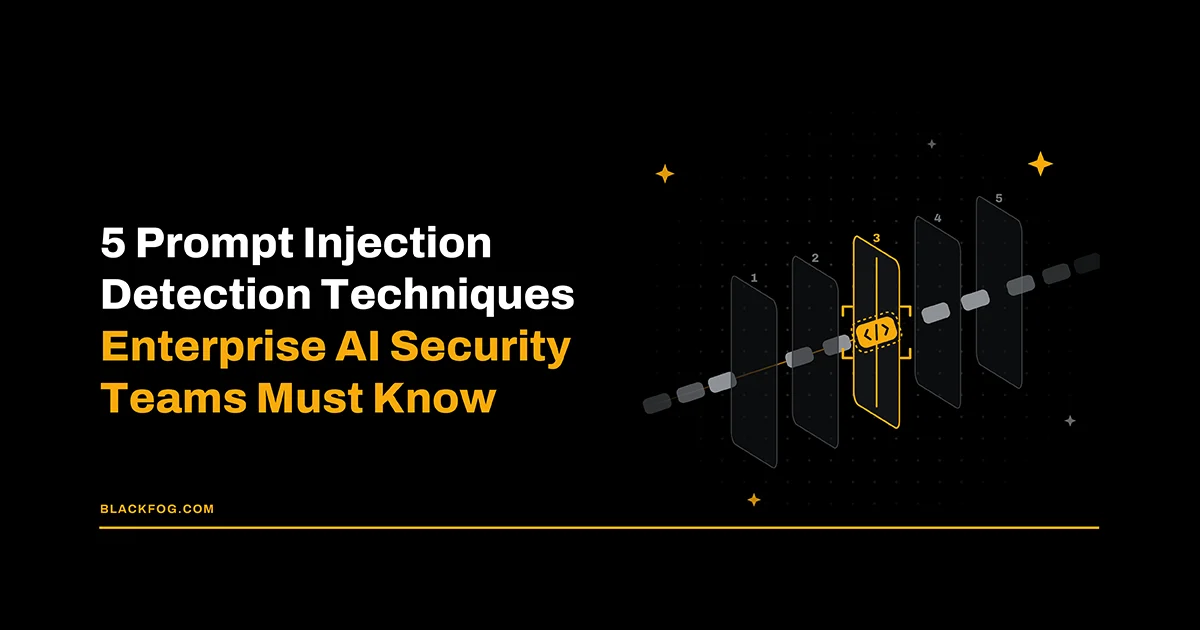
Attackers keep finding new ways past defenses, but security teams are not standing still. It’s particularly important to know how to detect indirect prompt injection in documents, emails and PDFs, as this is where hidden instructions most often sit. The below core techniques are essential for this. However, it’s not enough to focus on one or two approaches. These methods each have their own strengths and limitations, so they need to work together.
1. Pattern and keyword matching: The most basic layer scans inputs for known malicious phrases like “ignore previous instructions”. It is simple to implement, but catches only attacks it recognizes, so fresh wording slips through.
2. Machine learning classifiers: A trained model scores text as benign or malicious, catching variations a fixed rule can miss. A second AI can also review the exchange to flag signs of manipulation. However, both can misjudge unusual but harmless content, leading to false positives.
3. Structural and anomaly detection: This flags content that looks wrong, such as odd formatting, hidden text or misplaced instructions. As with AI-reviewed approaches, legitimate quirks can trigger false alarms.
4. Output and behavior monitoring: Rather than judging the input, this watches what the AI actually does, monitoring for unexpected connections and blocking responses until they can be evaluated, even if the prompts have evaded other layers of detection.
5. Tracking untrusted content: Everything the model reads from an outside source is tagged as untrusted, then followed through the system. If that content ends up triggering a sensitive action, such as sending data out, it is flagged for review.
Where Prompt Injection Detection Happens
Prompt injection detection can occur at several points in a workflow. Because each sees a different aspect of AI activity, however, no one touchpoint has the full picture. Therefore, a layered approach is essential.
- Vendor: Detection built into the AI provider’s own platform catches common attacks inside that service. It covers only that one tool, however, leaving the business with no visibility or control over it.
- Gateway: A proxy between the model and its connections screens and logs everything routed through it. It misses any traffic that bypasses it, though, including browser-based or shadow AI tools.
- Browser: Monitoring inside the web browser catches injections hidden in pages and web-based assistants. It sees nothing in desktop apps, local tools or direct API calls, while needing the extension installed.
- Endpoint: Detection on the device itself watches every AI interaction that happens there, including shadow AI, encrypted sessions and local servers. It can only protect devices where the agent is installed.
How To Detect Prompt Injection Early: 6 Key Steps
Spotting an attack early means watching the right signals continuously. Detection is an ongoing process that goes far beyond setting rules and signatures to look out for. These steps help catch an injection while it is still unfolding:
- Set a behavioral baseline: Establish what normal inputs, outputs and actions look like, so deviations stand out.
- Inspect content as it arrives: Check incoming emails, documents and pages for injection signs before the model acts.
- Monitor outputs and actions live: Watch responses and tool calls in real-time for anything unexpected.
- Track data movement: Flag sensitive information attempting to leave through any outbound channel.
- Automate instant alerts: Surface anomalies the moment they appear, without waiting for someone to notice.
- Review and tune continuously: Refine detection rules as attackers change tactics.
Prompt Injection Detection With BlackFog ADX Vision 2.0
BlackFog’s ADX Vision 2.0 is an independent control layer that brings prompt injection detection to the endpoint, whether this comes from inputs typed by employees or autonomous workflows where there is no human oversight of what is being sent, such as those generated by an AI agent. Within this, it includes seven distinct layers of protection to detect and respond to prompt injection attempts. These are:
- Context switching protection
- Obfuscation protection
- Jailbreak detection
- Data exfiltration protection
- Dangerous prompt pattern detection
- Fuzzy keyword detection
- Structural anomaly detection
The same protections apply whether a prompt is written by an employee or generated by an AI agent acting on their behalf, extending cover to autonomous workflows where no human reviews what is sent. Custom controls can also be applied at a company or departmental level, identifying sensitive information such as credit card numbers, Social Security numbers and domain-specific terminology.
Tools like ADX Vision 2.0 that run on the end-user’s device are able to spot activity that other layers of defense such as vendor and network tools miss, including shadow AI and encrypted sessions. This makes the endpoint the essential last line of defense in any prompt injection protection solution, stopping costly data exfiltration before it happens.
Prompt Injection Detection FAQs
Can prompt injection be detected reliably?
Not perfectly. Because attacks use ordinary or obfuscated language that can be endlessly reworded, no single method catches everything. Combining several detection techniques with endpoint visibility raises the hit rate considerably, but some attempts will always get through, which is why containment matters too.
What is a prompt injection detection model?
A machine learning model trained on many examples of injection attempts, so it can score new text as benign or malicious. Unlike fixed keyword rules, it recognizes reworded variations, though it can flag unusual but harmless content as a false positive.
Can you detect prompt injection hidden in a PDF?
Yes, to a point. Detection tools scan documents for hidden instructions, catching tricks like invisible text, odd formatting or encoded content in a PDF’s metadata. Deeply disguised or novel payloads can still slip past, so scanning works best alongside other layers.
What’s the difference between detecting prompt injection and detecting jailbreaks?
Injection detection looks for hidden commands that hijack the model, often from outside content. Jailbreak detection looks for attempts to bypass its safety rules. They overlap, since jailbreaking is one form of injection, but each looks for different warning signs.
Do we need detection if we already have prevention controls?
Yes. No prevention is foolproof, so some attacks will always get past the first line of defense. Detection is what catches those, letting a team contain it before data is exfiltrated. The two work together, not instead of each other.