 Skip to content

The Rise Of Shadow AI: Preventing Data Exfiltration In The Age Of ChatGPT
Generative AI has rapidly become embedded across everyday business workflows in many companies. However, this means enterprises are facing a new and rapidly emerging risk: shadow AI. Much like traditional shadow IT, shadow AI refers to the use of unapproved tools outside the visibility and control of IT and security teams. However, in today’s data-driven, AI-first world, it has the potential for far greater consequences.
According to McKinsey, nearly nine out of ten organizations (88 percent) used AI regularly in at least one business function in 2025, with 79 percent turning to generative AI. This is up from 78 percent of businesses just 12 months earlier, underscoring how quickly generative AI is spreading across the enterprise. Employees rely on public AI tools to analyze data, write code or generate content. To do this, they often share sensitive information with the services, which can then be exposed, retained or exfiltrated without governance or oversight.
As enterprise adoption accelerates, organizations must act now to understand the role of AI in cybersecurity, what risks shadow IT may pose and what controls should be in place to protect data.
Shadow AI Vs Shadow AI: How Are They Different?
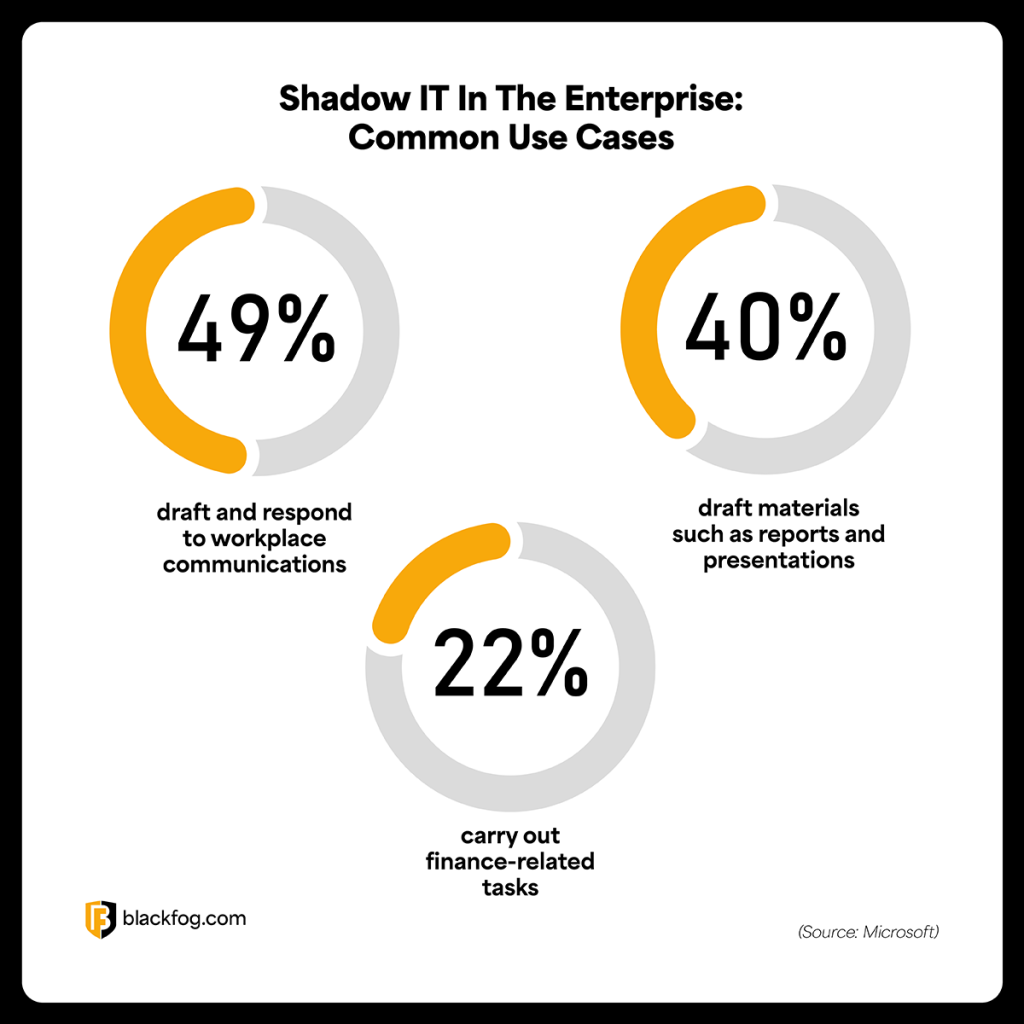
Shadow AI refers to the use of generative AI tools such as public chatbots, coding assistants and AI-powered analytics platforms without the approval, oversight or governance of IT and security teams. In many cases, these are being operated from personal accounts using consumer-grade offerings rather than the dedicated enterprise services offered by the likes of ChatGPT.
This is a natural evolution of shadow IT, but it has the potential for far greater risk. While shadow IT typically involves unsanctioned software or cloud services, shadow AI actively processes, stores and generates data using sensitive business information as input.
Unlike traditional shadow IT, shadow AI capabilities make it frictionless for users to paste proprietary data, source code, credentials or customer information directly into external systems. These interactions are difficult to monitor and rarely leave clear audit trails. This means cybersecurity teams may have no idea where this data resides, who has access or how it is being used.
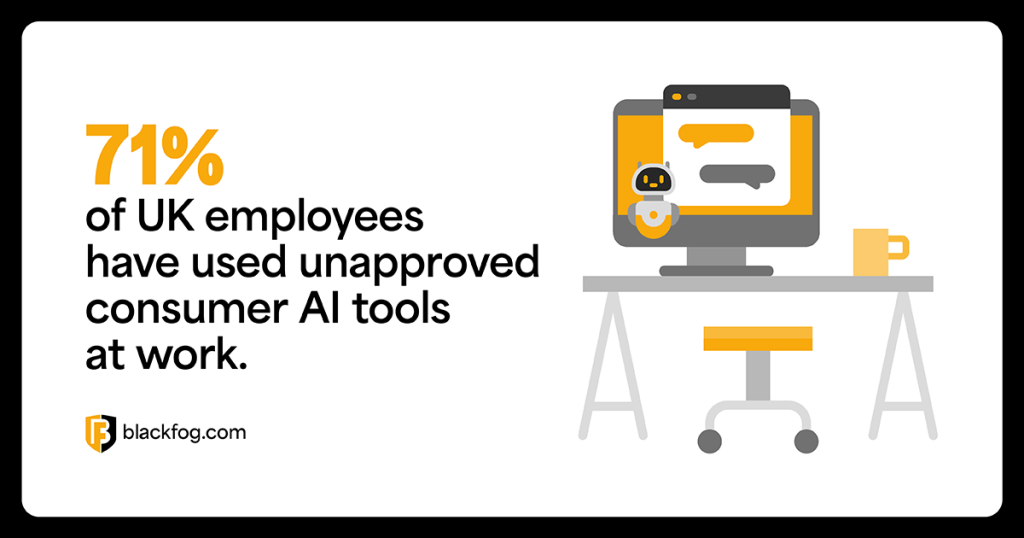
Shadow AI cybersecurity threats are a problem affecting a growing number of businesses. Research from Microsoft, for example, found that 71 percent of UK employees have used unapproved consumer AI tools at work, with more than half (51 percent) doing this every week. Common reasons for this include familiarity with the tools from their personal life and a lack of corporate-approved alternatives. However, just 32 percent said they were worried about the privacy of company or customer data they input into consumer AI tools.
“Generative AI is now woven into everyday business operations, often faster than security teams can govern it. Shadow AI represents a fundamental shift in cyber risk, not because the tools are malicious, but because they quietly move sensitive data beyond visibility, control and accountability. In an AI-first world, unmanaged data exposure can create far greater business impact than traditional shadow IT ever did.”
– Darren Williams, CEO and Founder, BlackFog
How Shadow AI Creates New Data Exfiltration Pathways
Shadow AI security risks include a wide and growing range of threats, with the unintended exfiltration of data a key issue. While much of the attention has focused on employees sharing sensitive data with external AI tools, unapproved or poorly governed AI use creates multiple new pathways for data to leave the organization undetected.
Some of the most common risks include:
- Prompt-based data leakage: Employees frequently paste sensitive information such as customer records, internal communications, credentials or source code directly into AI prompts. Once submitted, this data may be logged, retained or incorporated into the provider’s model training sets, potentially allowing proprietary information to be surfaced to unauthorized third parties via future queries.
- File uploads and automated indexing: Many AI platforms allow users to upload documents or connect directly to cloud storage to provide context. This allows large volumes of proprietary data to be transferred outside the organization in a single action. Furthermore, AI browser extensions may silently scrape or index data from internal SaaS applications without the user manually pasting content.
- Evasion of endpoint controls: Web-based AI services operate over standard HTTPS traffic, making them indistinguishable from legitimate web browsing to many legacy security tools. Because these interactions occur within approved browsers, sensitive data can leave endpoints without triggering alerts from signature-based controls, which lack the application-level visibility to parse AI traffic.
- AI-assisted data aggregation and inference: Generative AI can synthesize information from multiple disparate internal sources into a single, high-value output. This process increases the sensitivity of the information, as a single exfiltrated summary may contain the combined value of dozens of otherwise low-risk documents, or make inferences about data subjects that compromise their privacy.
Traditional security solutions, such as legacy data loss prevention tools, are not designed for these scenarios. These rely on predefined rules and known data patterns, making them unable to interpret the intent or context of natural language interactions with generative AI tools. This allows data to be exfiltrated quietly and at scale through the dynamic, conversational interface of shadow AI.
Why ChatGPT And Public GenAI Tools Are A Security Blind Spot
Public generative AI models such as ChatGPT have been widely adopted because they are easy to access, powerful and require no technical setup. In many cases, employees use these tools with good intentions, such as improving productivity, summarizing information or accelerating routine tasks. However, when consumer grade AI services are used inside the enterprise, they create a significant security blind spot.
Users may enter sensitive or regulated data into unauthorized AI tools without fully understanding how that information is stored, processed or retained. Public platforms often operate under data handling policies that differ from enterprise security requirements and organizations typically have little to no visibility into how submitted data is used once it leaves their environment.
While ChatGPT Enterprise security tools offer businesses ways to control how data is used, this is not the case for free and consumer-grade versions. This makes it difficult to track data flows, enforce governance or confirm whether information has been reused, shared or retained beyond its original purpose. Without visibility or control, organizations may not even realize sensitive data has been exposed until it is too late.
The Real World Impact Of Shadow AI On Enterprises
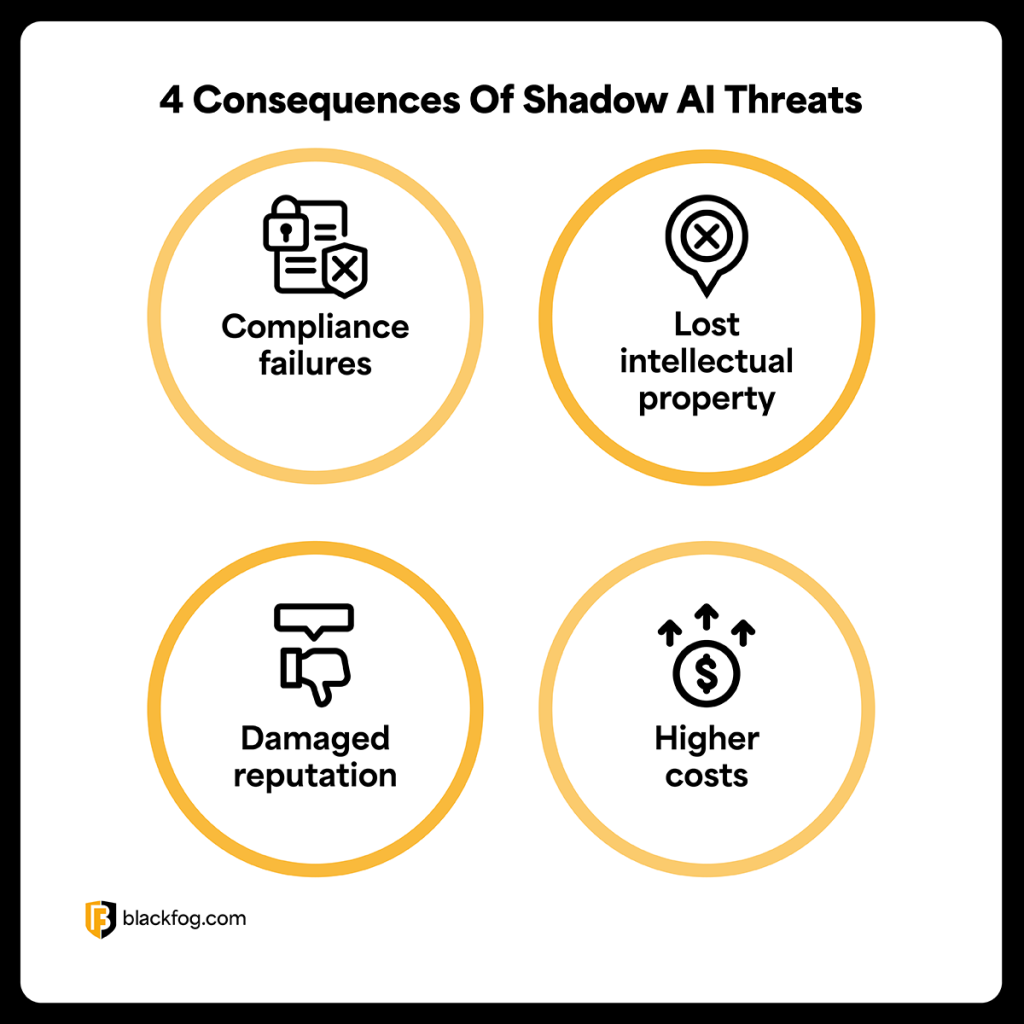
When shadow AI adoption is left unmanaged, the consequences for enterprises can be severe and long lasting. What often begins as well-intentioned use of AI tools can quickly escalate into material business risk, particularly when sensitive data is involved.
- Compliance violations: Unapproved AI use can result in regulated data being shared with third party services outside approved environments. In sectors such as healthcare, finance and government, this can lead directly to violations of regulations such as HIPAA, GDPR or industry specific mandates, triggering audits, fines and legal action.
- Loss of intellectual property: Employees may unknowingly expose proprietary data such as source code, product designs, research or strategic plans to external AI platforms. Once this information leaves the organization, it may be impossible to recover or control how it is reused.
- Reputational damage: Data exposure linked to shadow AI systems can undermine customer trust and damage brand reputation. Public disclosure of sensitive data misuse, even if accidental, can have long-term impacts on customer relationships and market confidence.
- Increased remediation costs: Investigating AI-related data exposure, responding to incidents and managing regulatory fallout is far more costly and disruptive than preventing data exfiltration in the first place.
These are not merely hypothetical risks. According to research by Gartner, more than 40 percent of enterprises will experience a shadow AI-related data breach by 2030. To mitigate these risks, employee education, clear enterprise-wide policies for AI tool usage and regular audits to detect shadow AI activity are essential.
Preventing Shadow AI Data Exfiltration At Scale
Addressing shadow AI data leakage requires a coordinated strategy. It’s not just about the right technology, but also requires clear policies and for everyone to take responsibility for how they use data.
Enterprises must also reduce risk without blocking innovation, as overly restrictive controls often drive employees toward unapproved tools. Effective prevention focuses on visibility, real-time protection and enabling safe AI use at scale.
When it comes to addressing user behavior and setting out policy measures, key steps include the following:
- Clear acceptable use policies for AI: Organizations must define which AI tools are approved, how they can be used and what types of data are prohibited. These policies should be practical and aligned with real workflows, not generic or overly restrictive.
- Employee education and awareness: Users need to understand that AI interactions are data-sharing events. Training should focus on real-world scenarios, such as prompts, file uploads and browser extensions, so employees recognize how data can leave the organization unintentionally.
- Shared accountability for data protection: Shadow AI should not be treated as a purely technical issue. Legal, compliance, HR and security teams must align on responsibilities to ensure AI usage meets regulatory and business requirements.
- Enablement of approved AI tools: Providing secure, enterprise-approved AI alternatives reduces the incentive for employees to seek out consumer grade tools. When approved options are easy to use, adoption follows policy rather than bypassing it.
On the technical side, there are also a range of controls and protections that should be implemented to ensure data is protected at all times. The following generative AI security solutions are especially important as businesses scale and the number of endpoints grows:
- Real-time data exfiltration prevention: Security controls must be able to detect and block sensitive data movement as it happens, regardless of whether the destination is an AI tool, browser session or cloud service. Post-event alerts are insufficient once data has already left the environment.
- Endpoint level visibility and control: Shadow AI protection must start at the endpoint. Lightweight endpoint protections are essential to monitor data access and prevent unauthorized transfers without degrading performance or user experience.
- Behavior-based detection: Traditional rule-based controls struggle with AI-driven workflows. Solutions must understand normal user behavior and identify anomalies, such as unusual data aggregation or outbound activity linked to AI usage.
- Protection beyond known channels: Controls must operate independently of specific technologies, such as email, file transfer or predefined applications. AI interactions frequently bypass these channels, making network-centric or signature-based tools ineffective.
- Scalable enforcement without friction: Security solutions should enforce policies consistently across users and devices while allowing legitimate AI-driven workflows to continue. Excessive friction increases shadow behavior rather than reducing it.
Preventing shadow AI data exfiltration is not about stopping AI adoption. It’s about enabling innovation safely by combining user awareness with real-time, behavior-driven protection that keeps sensitive data inside the enterprise where it belongs.
Shadow AI Is Here To Stay: Your Data Doesn’t Have To Leave
Shadow AI is not a passing trend. As generative AI becomes embedded across business operations, its unmanaged use represents a growing AI cybersecurity risk that no organization can afford to ignore. Waiting to respond until after data has already been exposed is costly, disruptive and often ineffective. Instead, enterprises must take proactive steps to address unsanctioned AI usage as part of a comprehensive, holistic data protection strategy.
By combining clear policies, user awareness and real-time controls that prevent unauthorized data exfiltration, organizations can embrace the benefits of responsible AI while keeping sensitive data secure. Shadow AI may be here to stay, but data loss doesn’t have to be.
Share This Story, Choose Your Platform!
Related Posts
What Enterprises Need To Know About Cyber Governance, Risk And Compliance
Learn all about cyber governance, risk and compliance in 2026 and why this must be a consideration at the highest levels of all organizations.
Navigating Essential Cybersecurity Compliance Standards: What To Know
There are a range of cybersecurity compliance standards firms of all sizes must deal with, including mandatory and voluntary frameworks. Here's what you need to know.
Understanding The Requirements Of Information Security Compliance
Learn precisely what information security compliance entails and the various steps that go into making this effective.
The Importance Of Effective Cybersecurity Services For Small Businesses
Find out why cybersecurity services for small businesses are more in-demand than ever as cybercriminals shift their focus to less-sizable enterprises.
Cybersecurity Compliance: What You Need Without Hiring A CISO
Find out what's required to ensure cybersecurity compliance and how this can be achieved without the need for a full-time CISO.
How Cybersecurity Startups Manage Compliance And Security Certifications
For cybersecurity startups, prioritizing compliance early builds trust, accelerates growth, and ensures security standards align with evolving threats and customer expectations.