 Skip to content

The Expanding Role Of AI In Cybersecurity For Enterprises
Cybersecurity teams are today facing a growing challenge, driven by a huge increase in both the volume and sophistication of the threats they face. A major part of this is the rise of AI-powered attacks that enable threat actors to move faster, operate at greater scale and adapt their tactics in real-time.
At the same time, the rise of shadow AI within enterprises is making it harder for defenders to maintain visibility into when data is being accessed, how it is being processed and where it is being sent.
With AI widely used by both employees and attackers, traditional security approaches are no longer sufficient on their own. To keep pace with this evolving landscape, security teams must focus more closely on the role of AI in cybersecurity. Adopting AI-driven defensive solutions is becoming essential to detect threats earlier, respond faster and protect sensitive data more effectively.
Why Traditional Cybersecurity Approaches Are No Longer Enough
The rapid rise of AI-powered cyberattacks is creating conditions that traditional cybersecurity tools were never designed to address. According to a 2025 survey by Darktrace, 78 percent of chief information security officers report that AI-powered cyber threats are having a significant impact on their organizations, highlighting the growth of these attacks.
Legacy tools so often struggle because they rely on static signatures, predefined patterns and predictable threat behavior. However, AI-enabled threats can change tactics in real-time, craft highly personalized social engineering campaigns and scale attacks across multiple vectors simultaneously. This dynamic behavior makes anomalous activity harder to detect and increases the likelihood of false positives, contributing to alert fatigue and slower response times.
How AI Strengthens Enterprise Cyber Defense
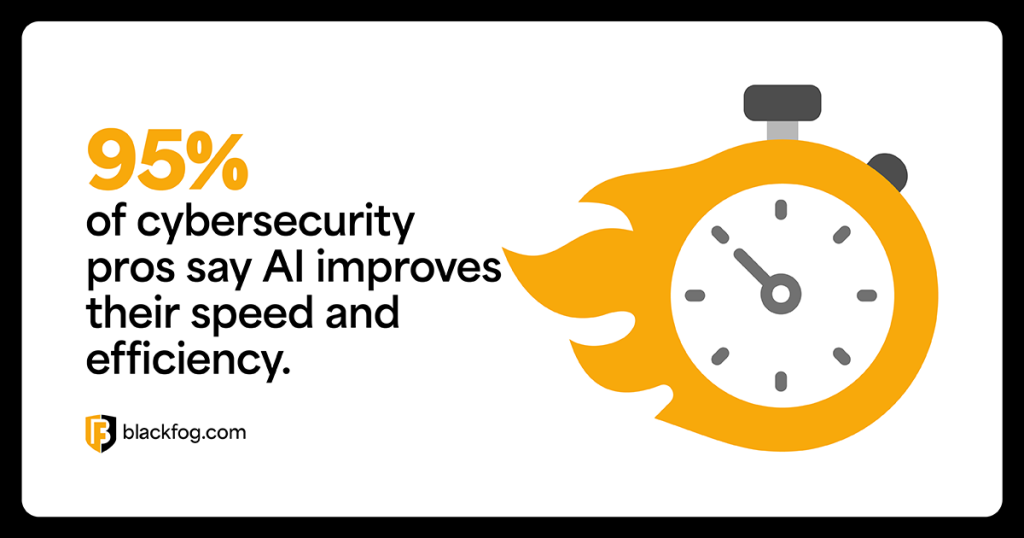
As AI cybersecurity threats grow more automated and adaptive, AI is becoming essential to modern cyber defense. Darktrace’s report also noted that 95 percent of cybersecurity professionals believe AI improves the speed and efficiency of security operations. In practice, use cases for this technology are emerging across several distinct areas of enterprise defense.
Identifying Anomalous Behavior
AI plays a critical role in identifying unusual or suspicious behavior by analyzing patterns of user activity, data access and system interactions at a scale and speed that traditional tools cannot match. Rather than comparing activity to predefined rules, AI can establish baselines of normal behavior for users, devices and applications, then detect deviations that may indicate a cybersecurity risk.
This is particularly valuable for identifying subtle, low-and-slow data exfiltration attempts, where small amounts of data are accessed or transferred over time to avoid detection. AI can correlate seemingly minor anomalies, such as unusual access times, unexpected data aggregation or unfamiliar traffic destinations, to surface threats that would otherwise go unnoticed.
Accelerating Threat Investigation And Triage
AI also plays an important role in helping security teams separate meaningful signals from background noise. Modern enterprise environments generate vast volumes of security alerts, many of which are low risk or false positives. AI can analyze these signals in context, correlating activity across users and endpoints to identify which events genuinely require investigation.
By prioritizing high-risk behavior, AI enables faster and more effective triage, reducing alert fatigue and improving response times. At the same time, AI acts as a support tool for cybersecurity analysts. By reducing false positives and highlighting the most relevant threats, the technology allows teams to focus their expertise on high-priority investigations and complex decision-making.
Preventing Data Exfiltration In Real-Time
AI also plays a critical role in guarding against the exfiltration of data. By acting as a last line of defense at the endpoint and continuously monitoring data access and movement, AI can identify suspicious behavior as it happens and take proactive steps to block it before sensitive information leaves the organization.
This real-time approach is especially important in AI-driven environments, where data can be transferred instantly through prompts, file uploads or automated workflows. AI-driven controls can detect abnormal data aggregation, unusual outbound transfers or unauthorized access attempts and intervene immediately. By stopping data loss in real-time, AI-powered endpoint protections help organizations minimize impact, maintain control over sensitive information and enable secure AI adoption at scale.
The Importance Of Responsible AI Use In Cybersecurity
While AI offers significant benefits for strengthening cybersecurity defenses, it also introduces important considerations around issues such as privacy, bias and transparency. AI systems rely on data to function effectively and organizations must ensure that sensitive information is handled responsibly and in line with regulatory and ethical expectations.
AI-driven security tools also have limitations. They can produce false positives, reflect bias in training data or make decisions that are difficult to explain without human oversight. This makes clear policies essential – not only for how generative AI tools are deployed, but also for how data is analyzed and acted upon during cybersecurity operations.
Ultimately, effective cybersecurity requires a comprehensive, layered strategy. AI should be used to augment human expertise, not replace it. Combining technology, policy and skilled cybersecurity professionals remains critical to building resilient and responsible cyber defenses.
Share This Story, Choose Your Platform!
Related Posts
Claude Coding Jailbreak: Latest Risks And Enterprise Impact
Claude coding jailbreaks: recent research, how enterprises can reduce artificial intelligence (AI) security risks with better monitoring and governance.
What Are The Advantages Of Using AI In Intrusion Detection?
Explore the advantages of AI in intrusion detection, from faster analysis and greater scale to identifying previously unseen attack patterns.
How Can Cybersecurity Professionals Defend Against Threats Posed By Malicious AI Tools?
Learn how cybersecurity professionals can defend against malicious AI tools with AI-specific monitoring, least-privilege access and outbound visibility.
Are There Any Government Policies On Using AI For Cybersecurity?
Learn how the EU AI Act and US NIST frameworks address the use of AI in cybersecurity and what their different approaches mean for businesses.
Can AI Be Used To Effectively Prevent Cyberattacks?
AI helps prevent cyberattacks by spotting threats without known signatures, but it works best alongside human oversight, governance and a layered strategy.
How Is GenAI Transforming Cybersecurity Strategies?
GenAI is reshaping cybersecurity strategy, from faster alert triage and incident response to the consolidation of tools into fewer platforms.