 Skip to content

AI Cybersecurity Threats Vs Traditional Attacks: What’s Changed?
The rise of AI has fundamentally changed the nature of the cyberthreats businesses face. While traditional attacks relied heavily on manual effort and fixed techniques, AI now enables threat actors to automate, scale and refine cyberattacks with unprecedented speed and precision, making it easier for cybercriminals to identify targets, craft convincing lures and adapt their tactics in real-time.
This shift introduces a new set of challenges for enterprises, from shadow AI to more sophisticated ransomware attacks. As defenses designed for predictable, signature-based threats struggle to keep up, organizations must therefore adapt their cybersecurity strategies to address the realities of AI-driven attacks and remain secure.
How AI Enables Attacks At Greater Scale And Speed
AI has dramatically increased the scale and speed at which cyberattacks can be carried out. Traditional attacks often required manual reconnaissance, handcrafted payloads and sequential execution. In contrast, AI allows threat actors to automate key stages of the attack lifecycle, from identifying vulnerable targets to launching attacks.
AI-powered tools can scan large environments to identify weaknesses, generate tailored content and launch thousands of attacks simultaneously with minimal human involvement. These can also adapt in real-time, modifying tactics to evade detection or exploit newly discovered opportunities.
This ability to operate continuously and at scale makes AI-driven cyberthreats particularly dangerous. Even well-defended organizations can be overwhelmed by the volume, speed and adaptability of attacks that far exceed what traditional security models were designed to handle.
Lowering The Barrier To Entry For Threat Actors
In addition to faster, larger attacks, AI also significantly lowers the barrier to entry for cybercriminals. Tools such as generative AI platforms and automated malware builders allow less skilled actors to carry out sophisticated cyberattacks that previously required deep technical expertise.
This shift enables threat actors to produce high-quality, highly personalized attacks at scale, increasing their likelihood of success. As a result, businesses face a growing number of credible threats from a wider pool of adversaries. The expansion of capable threat actors makes the cyberthreat landscape more crowded and more difficult for organizations to defend against using traditional security approaches alone.
Common Offensive AI Techniques Used In Modern Cyberattacks
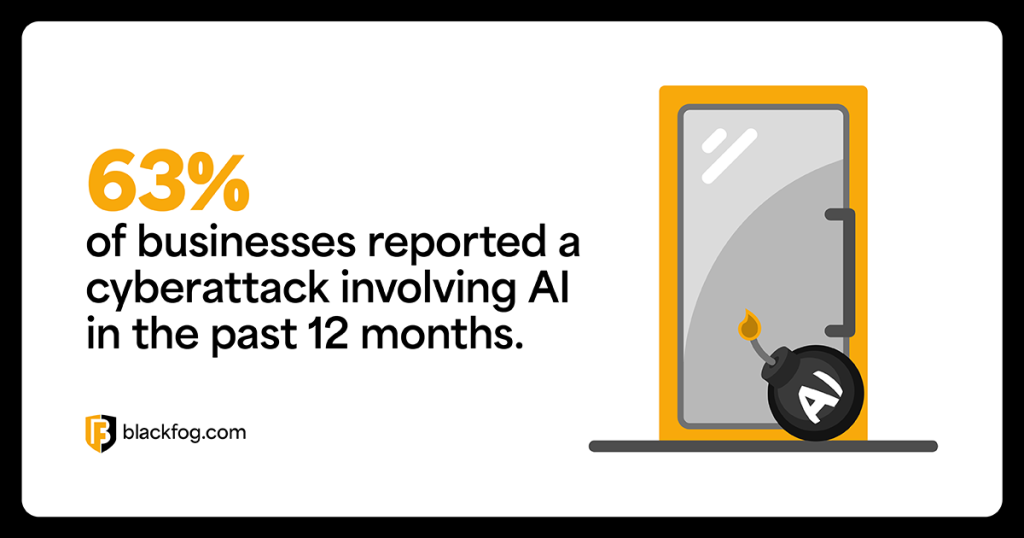
Understanding the range of AI-powered attack techniques helps teams identify what AI cybersecurity risks they face and how these dangers may manifest in practice. In many enterprises, this risk is no longer hypothetical. For instance, a recent survey found that more than six in ten organizations (63 percent) report experiencing a cyberattack involving AI in the past 12 months, highlighting how mainstream AI-powered threats have already become in the wild.
Common ways in which AI can be used to enhance cyberattacks include:
- AI-generated phishing and social engineering: AI can craft highly convincing phishing messages and social engineering content at scale, without the telltale errors that often make human-crafted attacks easy to spot. By analyzing publicly available data and contextual cues, AI generates personalized emails, texts or messages that mimic trusted senders with a level of sophistication far beyond traditional templated phishing. This increases click-through rates and makes detection by employees and automated filters more difficult.
- Deepfake and voice cloning attacks: Generative AI can create realistic audio or video impersonations of executives or trusted individuals. Attackers use these deepfakes in business email compromise and vishing campaigns to manipulate staff into transferring funds or revealing credentials, bypassing traditional identity checks.
- AI-assisted malware and ransomware development: AI accelerates malware creation, with tools able to automatically generate malicious code tailored to target environments, evade signature-based detection and adapt payloads in response to defensive measures, making traditional defenses less effective.
- Automated vulnerability discovery and exploitation: With AI, attackers can rapidly scan networks and software for weaknesses, prioritizing high-impact vulnerabilities. AI tools can also automate exploit creation, reducing the time between discovering a flaw and weaponizing it. This increases pressure on defenders to patch and respond faster than ever before.
These techniques highlight how AI is not just a tool for attackers to work faster, but a force multiplier that amplifies effectiveness and adapts in real-time, requiring security teams to evolve detection and response capabilities accordingly.
Why AI-Powered Attacks Are More Effective Than Traditional Methods
AI-powered cyberattacks are more dangerous than traditional methods because they are faster, more accurate and far harder to detect. AI enables attackers to analyze large datasets, identify optimal targets and tailor attack techniques with a level of precision that manual approaches cannot match. These attacks can also adapt in real-time, adjusting behavior to evade controls or exploit new opportunities as they arise.
Traditional security defenses were designed for slower, more predictable attack patterns. Signature-based detection, static rules and delayed response mechanisms struggle to keep pace with AI-driven threats that continuously evolve. As a result, organizations that rely on legacy tools risk falling behind attackers who can move faster and operate at scale.
To respond effectively, security strategies must evolve toward behavior-based, real-time detection and response models that can identify abnormal activity and stop attacks before damage occurs. AI is set to become the norm for attacks in the years to come, so businesses must deploy their own AI protection and make adapting to this new environment a top priority.
Share This Story, Choose Your Platform!
Related Posts
Claude Coding Jailbreak: Latest Risks And Enterprise Impact
Claude coding jailbreaks: recent research, how enterprises can reduce artificial intelligence (AI) security risks with better monitoring and governance.
What Are The Advantages Of Using AI In Intrusion Detection?
Explore the advantages of AI in intrusion detection, from faster analysis and greater scale to identifying previously unseen attack patterns.
How Can Cybersecurity Professionals Defend Against Threats Posed By Malicious AI Tools?
Learn how cybersecurity professionals can defend against malicious AI tools with AI-specific monitoring, least-privilege access and outbound visibility.
Are There Any Government Policies On Using AI For Cybersecurity?
Learn how the EU AI Act and US NIST frameworks address the use of AI in cybersecurity and what their different approaches mean for businesses.
Can AI Be Used To Effectively Prevent Cyberattacks?
AI helps prevent cyberattacks by spotting threats without known signatures, but it works best alongside human oversight, governance and a layered strategy.
How Is GenAI Transforming Cybersecurity Strategies?
GenAI is reshaping cybersecurity strategy, from faster alert triage and incident response to the consolidation of tools into fewer platforms.