Skip to content

What Is AI Prompt Security And Why Does It Matter?
AI has now embedded itself in the working day across almost every enterprise. Employees rely on large language models (LLMs) such as ChatGPT, Claude, Copilot and Gemini for a growing share of their work, through both approved deployments and unapproved tools adopted without oversight.
Each of these interactions begins with a prompt, with ChatGPT alone receiving around 2.5 billion of these every day. Every one of those is a potential channel for sensitive data to leave the business, which makes the prompt itself a security risk that must be addressed. Closing these vulnerabilities demands solutions built specifically for this new and heavily-used endpoint, in the form of AI prompt security.
What Is AI Prompt Security?
AI prompt security is the practice of protecting the instructions and data exchanged with AI tools at the point of user interaction. It works to ensure that what goes into a prompt is free from malicious content designed to manipulate the tool, while also keeping sensitive or confidential information from being exposed through it.
This matters because there are both internal and external risks relating to AI prompts. On one side, attackers can craft or plant instructions that hijack how a model behaves, turning a helpful tool into a means of attack. On the other, employees can unintentionally hand over regulated or proprietary data simply by typing it into a prompt. Effective prompt security has to address both threats at once, rather than treating either in isolation. IT should also be able to address risk in both approved and unapproved tools, making it a key part of shadow AI security management.
Common AI Prompt Security Risks
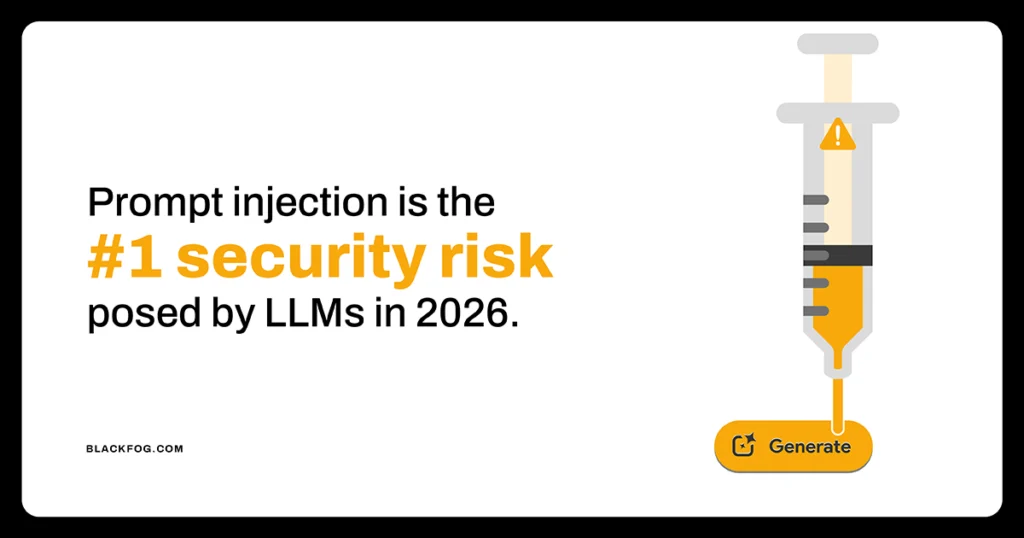
There are several threats related to AI inputs that are highlighted by shadow AI statistics, the largest of which is prompt injection. This has been identified by the Open Worldwide Application Security Project (OWASP) as the number one security risk facing large language models in 2026 – a position it has held for three years running.
Prompt injection generally falls into two categories: direct and indirect. However, alongside these deliberate attacks, inadvertent data exposure must not be overlooked, since OWASP ranks this as the second biggest LLM threat. Each of the three works differently.
- Direct prompt injection: An attacker interacts with the model directly, crafting inputs designed to override system instructions or bypass built-in guardrails. The aim is to make the tool behave in ways its developers never intended, such as revealing hidden information or ignoring safety limits.
- Indirect prompt injection: Malicious instructions are hidden inside external content the AI later processes, such as a web page, document or email. This avoids blunt-force instructions in prompts that may be filtered out by base-level defences and can allow attacks to be launched by innocent users who are unaware of the hidden instructions.
- Inadvertent data exposure: Employees enter confidential or regulated information directly into a prompt or attachment with no malicious intent, simply to get work done. Unapproved tools may then retain that data, use it for training or reproduce it in responses to other users, turning a routine query into a lasting leak.
Prompt Security And Agentic AI
While LLMs are frequently vulnerable to AI prompt security weaknesses, the growing use of agentic AI presents a new – and often wider – threat. Unlike a chatbot that simply returns text, an agent can take instructions and act on them directly, accessing systems, moving data or completing multi-step tasks without further human input. This means that a manipulated prompt can trigger real action.
This creates room for both deliberate attacks and accidental harm. For instance, an attacker could use indirect injection to make an agent forward confidential files or approve a fraudulent transaction. Even without malice, a poorly framed prompt might lead an agent to delete records, email the wrong recipient or overwrite critical data while trying to be helpful. The more autonomy a tool holds, the greater the damage a single flawed instruction can cause.
The Role Of Employee Awareness
Many of the AI prompt security risks come down to behavior which, in most cases, isn’t malicious. Often employees paste sensitive data into prompts or reach for unapproved tools for the sake of convenience, without understanding or thinking about where that data goes.
Effective awareness changes this. Teaching people how prompts can expose data or be exploited helps them make safer choices, steering them away from unsanctioned tools and toward those that sit within the scope of security teams. This makes education a core part of strong shadow AI security, not an afterthought.
Best Practices For Securing AI Prompts
Improving prompt security calls for a combination of clear rules, technical controls and ongoing vigilance. No single measure is enough on its own, so the most resilient organizations layer several together. The following steps offer a practical starting point:
- Set clear prompt guidelines: Define exactly what information may and may not be entered into AI tools, so employees know where the boundaries lie.
- Deploy DLP at the point of input: Use data loss prevention (DLP) tools to detect and block sensitive data before it can leave the business through a prompt or attachment.
- Apply least privilege to tools and agents: Limit what any single tool or agent can access or trigger, keeping the impact of a compromised prompt small.
- Train employees continuously: Build lasting awareness of injection and data-exposure shadow AI risks rather than relying on one-off sessions.
- Monitor and log AI interactions: Maintain visibility over prompts so misuse can be detected, reviewed and acted on.
Employee use of AI tools is not going away. The answer is not to ban the use of tools, but to control them through careful planning and a strong shadow AI management strategy. With clear guidelines, the right tools and a well-informed workforce, threats like prompt injection can be mitigated.
AI Prompt Security FAQs
What is prompt injection?
A prompt injection is an attack where crafted input alters an AI model’s behavior in ways its developers never intended. It can override safety instructions, extract hidden information or hijack the tool’s actions. OWASP ranks it the number one security risk facing large language models.
What’s the difference between direct and indirect prompt injection?
Direct injection is when an attacker feeds malicious input straight into the model. Indirect injection hides instructions inside external content the AI is asked to process, such as a web page or document
Can a prompt itself cause a data leak?
Yes. When employees enter confidential information into a prompt, unapproved tools may retain it, use it for training or reproduce it in responses to others. That single input can expose regulated or proprietary data permanently, with no way to recall it.
Why is prompt security becoming more important with AI agents?
Agents do not just return text, they take action. A manipulated prompt can drive an agent to move data, trigger transactions or alter records autonomously. This turns a flawed instruction into real-world consequences, making prompt security essential as agentic tools spread.
Does prompt security fall under existing compliance frameworks?
Not by name, but the data does. Regulations like GDPR and HIPAA govern how personal and sensitive information is handled, wherever it flows. Entering regulated data into an AI prompt falls squarely within that scope, so prompt security is a genuine compliance concern.