Skip to content

How Shadow AI Security Tools Help Close The Enterprise Visibility Gap
Shadow AI is now in widespread use across the enterprise, but this has opened a visibility gap that most security teams are still struggling to close. A large portion of unsanctioned AI use happens in places that are difficult to effectively monitor and control, such as personal phones and home laptops. Even when accessed on managed devices, browser-based platforms and embedded AI use can slip past controls if they have not been configured properly to inspect them.
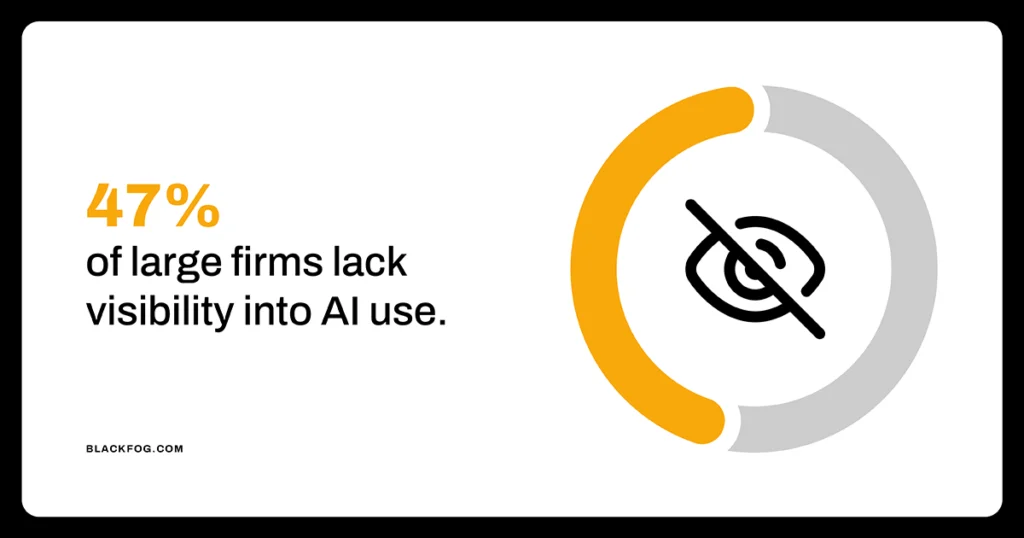
As a result, much activity goes unnoticed. This is borne out by wider shadow AI statistics, with research by consulting firm Protiviti, for example, finding that 47 percent of large organizations lack full visibility into the AI tools their employees use. This matters because security teams cannot protect against activity they cannot see. Closing this gap requires effective technology working alongside clear shadow AI management best practices, deployed together to bring unapproved AI use back into view.
What Is Shadow AI Security?
Shadow AI security refers to the tools and technologies used to detect, monitor and control unapproved AI use across an organization. In plain terms, it is the set of technical defenses that reveal which AI tools employees are actually using, watch what data flows into them and step in when that activity puts sensitive information at risk.
It is related to shadow AI management. However, where management sets the policies and governance that define acceptable AI use, shadow AI security tools focus on the technical enforcement that turns those rules into controls operating on live activity.
The technologies should be considered as an extension of defenses the business already runs. Endpoint protection, data loss prevention (DLP) and network monitoring all have a role to play in protecting against threats such as data exfiltration, while identity and access controls aid in guarding against AI prompt injection attacks.
The Layers Of Shadow AI Security
Effective shadow AI security is layered. No single tool can see every AI interaction and control every data flow, so the strongest defenses must have multiple elements that combine discovery, endpoint control and access management. Each of these addresses a different way shadow AI escapes oversight and together, they turn a critical visibility gap into a monitored, governed part of the cybersecurity estate.
Shadow AI Discovery Tools
The first stage requires knowing what tools are in use. Technologies such as cloud access security brokers and secure web gateways assist with this by inspecting outbound traffic to identify which AI services employees are reaching, including tools no one has approved.
DNS-layer monitoring adds a further view, flagging connections to known AI domains. In shadow AI environments, these tools do the essential first job of bringing hidden AI usage into the light, since new AI platforms appear constantly and AI features are increasingly buried inside already-approved software. A tool that has never been discovered cannot be tiered, monitored or blocked, which makes this layer the foundation everything else depends on.
Endpoint Monitoring And Anti Data Exfiltration
Employees sharing sensitive data with shadow AI tools in prompts or attachments is among the biggest risks enterprises face. Endpoint-based DLP and anti data exfiltration (ADX) technologies can play a key role in preventing this, but they must be designed and configured correctly to spot risky user behavior and intervene before sensitive data leaves the organization.
Traditional tools were not built for the unique nature of AI usage. Effective shadow AI defense therefore demands specific AI-aware capabilities. For instance, technologies must be able to inspect the actual content of a prompt or upload rather than just scanning for known file types, recognize when sensitive data is being pasted or typed into an AI service in a browser, and block such transfers in real-time, whether the device is on or off the corporate network.
AI Access Control Tools
Identity and access management solutions are another essential part of shadow AI security, but by definition, they can’t be applied directly to unsanctioned and unknown platforms. However, what they can do is limit how much damage such tools can cause.
By restricting what any user or connected integration can reach, data fed into an unapproved AI tool is confined to the narrow slice that identity was ever permitted to touch. This matters most with agentic AI, where employees may connect unsanctioned agents into company systems through API keys or OAuth grants. Auditing and tightly scoping those permissions ensures a rogue or manipulated agent cannot range across the wider business, turning a potential breach into a contained event.
Shadow AI: The Next Frontier For Data Protection
Shadow AI risks are now among the most pressing data protection challenges organizations face. The use of such services has opened a fast-growing channel for data to leave the business, through both careless everyday use and deliberate attacks that exploit unmonitored tools. As adoption accelerates, that exposure only grows.
The right combination of technology and policy is essential in closing this visibility gap. This must include pairing endpoint data controls and discovery tools with clear shadow AI management. Treating shadow AI as a core data protection priority is how enterprises stay ahead of this threat, bring unsanctioned usage into the light and keep sensitive data under control.
Shadow AI Security FAQs
Can firewalls or network monitoring detect shadow AI?
They help, revealing which AI services are reached over the corporate network. However, they miss use on personal or off-network devices, and encrypted traffic can hide what data is actually being shared, leaving significant blind spots.
Do browser extensions catch all shadow AI use?
No. Much shadow AI runs outside the browser entirely, in desktop software, mobile apps and embedded AI features. Extensions can also be removed or missing on unmanaged devices, so a browser-only approach leaves gaps that endpoint-level monitoring is needed to close.
What is endpoint-native AI detection?
This monitors AI activity directly on the device, seeing prompts, uploads and copy-paste actions before data leaves. Because it works at the endpoint, it catches interactions even when traffic is encrypted or the device is off the network.
Is shadow AI security the same as data loss prevention?
No, though they overlap. DLP is one component, focused on stopping sensitive data leaving. Shadow AI security is broader, adding discovery of unapproved tools and control over AI access, with DLP as part of the wider toolkit.