Skip to content

AI is now part of everyday working life across the enterprise. Employees rely on it to draft, analyze and accelerate their work, often through tools that IT and security teams never approved. For business leaders, this ‘shadow AI’ trend is not something that can be ignored, or treated with blunt instruments such as blanket bans. It is an immediate reality that, if not handled effectively, can put firms’ most sensitive data at risk.
The figures that follow reveal where the real priorities and vulnerabilities lie. They show how widely unsanctioned AI has spread, how often it leads to data leaving the business and how far governance still lags behind adoption. Understood together, they make a clear case for treating shadow AI management best practices as a core part of enterprise security.
Shadow AI Adoption Statistics
The starting point for any shadow AI problem is scale. Before considering data loss or governance gaps, it helps to grasp how many employees are using these tools, how many are doing so without approval and how willing they are to ignore restrictions if they think it will boost their productivity.
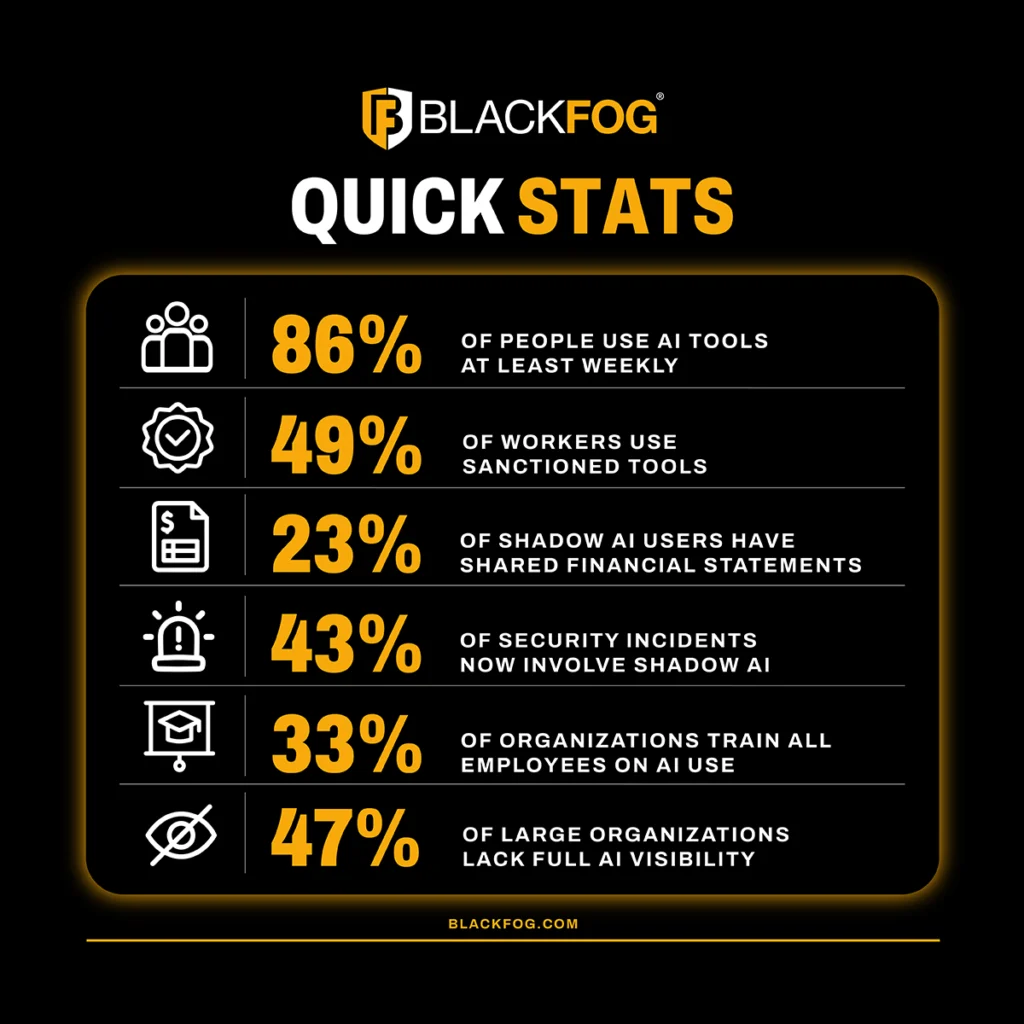
- 86 percent of people now use AI tools at least weekly for work-related tasks. (BlackFog)
- 49 percent of workers use AI tools that are not sanctioned by their employer. (BlackFog)
- 63 percent of employees consider it acceptable to use AI tools without IT oversight if no company-approved option is provided. (BlackFog)
- 67 percent of people use non-corporate accounts on their corporate devices to access AI services. (Verizon)
- 65 percent of employees working in organizations that have implemented AI say it has had a positive effect on their productivity and efficiency. (Gallup)
- 34 percent of employees in organizations that have implemented AI agree or strongly agree it has transformed how they work. (Gallup)
- 45 percent of workers have knowingly used banned AI tools at work. (Anagram)
- 40 percent of employees would break policy to finish a task faster. (Anagram)
- 21 percent of individuals believe their employer would turn a blind eye to the use of unapproved AI tools as long as work is completed on time. (BlackFog)
Shadow AI Data Leakage And Exposure Statistics
Every unsanctioned AI interaction is a potential exit route for sensitive data. Once information is entered into an external tool, the business loses control of where it is stored, who can see it and whether it resurfaces elsewhere.
- 28 percent of data-loss events involving shadow AI contained source code. (Verizon)
- 27 percent of employees using unapproved AI have entered employee data into these tools. (BlackFog)
- 23 percent of people have shared internal financial statements or sales data with unsanctioned AI. (BlackFog)
- 51 percent of employees have connected or integrated AI tools with other work systems or apps without IT approval or oversight. (BlackFog)
- 43 percent of security incidents now involve shadow AI, more than double last year’s 20 percent. (IBM)
- $5.39 million is the average cost of a breach involving shadow AI, compared with an overall average of $4.99 million. (IBM)
- 410 million data loss prevention (DLP) policy violations were tied to ChatGPT alone in a single year. (ZScaler)
- 21 percent of organizations that suffered a shadow AI incident paid a fine to regulators. (IBM)
Shadow AI Governance And Visibility Statistics
A major challenge of shadow AI security is that adoption has raced ahead of oversight. Most organizations still lack the policies, visibility and controls needed to govern how AI is used, leaving a gap between what employees are doing and what security teams can see or manage.
- 47 percent of large organizations lack full visibility into the AI tools their employees use. (Protiviti)
- 68 percent of breached organizations had no governance policy in place to manage AI or detect shadow AI. (IBM)
- 92 percent of organizations that experienced an AI-related breach lacked proper AI access controls. (IBM)
- 53 percent of employees understand how the data they enter into AI tools is saved, analyzed or stored, leaving nearly half unaware. (BlackFog)
- 66 percent of directors say their boards have limited to no knowledge or experience with AI. (Deloitte)
- 31 percent of organizations say AI is not on the board agenda at all, down from 45 percent the previous year. (Deloitte)
- Only 33 percent of organizations train all employees on AI use. (ISACA)
What These Stats Tell Enterprises
These stats clearly highlight how employees have embraced AI faster than their organizations can govern it. The result is a widening gap between everyday use and enterprise oversight.
Policy alone cannot address shadow AI risks. Bans won’t work, as many employees are quite happy to use unsanctioned tools even when they know they should not. The solution requires genuine visibility into how tools are used, technical controls at the point data leaves and a workforce trained to understand the risks. Organizations that act now will be best placed to benefit from AI safely.
Shadow AI FAQs
What is shadow AI?
Shadow AI is the use of AI tools without the knowledge or approval of an organization’s IT or security teams. It usually involves employees turning to public, consumer-grade tools for work tasks, often entering company data into services that were never assessed for business use.
Which industries are most affected by shadow AI?
Knowledge-heavy sectors see the most shadow AI, including technology, financial services and professional services, where employees handle large volumes of text and data. Regulated industries such as healthcare and finance face the greatest exposure, since the data involved is often sensitive or legally protected.
What type of data is most often shared with AI tools?
Source code is the single most common sensitive data type submitted to unsanctioned AI tools, followed by internal documents, images and structured business data. Employee records and financial information are also frequently entered, often with no awareness of where that data ends up.
What is agentic AI and what challenges does it bring?
Agentic AI describes tools that can take actions autonomously rather than simply generating text, such as accessing systems or completing multi-step tasks. This raises the stakes because a compromised or misdirected agent can cause real-world damage, not just expose information.
Why do employees use unapproved AI tools?
Mostly for speed and convenience. Workers turn to whatever tools help them complete tasks fastest, particularly when no approved alternative is provided. Research consistently shows this is driven by productivity pressure rather than any intent to put the business at risk.