Skip to content

The Real Risks Of Shadow AI In The Enterprise
Using Generative AI is now part of everyday life for employees across almost all enterprises. However, this often occurs without the knowledge or approval of the people responsible for security, even when approved tools are available. This unsanctioned use is known as shadow AI and is remarkably widespread. Our research found that 49 percent of employees use AI tools not sanctioned by their employer, with users frequently drawn in by the promise of faster, easier work.
While this does offer a real boost to productivity, it also creates a range of business risks. Every unapproved tool is a potential channel for sensitive data to leave the organization, a gap in compliance or an opening for attackers. These shadow AI risks arise out of sight of security teams, which is exactly what makes close shadow AI management a business essential.
5 Key Shadow AI Risks To Be Aware Of
Shadow AI risk comes in many forms. For starters, there are insider threats, where individuals within the business inadvertently or deliberately share sensitive data with large language models. The use of these tools can also open opportunities for external attackers, while consumer-grade models can also create their own threats to data protection or business integrity. Here are five key dangers to be aware of.
Sensitive Data Exposure
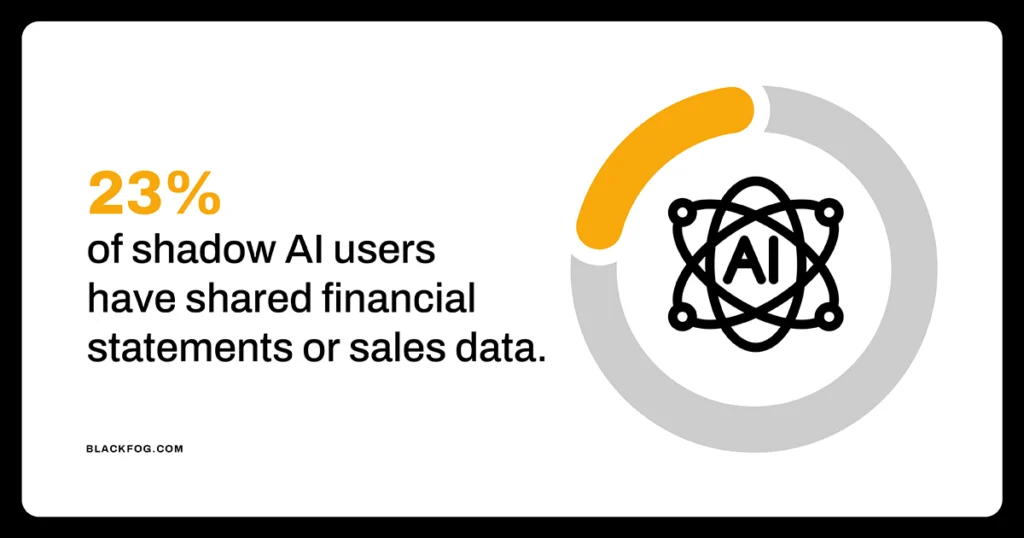
The most immediate risk is clear – employees sending confidential information to external AI tools. Most do so without considering where that data then goes and the scale is significant. Our research found that 27 percent of employees who use unapproved AI have entered employee data such as names, payroll or performance details, while 23 percent have shared financial statements or sales data.
Once submitted, this information sits with a third party the business has not vetted or approved. They may retain what users enter, use it to train future models or reproduce it in responses to other people. Data that leaves this way cannot be recalled, which can expose trade secrets or intellectual property, as well as breaching client confidentiality.
Compliance And Regulatory Challenges
Sending regulated data to an unapproved AI tool can breach rules governing how that information is handled. For instance, GDPR restricts how personal data on EU residents is processed, stored and transferred. Feeding it into a third-party tool with no lawful basis or safeguards can violate those rules. HIPAA imposes similar duties on protected health information in the US, while sector-specific rules cover financial and other sensitive records.
The difficulty is that shadow AI happens without oversight, so such breaches go unrecorded until it is too late. Firms cannot demonstrate compliance for data flows they cannot even see.
Prompt Injection And Other Attacks
Unapproved AI tools give external attackers a new way in, with exposure to prompt injection attacks among the most significant vulnerabilities. These techniques see threat actors inserting malicious instructions into content fed into an AI, either directly in the prompt or within content the AI processes, such as a web page, document or email. A model connected to company systems can then be manipulated into revealing confidential data or exfiltrating it to an attacker.
These tools can also be used to deploy malware into the business, whether through malicious output or by exploiting the access an unvetted tool has been granted. Strong AI prompt security is essential in preventing this, but unsanctioned tools cannot be covered by these defenses.
Operational And Decision-Making Risks
Shadow AI risks are not only limited to what goes into these tools, but also in what comes out. Unapproved AI tools will not have been assessed for accuracy or bias, so their suggestions may be flawed or wrong, or not take into account the specifics of the business. Without vetting, hidden bias and confident errors go unchecked.
This can result in poor decision-making by employees. For instance, 2022 research by DataRobot and the World Economic Forum found that 36 percent of organizations have suffered a direct business impact due to AI bias, with 62 percent of those losing revenue.
Reputational Harm
Shadow AI breaches don’t just have operational consequences – they can cause lasting damage to how a business is perceived. When a data leak, compliance failure or flawed decision comes to light, customers, partners and regulators may conclude that the organization cannot be trusted with sensitive information.
That perception is hard to reverse. Existing customers may take their business elsewhere, while prospects may walk away. In sectors built on confidentiality in particular, the reputational fallout from a shadow AI incident can outlast the financial and technical harm by years.
Why Shadow AI Is So Hard To Detect
Shadow AI is often far harder to spot than traditional shadow IT. In the past, unapproved applications often left a trace somewhere, such as in network traffic or installed software. However, this is not always the case with shadow AI.
While shadow AI can be detected on corporate-owned and monitored devices, through signs like DNS requests, web proxy logs and browser history, much of it happens through personal phones and laptops well beyond the corporate network.
An employee pasting data into a chatbot at home generates nothing for security teams to catch. This is exactly why visibility sits at the heart of shadow AI security. Closing the detection gap is the difference between managing the risk and never knowing it exists.
Shadow AI Risks FAQs
What is the biggest risk of shadow AI?
Sensitive data exposure is usually the most serious. Employees enter confidential information into unapproved tools that may store it, use it for training or reveal it to others. Once that data leaves the business, it cannot be recalled, making this a permanent loss.
Is shadow AI a compliance violation?
Using AI is not a violation in itself. However, feeding regulated data into unsanctioned tools can breach frameworks like GDPR or HIPAA. Because shadow AI happens without oversight, organizations often cannot prove compliance for data flows they cannot see, compounding the problem.
Can shadow AI lead to a data breach?
Yes. Unapproved tools can expose data directly through user inputs or serve as an entry point for attackers using techniques such as prompt injection. Shadow AI statistics from IBM show it was a contributing factor in one in five reported breaches.
How is shadow AI different from shadow IT in terms of risk?
Shadow IT covers any unapproved technology used without approval. Shadow AI is a subset with sharper risks, because these tools actively absorb the data entered into them, then may store, train on or reproduce it, turning everyday use into ongoing exposure.