 Skip to content

The ChatGPT Security Risks Enterprise Teams Need To Know About
Large language model (LLM) AI tools like ChatGPT have become a fixture of the modern workplace. Employees turn to them for everything from drafting emails and analyzing data to writing code and summarizing meetings. Many businesses have responded by rolling out clear AI usage policies and signing up for enterprise-grade accounts that offer stronger security and data handling guarantees.
However, a far larger number remain exposed because of unsanctioned use of these tools, with staff accessing public, consumer-grade versions on personal devices or outside official channels. This often takes place without IT and cybersecurity teams’ knowledge, and this lack of visibility can pose just as serious a risk to a business as more headline-grabbing AI threats like data poisoning.
The Rise Of Shadow AI In The Workplace
Shadow AI refers to the use of AI tools by employees without the knowledge, approval or oversight of IT and security teams. It is a close cousin of shadow IT, the long-standing problem of staff adopting unsanctioned software and services, but the speed and ease of access to public AI tools has driven it to a scale that traditional shadow IT never reached.
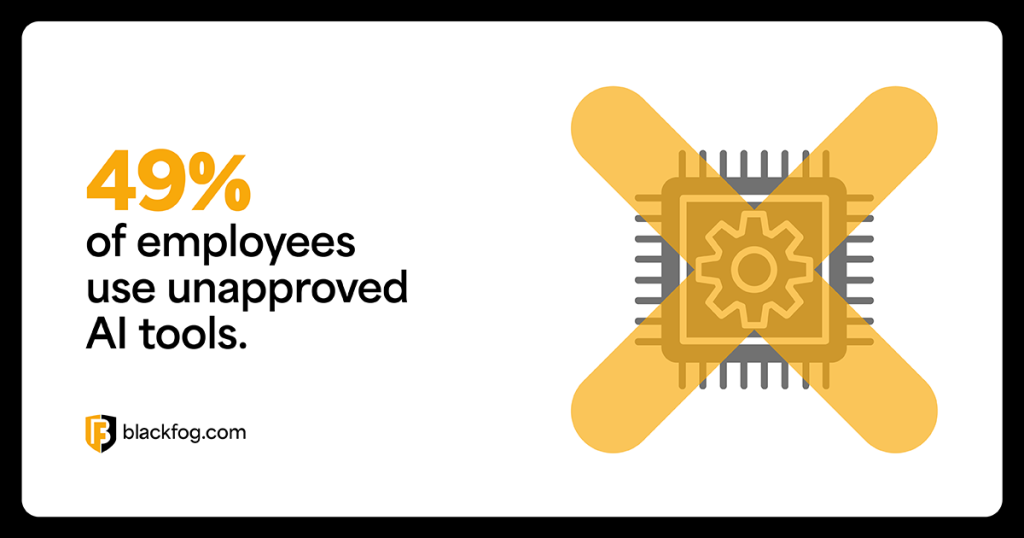
BlackFog research found that 86 percent of employees now use AI tools for work on a weekly basis. However, almost half of these (49 percent) use solutions that are not approved by their employer. What’s more, 58 percent rely on free versions, which often lack enterprise-grade security, data governance and privacy protections.
There are several reasons behind this. Employees turn to ChatGPT and similar tools to save time, boost productivity, tackle creative blocks or get around restrictive corporate processes. Our research also indicates that many believe the pros outweigh the cons, with 60 percent saying that the speed gains are worth the security risks.
How Sensitive Data Leaks Through ChatGPT
Consumer AI tools handle data very differently from enterprise-grade offerings. Free and personal ChatGPT accounts often use submitted inputs to improve the underlying models, retain data on third-party servers and offer none of the contractual protections businesses expect from a vendor. What’s more, once data has been submitted to a public LLM, recovering or deleting it securely is rarely straightforward – and in many cases simply impossible.
Within this, there are several common routes for sensitive information to escape the organization, including:
- Pasting confidential content into prompts: Source code, financial figures, customer records or internal documents may be shared to speed up analysis or summarization.
- Uploading files for processing: Confidential spreadsheets, reports and presentations are fed directly into the AI for review or rewriting, exposing their full contents.
- Use on unmanaged endpoints: Staff working from personal devices or in BYOD setups can move corporate data outside the security perimeter entirely.
- Unofficial browser extensions and plugins: Third-party add-ons can route data through additional providers, each with their own data handling practices.
The Risk Of Bypassing Security And Governance Controls
Even businesses with strong security and governance frameworks can find these systems quietly undermined by shadow AI. Traditional data loss prevention tools, content filters and acceptable use policies were not designed to inspect AI traffic, making sensitive data uploads hard to spot in real-time.
This has serious compliance implications, as regulations like GDPR, HIPAA and the rapidly expanding EU AI Act all impose strict obligations on how personal and sensitive data is handled. The EU AI Act in particular demands documented data governance and human oversight for high-risk AI use, which cannot be achieved if staff are pasting regulated data into tools IT has no visibility over.
Poor ChatGPT security can expose businesses to regulatory fines, breach notification obligations and reputational damage long before any traditional cyberattack occurs.
Practical Steps To Reduce ChatGPT Security Risks
Tackling ChatGPT security risks requires controls and policies tailored specifically to how these tools are accessed and used. Important steps to take include:
- Deploy AI-aware visibility tools: Use solutions that can identify ChatGPT and other LLM traffic across managed and unmanaged endpoints, giving security teams a clear view of who is using what.
- Implement anti data exfiltration controls: Block sensitive data from being submitted to public LLMs at the device level, before it can leave the endpoint.
- Provide sanctioned enterprise alternatives: Offer staff approved versions of ChatGPT or similar tools with proper data handling agreements, so they are not driven to consumer accounts.
- Set clear AI usage policies: Define which tools are approved, what data must never be shared with public LLMs and what the consequences of violations are.
- Train employees on LLM data handling: Help staff understand how prompts and uploads are stored, processed and potentially reused by public AI services.
ChatGPT and similar AI tools are not going away. Businesses that act now to bring this usage under IT oversight will be far better placed to capture the productivity benefits without inheriting security and compliance risks, such as AI poisoning or data leakage.
ChatGPT Security FAQs
What are the biggest ChatGPT security risks for enterprises?
The main risks are data leakage through prompts and uploads, the use of consumer accounts that retain and may reuse submitted data, shadow AI use on unmanaged endpoints and compliance breaches when regulated data is shared with public LLMs.
Can employees accidentally leak sensitive data through ChatGPT?
Yes, and it is one of the most common causes of AI-related data exposure. Staff routinely paste source code, financial figures or customer information into prompts to save time, often without realizing the data is processed outside the organization’s control.
What is shadow AI and how does it affect enterprise security?
Shadow AI is the use of AI tools without IT approval or oversight. It creates blind spots that bypass existing security controls, exposes sensitive data to third-party services and undermines compliance with regulations like GDPR and the EU AI Act.
How can organizations monitor unsanctioned AI usage?
By deploying AI-aware visibility tools that detect LLM traffic across endpoints, applying anti data exfiltration controls and maintaining a clear inventory of approved AI services.
What steps can businesses take to secure ChatGPT usage?
Provide sanctioned enterprise alternatives, set clear usage policies, deploy endpoint-level controls to block sensitive data uploads and train staff on safe prompt and file handling.
Share This Story, Choose Your Platform!
Related Posts
QTFY: Industrializing Cyber Exploitation Against Critical Infrastructure
QTFY: Industrializing Cyber Exploitation Against Critical Infrastructure
Stopping Data Exfiltration Through LLM Prompts And Responses
Data can leave through LLM prompts, responses or agent actions. Learn how each path works and what actually stops it.
The 7 Layers Of Prompt Poisoning Protection Every AI Application Needs
Discover the seven layers of prompt poisoning protection every AI application needs, from input validation to endpoint monitoring.
What Is Zero Trust In Cybersecurity And How Does It Apply To Shadow AI?
Zero Trust means never trust, always verify. Learn how this principle applies to shadow AI and closes the gaps legacy security misses.
What Are The Main Features Of Shadow AI Applications?
Shadow AI applications share five distinct traits, from unapproved access to free-text input. Learn what to look for and why it matters.

How To Avoid Shadow AI In Enterprises
Learn how to avoid shadow AI in enterprises through continuous discovery, fast-tracked approvals and endpoint-level monitoring.