 Skip to content

The Importance Of Effective Shadow AI Detection In Enterprise Security
Enterprise AI security is often focused on direct, targeted threats like data poisoning and prompt injection attacks, where outside actors deliberately set out to compromise corporate systems. However, these are not the only ways in which use of AI tools can expose businesses to risk. In many cases, it is the everyday use of AI tools that can leak highly sensitive data, when employees stray from established procedures or act without proper authorization.
This ‘shadow AI’ activity is particularly difficult to stop because IT and security teams have no visibility into what is happening on their own endpoints. However, the consequences can be severe, which is why effective shadow AI detection tools are now an essential part of any modern security strategy.
Why Shadow AI Is So Hard To Detect
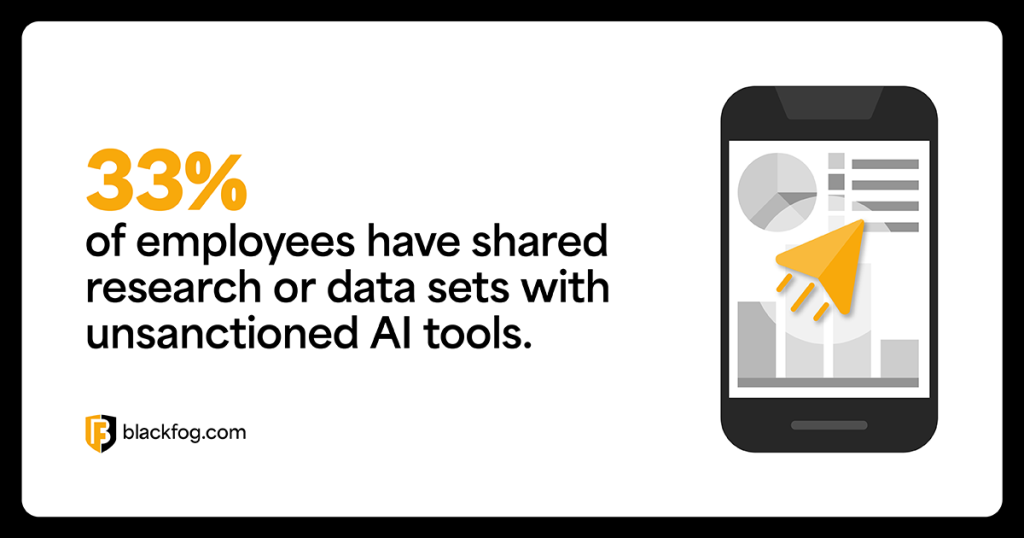
In many cases, shadow AI tools are being used to handle firms’ most sensitive data without the approval of security teams. For instance, BlackFog’s research has found that one-third of employees (33 percent) have shared research or data sets with unsanctioned AI tools, while more than a quarter (27 percent) have entered employee data such as payroll or performance information into these tools, and 23 percent have done so with financial statements or sales data.
This behavior is often tacitly accepted by senior leaders. Some 69 percent of C-suite and president-level respondents say that speed is more important than privacy or security. That cultural acceptance makes it far harder to impress upon employees why caution matters.
Shadow AI is also uniquely difficult to spot on a technical level. AI services run over standard HTTPS to widely trusted domains, blending into legitimate web traffic. Many are accessed via browser tabs, mobile apps or personal accounts that never touch managed corporate infrastructure, while AI features embedded in sanctioned SaaS platforms cannot be blocked without disrupting approved workflows.
The Limits Of Traditional Security Tools
Most enterprise security stacks were built to defend against threats that look very different from shadow AI. Data loss prevention (DLP) tools, for instance, are designed to spot recognizable patterns such as credit card numbers, customer records or specific file types leaving the network. When sensitive content is broken up across conversational prompts or pasted in fragments that no longer match a defined signature, safeguards can be far less effective.
Secure web gateways and firewalls are similarly limited. They block known malicious domains but treat legitimate AI services as ordinary web traffic, since these tools share infrastructure with countless other sanctioned cloud platforms.
Traditional endpoint security suites, meanwhile, are intended to detect malware, suspicious processes and known indicators of compromise, not the everyday behavioral signals that indicate an employee is feeding sensitive data into a public AI tool such as ChatGPT. The result is a security stack that may catch obvious violations but routinely misses the everyday activity where most shadow AI risk actually sits.
The Consequences Of Detection Failure
When shadow AI activity is left unchecked, the data flowing into consumer-grade tools can include almost anything an employee touches in their daily work. Common examples of sensitive information being shared with unsanctioned AI services include:
- Source code and technical documentation: Pasted into free coding assistants to debug issues or generate new functions.
- Customer and client lists: Uploaded to summarize accounts, draft communications or prepare for meetings.
- Financial reports and sales data: Submitted for rewriting, analysis or forecasting support.
- HR and employee records: Shared to help draft communications, performance reviews or policy documents.
- Internal strategy documents: Fed into AI tools for summarization, translation or presentation prep.
Once submitted, this information can be retained indefinitely, used to improve future model outputs or exposed in the event of a breach at the AI provider itself. There is rarely a clean way to recover it.
The compliance implications are equally serious. Sharing regulated data with unsanctioned AI services breaches obligations under the EU AI Act, GDPR and HIPAA, with no audit trail to fall back on. That can translate directly into significant fines, breach notification duties and lasting reputational harm.
What Effective Shadow AI Detection Looks Like
A capable shadow AI detection solution should offer:
- Endpoint-level visibility: Detection that operates directly on the device, capturing AI activity at the source rather than relying solely on network or cloud telemetry.
- Broad coverage of AI services: The ability to identify hundreds of public and emerging AI platforms, not just well-known names like ChatGPT.
- Real-time monitoring and blocking: The power to intervene before sensitive data leaves the device, not simply log it after the fact.
- Behavioral context: Distinguishing routine, low-risk AI activity from genuinely concerning behavior to keep alerts focused and actionable.
- Integration with existing security tooling: Feeding shadow AI insights into the SIEM, reporting workflows and policies already in use across the business.
These capabilities are essential parts of any AI cybersecurity strategy. Full visibility is the foundational requirement on which every other defense depends, whether the threat is everyday data leakage or more targeted attacks like AI poisoning.
FAQs About Shadow AI Detection
What is shadow AI in enterprise environments?
Shadow AI is the use of AI tools by employees without the knowledge or approval of IT and security teams. It typically involves free or consumer versions of LLMs accessed outside official channels.
Why do traditional DLP tools miss shadow AI activity?
Conventional DLP relies on recognizable patterns and file signatures. Shadow AI use often involves sensitive content pasted into prompts in fragments or rewritten by the user, none of which match the rules these tools were designed for.
How can organizations detect unsanctioned AI usage?
The most effective approach is endpoint-level monitoring that captures AI activity directly on the device, paired with broad coverage of public LLM tools and the ability to block sensitive data uploads in real-time.
What are the risks of unmanaged AI applications?
Unmanaged AI applications can expose source code, customer data, financial information and intellectual property to third-party services. They also create compliance gaps under regulations like the EU AI Act, GDPR and HIPAA.
How does behavioral monitoring improve shadow AI detection?
Behavioral monitoring focuses on how AI tools are being used rather than just whether they appear in network traffic. This makes it possible to distinguish low-risk activity from genuinely sensitive data movement, reducing false positives.
Share This Story, Choose Your Platform!
Related Posts
QTFY: Industrializing Cyber Exploitation Against Critical Infrastructure
QTFY: Industrializing Cyber Exploitation Against Critical Infrastructure
Stopping Data Exfiltration Through LLM Prompts And Responses
Data can leave through LLM prompts, responses or agent actions. Learn how each path works and what actually stops it.

The 7 Layers Of Prompt Poisoning Protection Every AI Application Needs
Discover the seven layers of prompt poisoning protection every AI application needs, from input validation to endpoint monitoring.
What Is Zero Trust In Cybersecurity And How Does It Apply To Shadow AI?
Zero Trust means never trust, always verify. Learn how this principle applies to shadow AI and closes the gaps legacy security misses.
What Are The Main Features Of Shadow AI Applications?
Shadow AI applications share five distinct traits, from unapproved access to free-text input. Learn what to look for and why it matters.
How To Avoid Shadow AI In Enterprises
Learn how to avoid shadow AI in enterprises through continuous discovery, fast-tracked approvals and endpoint-level monitoring.