 Skip to content

Data Poisoning Attacks: The Emerging AI Threat Security Teams Aren’t Monitoring For
Enterprise adoption of AI is accelerating at a remarkable pace. Organizations are increasingly embedding machine learning models into every aspect of their operations, from core business functionality to HR, marketing and security operations tools. Regardless of function, these systems depend on vast volumes of data. Information is continually ingested, updated and refined to keep outputs accurate and relevant.
This increasing dependency creates a new and often overlooked attack vector: data poisoning. This is a fast-emerging generative AI security threat in which attackers deliberately manipulate training data or inference inputs to alter how a model behaves and produce misleading or harmful results. Left unchecked, it can introduce hidden security blind spots, drive inaccurate decisions and create serious operational risks, particularly as employees turn to shadow AI tools that sit outside the visibility of IT teams.
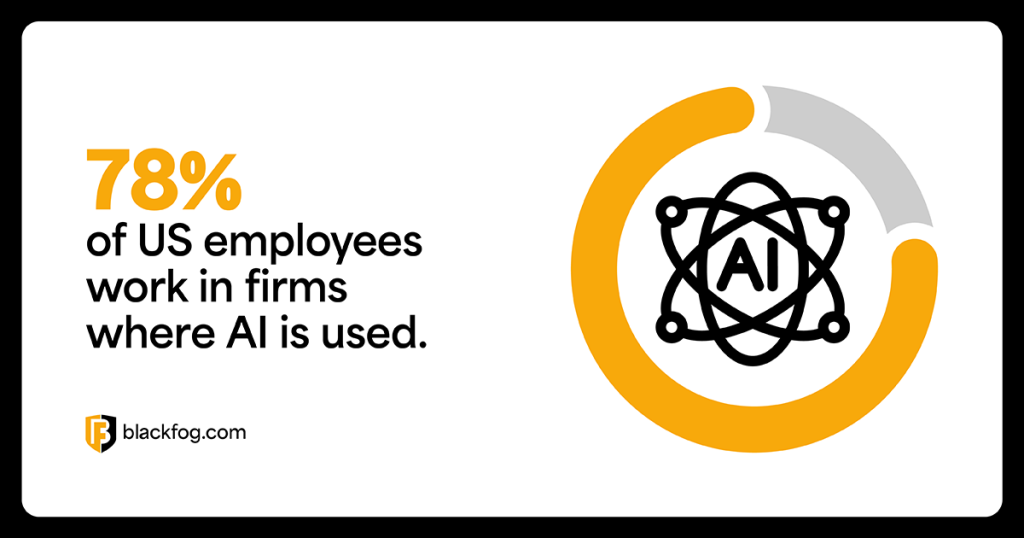
AI is no longer experimental. The Federal Reserve reports that as of November 2025, 78 percent of the US labor force worked at firms that have adopted AI, with about 54 percent of firms using large language models (LLMs). That level of dependency creates a powerful incentive for attackers to target the data these systems rely on. Therefore, understanding the threat of AI data poisoning and knowing how to address it will be essential for any business operating in the age of AI.
What Is Data Poisoning In Enterprise AI?
Data poisoning in AI is a type of adversarial attack in which threat actors deliberately corrupt the data an AI model learns from or processes, causing it to behave in ways its developers did not intend. There are several distinct forms that may take at different stages in the development and deployment of an AI model. These include:
- Training data poisoning: Malicious records are injected into training datasets, skewing the model’s baseline understanding.
- Inference-time poisoning: Crafted prompts manipulate a live model into producing inaccurate or harmful responses without touching training data.
- Backdoor attacks: Hidden triggers are embedded so the model behaves normally until a specific input pattern produces a malicious output.
- Label flipping: Existing data is mislabeled, teaching incorrect associations between inputs and outcomes.
Once a model is corrupted by AI poisoning, every decision it makes thereafter will be influenced by its flaws. Enterprise systems are especially vulnerable because they pull from large, diverse and loosely governed sources that are difficult to validate at scale.
“AI is only as reliable as the data it consumes. As enterprises rapidly deploy AI across the business, data poisoning attacks are becoming a serious concern because they can corrupt outputs, distort decision-making and introduce hidden security risks.
“At the same time, organizations must address the growing challenge of sensitive data flowing into AI applications and shadow AI tools outside traditional security controls. Visibility into where data is going, who is accessing it and how it is being used is becoming essential to maintaining both trust in AI and control over enterprise data.”
– Darren Williams, CEO and Founder, BlackFog
Why Security Teams Are Missing The Threat
Data poisoning takes advantage of a growing gap between traditional cybersecurity and AI governance. While security teams recognize the risks associated with generative AI, the specific mechanics of data poisoning rarely fit the threat models their existing tools were built around. Several factors explain why this attack vector continues to slip past even mature security functions. Key challenges include:
- Outdated security stacks: Traditional tools like SIEMs, EDR platforms and firewalls were not designed for AI workflow security. Their focus is on detecting known signatures and network anomalies, not subtle manipulations of data.
- A lack of monitoring: AI pipelines often operate outside existing security systems. Data science teams use tools like cloud environments and storage that can make model development invisible to security teams.
- Limited visibility into data sources: Input data for AI models can come from a wide variety of sources, including training data, third-party datasets and employee AI interactions. Many organizations struggle to maintain visibility into all of these, making tampering almost impossible to spot.
- Model behavior drift: It can be hard for businesses to understand exactly why AI models give the answers they do. When outputs gradually shift, teams assume natural drift rather than malicious influence, letting poisoning go undetected.
AI adoption is outpacing security adaptation, with many tools bypassing standard governance entirely. Teams are increasingly trusting AI outputs without validating the data behind them. What’s more, shadow IT dramatically increases exposure to these issues, as employees using unsanctioned tools pushes corporate data into systems IT cannot govern. Therefore, shadow AI detection must have a key role to play in tackling the issue of data poisoning in generative AI.
How Data Poisoning Attacks Work In Real Environments
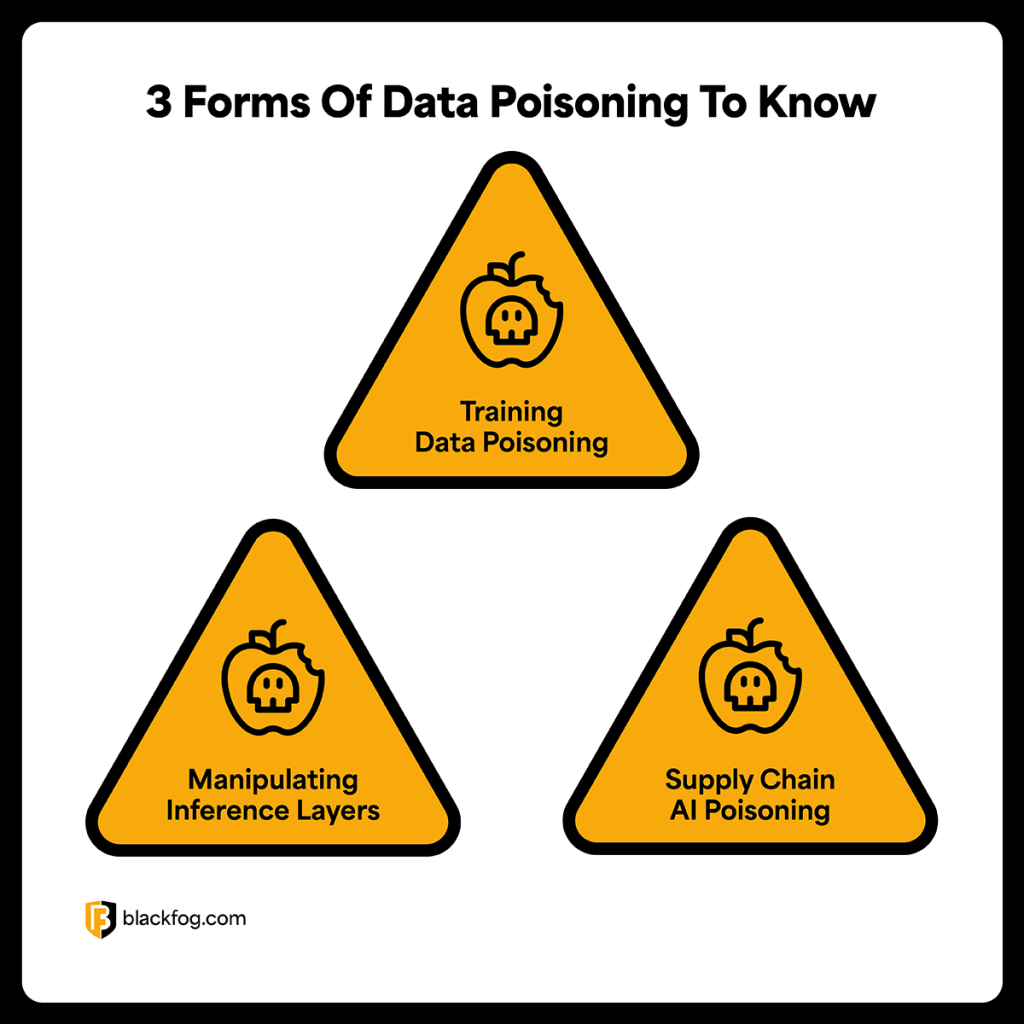
A data poisoning attack is not a single technique. Instead, it is a broad category that can vary significantly depending on the model, the data sources and the attacker’s objectives. Threat actors have a growing toolkit of methods for targeting businesses through their AI platforms, each exploiting a different stage of the model lifecycle. However, there are a few common attack vectors firms should be aware of.
Poisoning Training Data
Attackers often target the large, publicly sourced datasets used to train enterprise models. These may include scraped web content, open repositories and crowd-sourced labeling platforms. By seeding these sources with manipulated records, mislabeled samples or subtly altered images, threat actors can shape a model to produce biased recommendations, inaccurate classifications or insecure code suggestions.
The result is a compromised model that quietly serves attacker interests, whether that means evading fraud detection, leaking sensitive information or weakening downstream security decisions.
Manipulating Inference Layers
Some poisoning attacks aim directly at the data a model draws on when generating predictions in production, rather than the data it was originally trained on. By corrupting reference datasets, retrieval sources or the continuous feedback loops that fine-tune live models, attackers can shift the predictive logic a system uses to reach its conclusions – altering its ‘inferences’.
The result is a model that still appears to function normally, but quietly produces skewed outputs, misclassifies threats or reaches decisions that consistently favor the attacker.
Supply Chain AI Poisoning
Few enterprises build AI systems entirely in-house. Most rely on pre-trained models, third-party plugins, open-source libraries and shared repositories. Each of these dependencies is a potential entry point.
A compromised vendor, tampered open-source model or malicious plugin can introduce manipulated data or hidden behaviors directly into the enterprise AI stack, creating blind spots that bypass internal security layers and quietly expose sensitive corporate data to attackers long before any anomaly is detected.
The Business Risks Of Poisoned AI Systems
The consequences of a successful data poisoning attack extend far beyond the AI system itself. Because enterprise models increasingly inform decisions across security, finance, customer service and operations, a compromised model can ripple through the business in ways that are difficult to trace back to their original cause. Potential outcomes range from financial costs to the impact on AI trust and reliability, and include:
- Operational disruption: Poisoned LLMs can produce unreliable and malicious model outputs that break automated workflows, delay decisions and force teams to revert to manual processes.
- Security decision manipulation: When threat detection or triage tools are corrupted, attackers can effectively turn the business’ own defenses against it, hiding malicious activity in plain sight.
- Compliance failures: Biased or inaccurate outputs in regulated areas such as finance, healthcare or hiring can breach data protection and fairness obligations.
- Brand trust damage: Customers exposed to flawed recommendations or offensive content quickly lose confidence in the business.
- Data leakage risks: Manipulated models can be coaxed into revealing sensitive training data, intellectual property or credentials, bypassing traditional data exfiltration routes.
- Financial consequences: Recovery costs, regulatory fines, litigation and lost revenue from disrupted services can add up to significant long-term financial damage.
Data Poisoning Vs Prompt Injection: What’s The Difference?
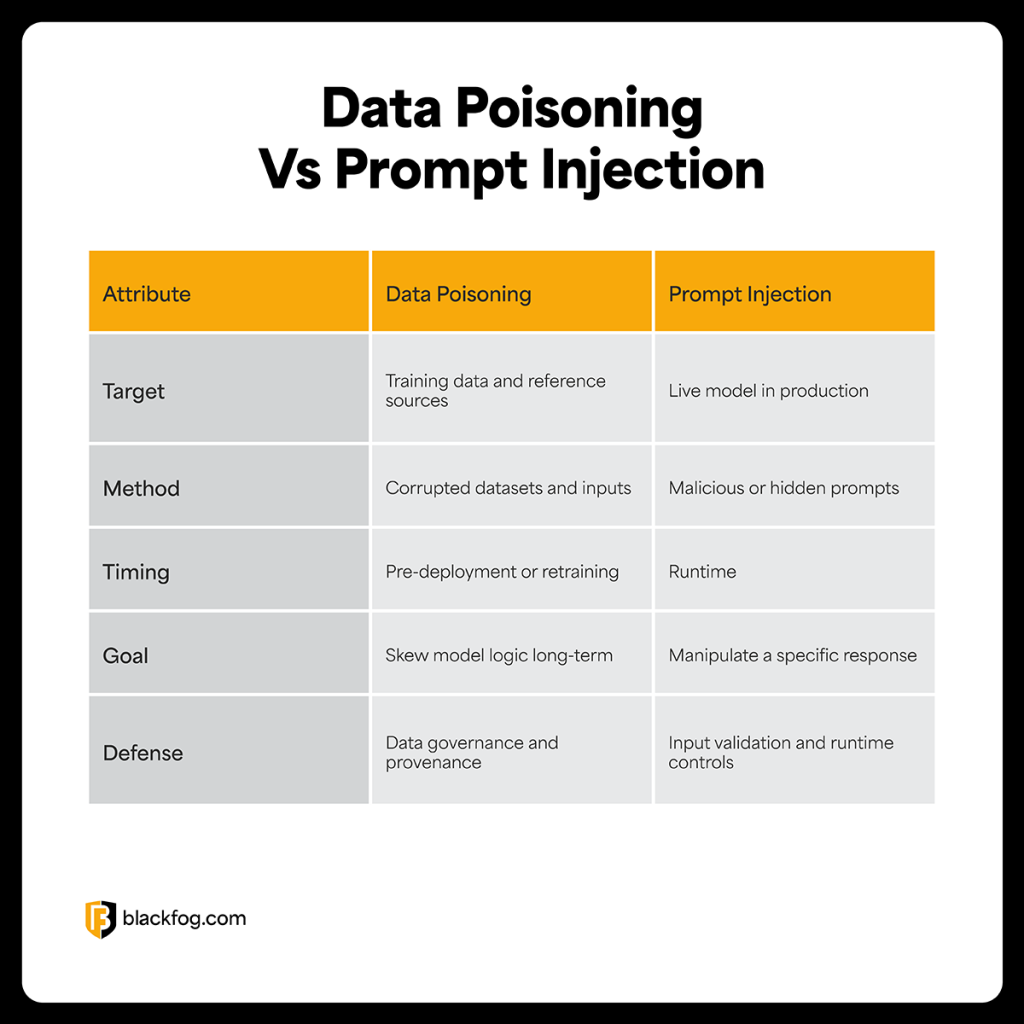
Data poisoning and prompt injection are often discussed together as key threats targeting AI systems. However, they work in fundamentally different ways, so it’s vital security pros are aware of the difference.
Put simply, data poisoning is an attack on the data a model learns from or relies on for predictions, whether that is the original training set, a fine-tuning dataset or a connected reference source. The goal is to corrupt the model’s internal logic so that its outputs are skewed long before any user interacts with it.
Prompt injection is an attack on a model already in production. It is usually a more directed, focused threat with a clear goal in mind, such as forcing an LLM to expose sensitive data. Attackers craft malicious inputs or embed hidden instructions in documents and web content to manipulate how the AI responds to a specific query, without changing the model itself. This has become a particular concern in areas like ChatGPT security, where employees pasting confidential information into public chatbots can hand attackers an easy route to exfiltrate sensitive data.
Stopping prompt injection requires input validation and runtime controls, while defending against poisoning demands governance of the data pipelines feeding the model.
Why AI Governance And Compliance Now Matter More Than Ever
Regulatory environments around enterprise AI are tightening fast, which will require a closer focus than ever on potential weaknesses like data poisoning. One of the most consequential changes is the EU AI Act, which entered into force on 1st August 2024 and phases in obligations in the coming years.
Bans on prohibited AI practices and transparency rules for general-purpose AI models are already enforceable, while new obligations that require businesses to disclose to customers if they are interacting with AI tools come into force in August 2026.
More obligations for standalone high-risk AI systems will apply from December 2027, with rules for high-risk AI embedded in products taking effect from August 2028. Penalties for non-compliance can reach €35 million ($40.75 million) or seven percent of global turnover for violations of prohibited practices. Fines for breaches of high-risk AI rules will be up to €15 million or three percent of global turnover.
This regulation demands documented data governance, risk management and human oversight for high-risk systems, all of which depend on being able to demonstrate the integrity of the data feeding a model.
Other jurisdictions including the UK, US and Canada are moving in the same direction, with growing emphasis on AI accountability and auditability. Businesses will need far deeper visibility into their AI supply chains and data pipelines than most have today, both to secure their models and to prove they have done so.
How Organizations Can Reduce Data Poisoning Risks
While data poisoning is a complex and evolving threat, businesses are not powerless against it. AI misuse prevention requires a combination of technical controls, governance practices and security hygiene, which can significantly reduce exposure and limit the damage if an attack does succeed. The key is recognizing that AI security cannot be bolted on after deployment, but rather be built into how data, models and tools are managed across the organization. Important steps in this include:
- Monitor AI data pipelines: Treat training data, fine-tuning datasets and reference sources with the same scrutiny as production systems. Maintain an inventory of data sources feeding enterprise models, log changes and watch for unexpected modifications, unusual volumes or unverified contributors.
- Use behavioral detection controls: Rather than relying on signature-based tools, deploy behavioral analytics that can spot when AI systems or the data leaving them deviate from established patterns, flagging early signs of compromise or data exfiltration before damage spreads.
- Restrict unsanctioned AI usage: Shadow AI is one of the biggest sources of unmanaged risk. Establish clear policies on which tools employees can use, block access to high-risk public services and provide approved alternatives so staff are not driven to workarounds.
- Secure third-party AI integrations: Vet every vendor, plugin and pre-trained model before deployment. Require evidence of data provenance, security testing and ongoing maintenance, and treat external AI components as part of the broader supply chain attack surface.
- Continuously validate AI outputs: Build human oversight into critical AI workflows. Cross-check model outputs against trusted sources, monitor for drift in accuracy or behavior and investigate anomalies promptly rather than dismissing them as routine model variability.
Why Data Poisoning Will Become A Major Enterprise Security Priority
AI attacks are no longer theoretical. Data poisoning incidents, manipulated models and compromised training pipelines are already being documented in the wild and will only become more commonplace. This is why ChatGPT security and broader AI security strategies must cover a far wider range of threats than employee misuse and insider AI threats alone, including data poisoning, prompt injection, model theft and supply chain compromise.
As AI becomes embedded deeper into enterprise operations, the risks increase. The rise of autonomous agents will allow attackers to manipulate not just outputs but actions taken on the business’ behalf, while AI-assisted workflows across development, security and customer-facing functions continue to expand the attack surface in ways traditional controls were never designed to address.
Waiting until a poisoned model causes a visible failure is not a viable approach. Organizations need proactive detection, continuous monitoring and validated data pipelines rather than reactive remediation after the damage is done.
Future cybersecurity strategies must treat AI as critical infrastructure, applying the same rigor to model integrity, data governance and behavioral monitoring as is applied to networks, endpoints and identity today. Those that move now will be far better placed to defend against what comes next.
Data Poisoning FAQs
What is a data poisoning attack in AI?
A data poisoning attack is a form of adversarial threat in which attackers deliberately corrupt the data an AI model learns from or relies on for predictions. The goal is to manipulate the model’s internal logic so it produces biased, inaccurate or malicious outputs once deployed.
How does data poisoning affect machine learning models?
Poisoned data distorts the patterns a model uses to make decisions. This can result in misclassifications, hidden backdoors that trigger on specific inputs, biased recommendations or weakened security detections, all of which propagate into every downstream system relying on the model.
What industries are most vulnerable to data poisoning attacks?
Sectors that depend heavily on AI for high-stakes decisions are at greatest risk. This includes financial services, healthcare, critical infrastructure, defense and cybersecurity itself, where compromised models can directly enable fraud, misdiagnosis, operational disruption or undetected intrusions.
Can data poisoning attacks be detected?
Yes, but it is challenging. Detection requires continuous monitoring of training data, model behavior and outputs, alongside strict data provenance controls. Behavioral analytics and anomaly detection can flag subtle drifts that traditional security tools tend to miss.
What is the difference between data poisoning and prompt injection?
Data poisoning targets the data a model learns from or references, corrupting its underlying logic. Prompt injection targets a live model through crafted inputs, manipulating how it responds to a specific query without altering the model itself.
Share This Story, Choose Your Platform!
Related Posts
QTFY: Industrializing Cyber Exploitation Against Critical Infrastructure
QTFY: Industrializing Cyber Exploitation Against Critical Infrastructure
Stopping Data Exfiltration Through LLM Prompts And Responses
Data can leave through LLM prompts, responses or agent actions. Learn how each path works and what actually stops it.
The 7 Layers Of Prompt Poisoning Protection Every AI Application Needs
Discover the seven layers of prompt poisoning protection every AI application needs, from input validation to endpoint monitoring.

What Is Zero Trust In Cybersecurity And How Does It Apply To Shadow AI?
Zero Trust means never trust, always verify. Learn how this principle applies to shadow AI and closes the gaps legacy security misses.
What Are The Main Features Of Shadow AI Applications?
Shadow AI applications share five distinct traits, from unapproved access to free-text input. Learn what to look for and why it matters.

How To Avoid Shadow AI In Enterprises
Learn how to avoid shadow AI in enterprises through continuous discovery, fast-tracked approvals and endpoint-level monitoring.