 Skip to content

The EU AI Act: Compliance Requirements For 2026 And Beyond
As AI becomes more common across almost all aspects of society, regulators and governments are rushing to catch up. One significant response is the EU AI Act, which is one of the most consequential pieces of data protection legislation of recent years. This sets out the first comprehensive legal framework anywhere in the world for how AI may be developed, deployed and used, so is not something any firm can ignore.
While it is European legislation, its impact reaches far beyond the bloc itself. Any business that offers AI systems to users in the EU, or whose AI outputs affect people inside it, falls within scope, regardless of where that business is headquartered. Therefore, understanding what EU AI Act compliance requirements 2026 will bring is essential for almost any modern enterprise. A clear grounding in this act is vital as AI spreads rapidly across business workflows and introduces new threats like data poisoning, prompt injection and shadow AI.
What The EU AI Act Covers
The EU AI Act applies to any provider, deployer, importer or distributor of AI systems that operates within the 27 member nations, including organizations based elsewhere whose AI affects people inside the bloc. It regulates how these systems are designed, brought to market and used, with particular focus on transparency, accountability and the protection of fundamental rights.
The legislation takes a risk-based approach, classifying AI systems into four broad categories that determine the obligations placed on them. These are:
- Prohibited practices: Uses considered an unacceptable threat to safety or rights, such as social scoring, manipulative AI and certain forms of biometric surveillance, which are banned outright.
- High-risk AI systems: Tools used in sensitive areas like critical infrastructure, employment, biometrics and law enforcement, subject to the strictest obligations.
- Limited-risk AI: Covers systems with transparency duties. Providers must ensure that users know they are interacting with a chatbot, while AI-generated media (including text and images) must be clearly labeled.
- Minimal-risk AI: Most general-purpose tools, subject to few additional requirements.
The EU AI Act Implementation Timeline
The EU AI Act formally entered into force on 1st August 2024, but its obligations are being phased in across several years to give businesses time to prepare. Key dates so far and upcoming deadlines to be aware of include:
- February 2025: Bans on prohibited AI practices took effect, outlawing uses such as social scoring, manipulative AI and certain forms of biometric categorization. The same date introduced a requirement for organizations to ensure that staff involved in operating or using AI systems have an appropriate level of AI literacy for their role.
- August 2025: Rules for general-purpose AI models came into force, requiring developers of foundation models to provide technical documentation, summaries of training data and information on copyright compliance. Stricter obligations apply to models classed as posing systemic risk, including risk assessment and incident reporting duties.
- August 2026: Article 50 transparency rules take effect, meaning businesses must disclose to users when they are interacting with an AI system such as a chatbot and ensure outputs of generative AI systems are marked as artificially generated. Under the May 2026 Digital Omnibus agreement, watermarking requirements for generative AI systems already on the market before this date have been postponed until 2nd December 2026.
- December 2027: The main obligations for standalone high-risk AI systems apply, covering areas such as biometrics, critical infrastructure, employment and access to essential services. These obligations were originally due in August 2026, but were pushed back to allow businesses more time to put the necessary data governance, documentation and oversight processes in place.
- August 2028: Rules for high-risk AI embedded in regulated products take effect, completing the main rollout of the framework and bringing AI-driven components of products such as medical devices, vehicles and machinery fully within scope.
The Consequences Of Non-Compliance
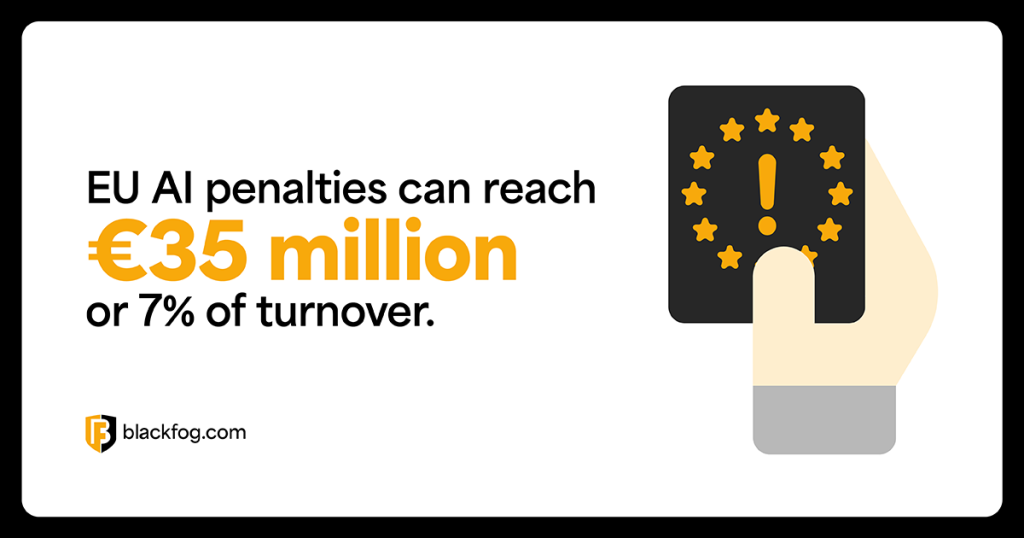
The EU AI Act includes some of the toughest financial penalties of any digital regulation, with fines that vary depending on the nature of the breach. Key provisions for failures are:
- Prohibited AI practices: Fines of up to €35 million (around $40.75 million) or seven percent of global annual turnover, whichever is higher.
- High-risk AI obligation breaches: Fines of up to €15 million or three percent of global annual turnover.
- Providing incorrect or misleading information to authorities: Fines of up to €7.5 million or one percent of global annual turnover.
The reputational and operational risks are equally serious. Failing to address threats like AI poisoning can leave businesses making decisions based on corrupted outputs, eroding customer trust, exposing sensitive data and triggering enforcement action that can halt AI deployments entirely.
Meeting EU AI Act Compliance Requirements In 2026 And Beyond
Preparing for expanded EU AI Act compliance requirements means putting practical controls in place across the business, not just updating policy documents. Key steps include:
- Establish full visibility into AI use: Maintain a clear inventory of every AI system in the business, including those introduced without IT approval.
- Invest in employee training: Ensure staff have the AI literacy the Act requires, with role-specific guidance on safe data handling.
- Enforce clear AI usage policies: Define which tools are sanctioned, what data can be shared and how exceptions are managed.
- Identify unsanctioned tools at the endpoint: Deploy shadow AI detection tools to find services operating outside IT oversight.
- Block sensitive data uploads to consumer tools: Strengthen ChatGPT security at the device level so regulated data cannot leave the business through public AI tools.
The fact that some provisions have already been delayed highlights the complexity of the Act’s requirements. However, businesses should not view these delays as a reason to defer their own compliance actions. Building these capabilities now is essential in ensuring businesses are well-placed to meet rising regulatory expectations.
EU AI Act Compliance Requirements FAQs
What are the main EU AI Act compliance requirements for 2026?
The main 2026 requirement is the Article 50 transparency obligations applying from 2nd August 2026. Businesses must disclose when users are interacting with an AI system such as a chatbot, and clearly label media deepfakes and AI-generated text that is published to inform on matters of public interest.
What qualifies as a high-risk AI system under the EU AI Act?
High-risk systems include AI used in critical infrastructure, biometrics, employment, education, access to essential services, law enforcement and the administration of justice. AI components embedded in regulated products are also covered.
How can CISOs prepare for EU AI Act compliance?
By building a full inventory of AI use, classifying systems by risk, documenting data governance, training staff and deploying detection tools to surface unsanctioned activity.
Why is AI governance important for compliance readiness?
The Act demands documented data governance, risk management and human oversight, all of which require structured governance rather than ad-hoc controls.
What security controls help support EU AI Act compliance?
Endpoint-level visibility, shadow AI detection, anti data exfiltration tools and clear AI usage policies all play a role in demonstrating compliance and protecting regulated data.
Share This Story, Choose Your Platform!
Related Posts

QTFY: Industrializing Cyber Exploitation Against Critical Infrastructure
QTFY: Industrializing Cyber Exploitation Against Critical Infrastructure
Stopping Data Exfiltration Through LLM Prompts And Responses
Data can leave through LLM prompts, responses or agent actions. Learn how each path works and what actually stops it.
The 7 Layers Of Prompt Poisoning Protection Every AI Application Needs
Discover the seven layers of prompt poisoning protection every AI application needs, from input validation to endpoint monitoring.
What Is Zero Trust In Cybersecurity And How Does It Apply To Shadow AI?
Zero Trust means never trust, always verify. Learn how this principle applies to shadow AI and closes the gaps legacy security misses.

What Are The Main Features Of Shadow AI Applications?
Shadow AI applications share five distinct traits, from unapproved access to free-text input. Learn what to look for and why it matters.

How To Avoid Shadow AI In Enterprises
Learn how to avoid shadow AI in enterprises through continuous discovery, fast-tracked approvals and endpoint-level monitoring.