Skip to content

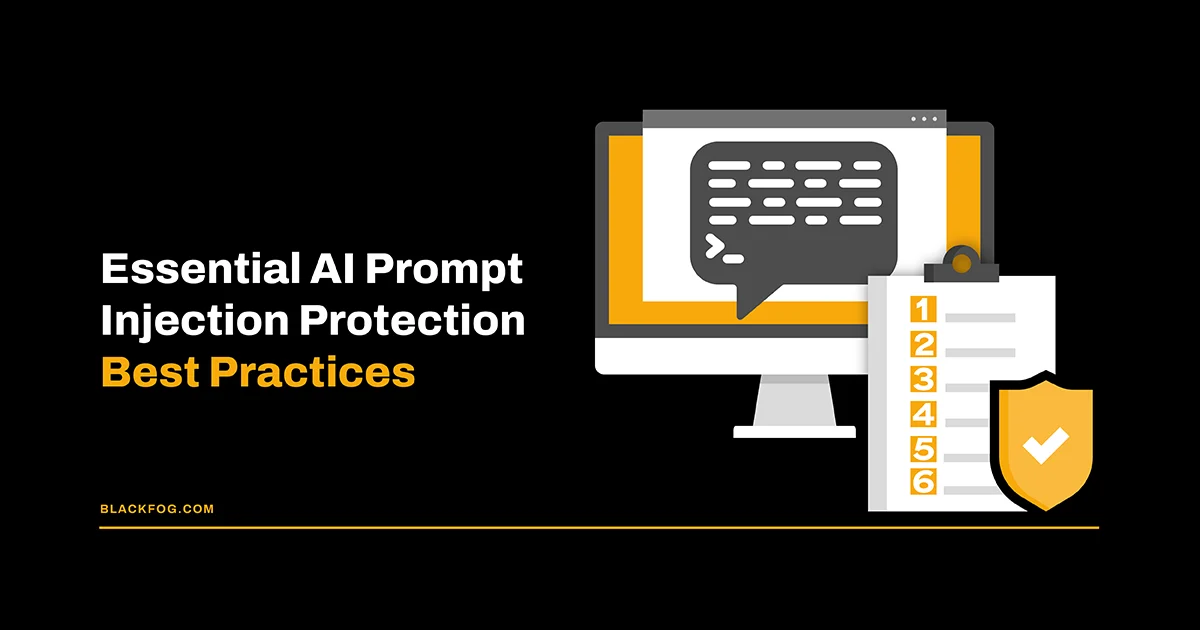
6 Key Best Practices to Prevent AI Prompt Hacking
Securing AI systems needs to be a top priority as employee usage of these tools increases. One key pillar of this is prompt injection protection, which is critical in guarding against attacks where threat actors exploit AI models using carefully crafted or hidden inputs. Left unchecked, these attack vectors can result in data leakage, compliance failings or even full system compromise.
Prompt injection attacks are an increasing risk as more users engage with AI tools on a daily basis, especially generative large language models (LLMs). With so many prompts being entered into these systems, it can be easy to overlook attacks they try to hide within everyday AI usage. Traditional defenses can also struggle with prompt injection detection as attacks may be written in natural, if obfuscated, language rather than code.
There’s no one solution to stopping prompt injection attacks. But with a layered approach that covers AI tools, permissions, outputs and data flows, businesses can greatly mitigate the risks.
Why Is Prompt Injection So Hard To Prevent?
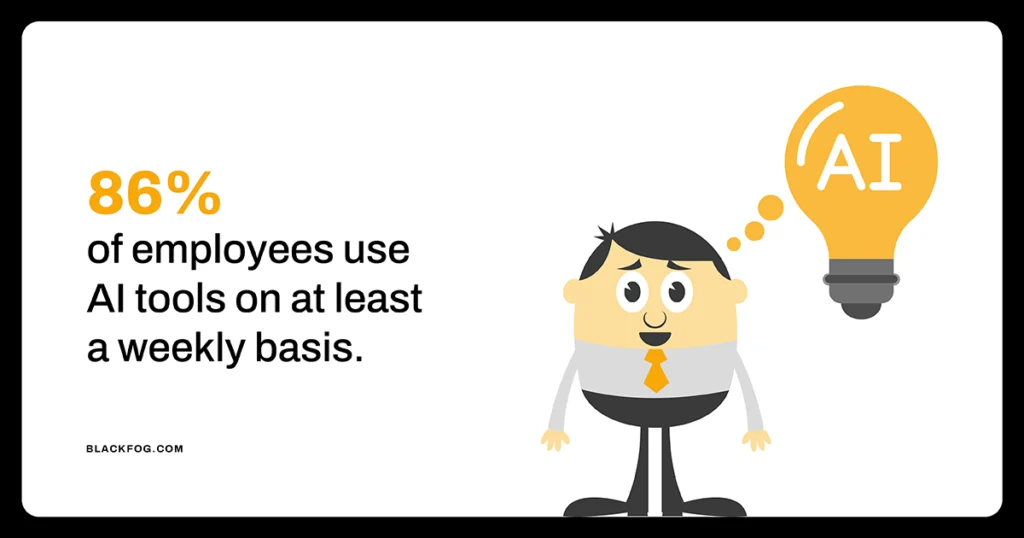
The use of AI across the workplace has become routine, with BlackFog’s research finding 86 percent of employees in 2026 use AI tools for work on at least a weekly basis. What’s more, many individuals rely on unsanctioned apps that are outside IT oversight, so every prompt that connects with company data or applications widens the attack surface.
However, the main challenge that makes prompt injection attacks hard to stop lies in the way LLMs work. Typically, AI models read the system’s instructions, the user’s request and any external content as a single stream of text, with no built-in boundary between them. As a result, they cannot inherently separate legitimate instructions from new external data.
OWASP states that the fundamental makeup of LLMs means that “it is unclear if there are fool-proof methods of prevention for prompt injection”. However, this doesn’t mean that the risks can’t be mitigated with the right combination of defensive measures.
The Importance Of Prompt Injection Protection For AI Assistants
Rather than using custom in-house systems, most organizations now rely on third-party AI assistants that integrate directly into everyday workflows and are granted permission to access sensitive data. This can expose a business to a breach even when the user does nothing wrong.
Because these assistants act on whatever content they receive, even everyday tasks come with added risk. For example, if a user asks an AI to summarize an email that, unknown to them, contains malicious instructions, the assistant may read them as commands and carry out an indirect prompt injection attack, quietly leaking data without the individual or company realizing.
Flaws of this kind have already appeared in Microsoft 365 Copilot and Slack AI, where hidden prompts could siphon sensitive information. This is why comprehensive prompt injection protection must have full visibility across every AI assistant an organization uses. Shadow tools adopted without approval sit beyond that view, so they can’t be monitored or defended, leaving businesses open to attacks they can’t see or stop.
How To Prevent Prompt Injection: 7 Strategies For Enterprise AI Deployments
With prompt injection presenting a growing risk, businesses must take clear, practical steps to defend their AI systems, with a defense-in-depth approach the key to success. The following LLM cybersecurity best practices provide a foundation for securing AI platforms from manipulation, minimizing the chance of data exposure and ensuring responsible, secure use of generative AI tools across the enterprise.
Closely Monitor The AI Tools Employees Use
Visibility has to come first, because an organization cannot protect against AI tools it does not know are being used. The starting point is identifying every AI tool in use across the business, from sanctioned platforms to tools adopted independently by employees. From there, monitoring prompts, responses and tool interactions provides a complete picture of all AI activity.
This gives security teams an understanding not only of which tools are in operation, but of the data they are reading, generating and passing on. Monitoring also supports incident response and forensic analysis in the event of a successful attack. Pinpointing how a breach occurred and what was taken guides next steps and can help ensure that vulnerabilities are closed to prevent future incidents.
Train Staff To Recognize Prompt Injection Risks
Because hidden instructions can sit inside emails, documents and web pages, staff should know any content an assistant reads might carry malicious prompts. Some attacks do leave visible traces, such as unexpected links, odd formatting or requests for data and actions nobody made, so educate employees on red flags to look for. However, many prompt injection attacks act silently and show nothing at all, so this is not a surefire way to spot threats.
Instead, emphasize the importance of preventive measures, including not pasting untrusted content into an assistant, verifying output before acting on it and reporting anything suspicious. As training cannot catch an injection employees never see, technical controls remain the backstop.
Utilize Clear Access Controls And Least Privilege
Controlling who can interact with AI systems and what the tools themselves have access to is essential for minimizing data exposure. Multi-factor authentication, role-based access controls and IP-based restrictions remain effective tools, with levels set by data sensitivity.
Least privilege then limits what each assistant or agent can reach, granting only the files, mailboxes and systems it needs, not broad standing access. For example, an employee using an LLM for summarizing meeting notes should not be able to access customer financial records through the same model.
AI agents increasingly connect to a wide range of external platforms, databases and information sources though standards like Model Context Protocol (MCP), so using strong MCP security helps control how these tools interact with disparate systems, while separating read from write permissions narrows the risks further.
Ensure Tools Have Guardrails To Filter And Sanitize Inputs
Filtering and sanitizing inputs before they reach the model is one of the most effective guardrails against LLM prompt injection attacks. This involves detecting and removing manipulative commands, override attempts and instruction-based phrasing. Filters can be rule-based or AI-powered, but must be continuously updated as attacks evolve.
No filter is foolproof, though, since attackers slip past them using encoding, invisible characters and deliberate misspellings that hide malicious intent. That makes the quality of these guardrails a key question for any business buying an AI platform. Before committing, security teams should understand how a tool separates trusted instructions from untrusted content such as incoming emails and shared documents.
Require Human Approval For High-Risk Actions
Some actions carry too much risk for an assistant to take unsupervised. The first step is defining what these are. Usually anything that sends an email, shares a file, moves money or calls an external tool will be in this category. Each should have a ‘human-in-the-loop’ principle that requires a person’s confirmation before it proceeds. This trades some speed for safety, but a few seconds of review is a small price against the data loss or financial theft one unchecked action can cause.
Use Output Filtering
Just as inputs are filtered, outputs should be monitored and controlled to prevent data exfiltration after a successful injection. Output filtering tools scan AI-generated responses for unauthorized content, such as confidential information or commands that breach company policy, then block or modify anything risky before it reaches the user. This is especially useful in customer-facing systems visible to outside users.
Some data exfiltration techniques can be blocked deterministically rather than left to the model. An injected link or image that smuggles data out in its URL, for instance, can be stripped or prevented by a fixed rule.
Regularly Test To Identify Weaknesses
Regular testing keeps defenses ahead of evolving tactics. Red teaming exercises against AI platforms means probing all assistants and agents rolled out to staff and attacking them as an adversary would. Use poisoned emails, documents and web pages, not just typed prompts, then run each exercise against a risk assessment checklist for prompt injection vulnerabilities. This surfaces weak spots filters and access controls miss, so they can be fixed before exploitation.
When Prevention Fails: Stopping Data Exfiltration
No defense is foolproof, so firms should assume that some prompt injection attempts will eventually get through, however strong the earlier controls. Planning for that reality means building a last line of defense that is not aimed at keeping attackers out, but at stopping sensitive data from leaving once they are in.
To be effective, this has to happen close to the data itself, on the device where the employee’s AI interaction actually takes place. Many traditional network-layer tools are not suited to this, as they cannot see inside encrypted browser sessions, gain visibility into activity on unmanaged personal devices or flag AI embedded in approved apps, which looks like ordinary, sanctioned traffic.
Only controls running on the endpoint can watch what an assistant is about to send and block confidential data exfiltration at the moment it tries to leave, containing the damage even when prevention has already failed. Ensuring solutions are able to automatically step in and stop suspicious traffic without the need for human oversight is a must here, as AI interactions happen at speeds that manual review cannot cope with.
Prompt Injection Protection In Practice: How BlackFog ADX Vision 2.0 Works
Building on the endpoint-first principle, BlackFog’s latest release, ADX Vision 2.0, responds to this threat directly, applying seven layers of protection built to catch prompt injection attempts and other manipulated prompts before they can do harm.
Because it runs on the device itself, rather than the network, it sees the shadow AI that perimeter tools are unable to monitor, including activity in encrypted browser sessions, unmanaged personal devices and AI features inside approved apps.
The same protections apply whether a prompt is typed by an employee or generated by an AI agent acting on their behalf. Organizations can also set custom controls at a company or departmental level, defining the specific sensitive information that must never leave, so protection reflects the data each team actually handles day to day.
Prompt injection is a risk that will only grow as AI becomes more deeply woven into how businesses operate. The organizations that stay secure will be those that treat it as a core concern now, layering practical defenses across their tools, people and data, while assuming some attempts will still get through. Putting those fundamentals in place today is what keeps AI an asset rather than a liability for the business.
Prompt Injection Protection FAQs
Can an employee trigger a prompt injection without realizing it?
Yes. Indirect injection hides instructions inside content the AI reads, so simply asking an assistant to summarize an email or document can set off an attack. The employee does nothing wrong and often never sees it happen.
Do we need prompt injection protection if we only use tools like ChatGPT Enterprise or Copilot?
Yes. Enterprise tiers add data governance, but the underlying models remain vulnerable to prompt injection. Microsoft 365 Copilot itself had a zero-click flaw that leaked data, so approved tools still need their own protection.
Do AI vendor guardrails stop prompt injection on their own?
No. Built-in guardrails help, but none is foolproof, since a model cannot reliably separate trusted instructions from malicious input. Attackers also evolve ways around them, so vendor controls need layering with your own defenses.
What should prompt injection protection tools include?
Look for visibility across every AI tool in use, input and output filtering, least-privilege access, human approval for high-risk actions and on-device blocking that stops sensitive data leaving even after an injection succeeds.