Skip to content

Cyber Asset Attack Surface Management’s Role In Finding Hidden Risks
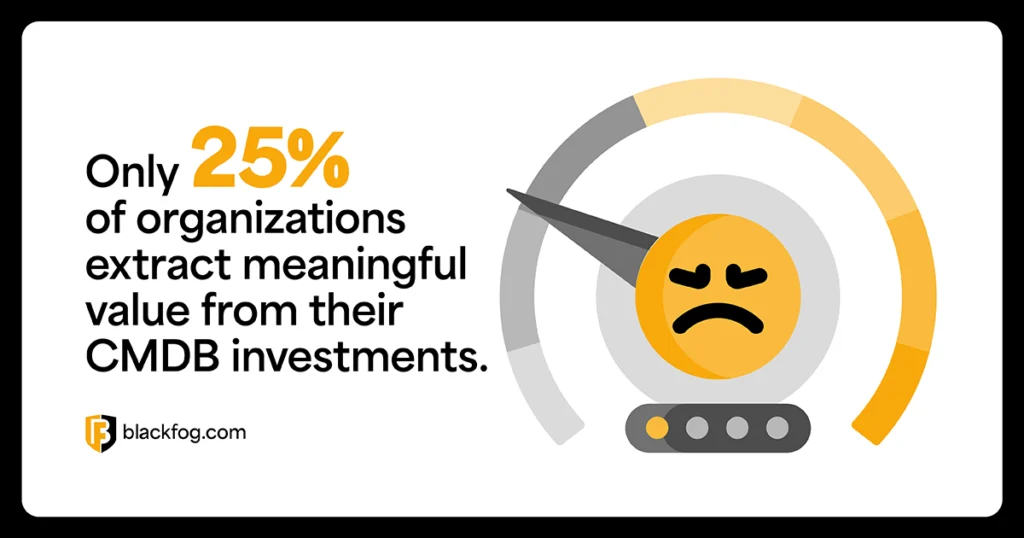
Most organizations believe they have a complete and accurate asset inventory. In reality, they don’t. In fact, only 25 percent of organizations extract meaningful value from their Configuration Management Database (CMDB) investments, according to Virma.
The gap is not a minor discrepancy; it could lead to a security failure. Every missing asset represents an unmonitored entry point. Every outdated record creates a blind spot and in an environment where threat actors actively search for weaknesses, those blind spots are where breaches begin.
This is why cyber asset attack surface management matters, not as a theoretical concept, but as a practical way to close the visibility gap and restore control.
Why Asset Inventories Break Down
The problem doesn’t start with threat actors, but with how organizations manage assets internally. Traditional inventory approaches struggle to keep pace with modern environments. Here are some common reasons inventories fail:
CMDB Staleness
CMDBs rely heavily on manual processes. Assets are added, updated or removed based on workflows that are often inconsistent or bypassed.
Over time, this leads to stale data. New systems appear without being recorded, while old systems remain listed long after they are gone. The inventory looks complete, but it no longer reflects reality.
Shadow IT
Employees regularly adopt tools such as cloud-based software without involving IT. These improve productivity, but they introduce assets that sit entirely outside formal inventory processes.
They may store or process sensitive data, yet they remain invisible to IT teams, meaning there is no way to assess or reduce risk.
Dynamic Cloud Environments
Cloud infrastructure can be created and removed in minutes, often automatically. This means that manual tagging cannot keep up. By the time an asset is recorded, it may have already changed or disappeared, leaving gaps in visibility.
Third-Party Assets
Suppliers and partners often have access to internal systems. However, their assets are frequently excluded from internal inventories.
This creates a false boundary around risk. In reality, third-party systems are a common entry point for attackers.
IoT And OT Devices
Internet of Things (IoT) and operational technology (OT) devices are rarely integrated into enterprise inventories. These often lack standard security controls and are not prioritized for updates. Because they sit outside the inventory, they also sit outside visibility.
When Visibility Fails, Risk Increases
These gaps are not theoretical and they create real, exploitable risks, as businesses cannot monitor, prioritize or reduce what they do not know exists.
Unknown, untracked or outdated assets become ghost systems that are ideal entry points for threat actors.
Once inside, threat actors can move laterally, escalate privileges and ultimately exfiltrate data. Breaches often do not begin with sophisticated hacking techniques, but with incomplete visibility within enterprises.
Better Inventory, Better Risk Prioritization
Risk prioritization depends entirely on what you can see. If assets are missing from the inventory, risk calculations are incomplete. Security teams may focus on well-known systems while overlooking more exposed or vulnerable ones.
As inventory quality improves, teams can identify the most exposed assets, focus remediation efforts where they have the greatest impact and reduce wasted effort on low-risk systems.
Without complete visibility, prioritization becomes guesswork. With it, decisions are grounded in evidence.
What A Complete Inventory Looks Like
To fix the problem, organizations need to rethink what complete means to them. This should not be a static list of known devices, but a continuously updated view of all assets interacting with the environment.
In practice, this includes:
- Known assets already recorded and managed
- Unknown assets discovered through scanning and analysis
- Unmanaged assets with no clear owner or accountability
- Transient assets such as short-lived cloud instances
- Third-party assets with access to internal systems
Having a complete inventory is about maintaining visibility as environments change, not merely conducting a single discovery exercise.
How Cyber Asset Attack Surface Management Improves Inventory Quality
This is where cyber asset attack surface management solutions directly address the root of the problem. They replaces static inventory processes with continuous discovery and validation.
Instead of relying on manual updates, these tools enable:
- Continuous passive discovery to identify assets without disruption
- Active discovery to uncover hidden or unmanaged systems
- Asset fingerprinting to identify device types and behaviour accurately
- Ownership attribution to ensure accountability for every asset
- Integration with CMDBs to automatically update records
The result is a living inventory that reflects reality, not assumptions.
Building A Living Asset Register
A modern asset register must evolve with its environment instead of only capturing a point-in-time snapshot. To support effective decision-making, it should include:
- Asset type
- Owner
- Risk score
- Last seen
- Exposure level
These fields provide context, not just identification, allowing organizations to understand which assets matter most and why.
Maintaining this register requires automation. Assets should be updated as they appear, change or disappear to remove the delay between change and visibility.
Closing The Visibility Gap
Incomplete inventories are one of the most common enablers of data exfiltration. Threat actors specifically target assets that organizations are unaware of.
These assets are less likely to be monitored, patched or secured. Even with attack surface monitoring in place, unknown assets remain invisible, creating unaddressed gaps. Once compromised, they provide a low-risk pathway for sensitive data to leave the organization.
This is where alignment with anti data exfiltration technology becomes critical. Preventing data exfiltration is not only about blocking outbound threats but also about removing the hidden pathways that make exfiltration possible.
FAQs About Cyber Asset Attack Surface Management
Why do most organizations have incomplete asset inventories?
Mostly due to traditional tracking methods, which cannot keep up with constant changes across cloud, SaaS and third-party environments. Assets are often added without formal processes, while shadow IT and unmanaged devices sit outside visibility. As a result, inventories quickly become outdated and unreliable.
What are unknown or “ghost” assets in cybersecurity?
Unknown or “ghost” assets are systems that exist within an environment but are not recorded in the organization’s inventory. Because they’re not tracked, they’re not monitored, patched or secured. This makes them ideal entry points for threat actors looking to access systems undetected.
What should a complete asset inventory include?
A complete asset inventory should include all known, unknown, unmanaged, transient and third-party assets connected to the environment. It should also capture key details such as asset type, owner, risk level and exposure. Most importantly, it must be continuously updated to reflect real-time changes.
How does asset inventory impact risk prioritization?
Asset inventory directly impacts risk prioritization because you can only assess and prioritize what you can see. Incomplete inventories lead to gaps where high-risk assets may be overlooked. With full visibility, organizations can focus on the most exposed and critical assets with confidence.